In January of 2011, on this blog, I posted an entry with the title “A New Post-Catholic State of Awareness: Has Public Discussion of Catholicism Reached a New Moment?” In that entry, I suggested that “a new courage for telling the truth about the range of affiliations in and out of Catholicism seems to have taken over in the last several years, and I wonder if 2010 was the year in which this dynamism reached a certain irreversibility.”
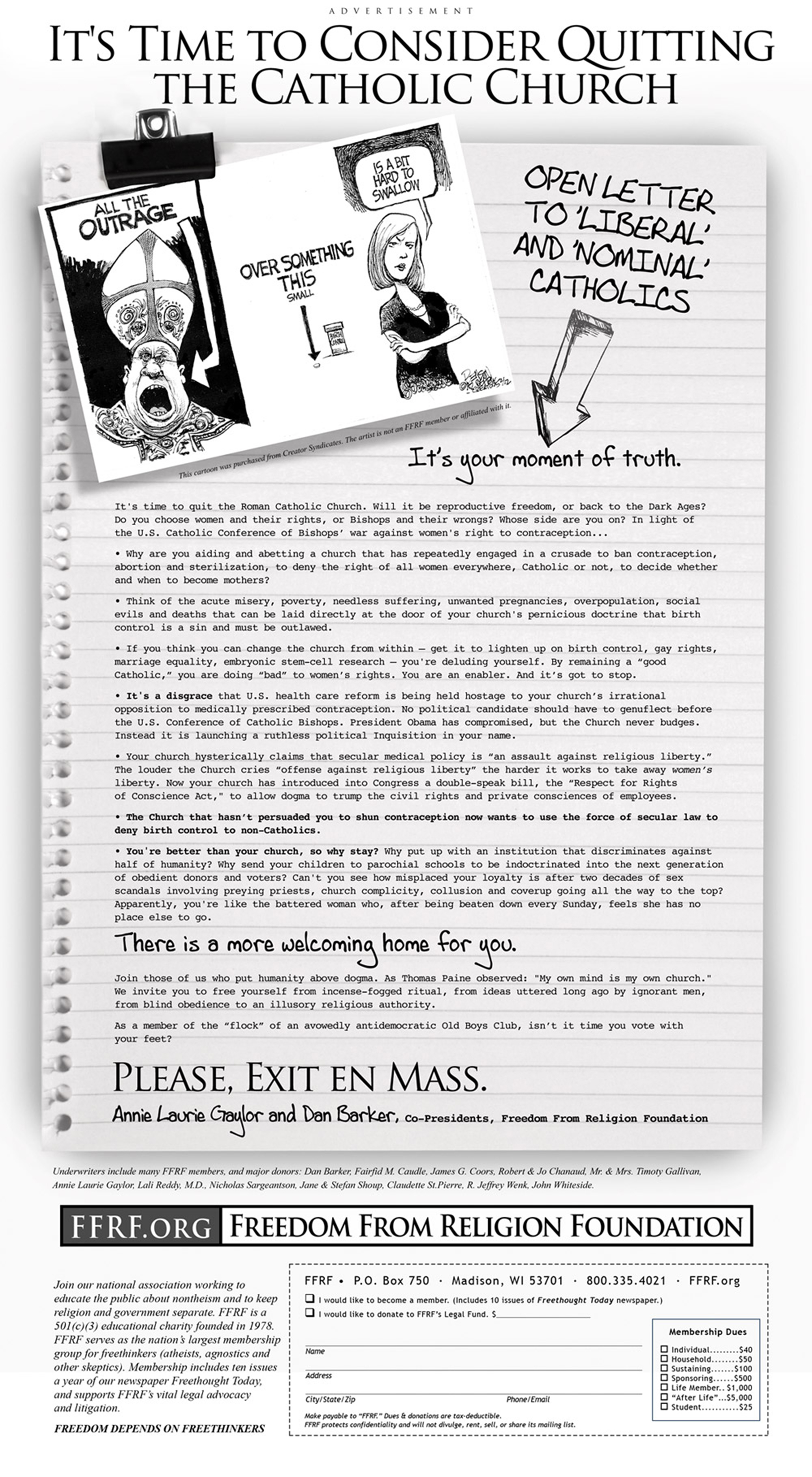
I thought about that irreversibility when, today, I opened the New York Times to page A13, and I saw a full-page ad by the Freedom From Religion Foundation, headlined “It’s Time to Consider Quitting the Catholic Church.” You can see the ad at the FFRF website here.
The ad, an “open letter to ‘liberal’ and ‘nominal’ Catholics,” asks Catholics to consider leaving Catholicism because of a range of public harms that it lists as being propagated by the Catholic Church, focusing most of all on the recent debate over contraception. It concludes by pleading, in a pun that would otherwise be playful were it not so striking in its content, “Please, Exit En Mass.”
A short blog post is not adequate space to think thoroughly enough about this ad, but I want to offer a few reflections and see what comments folks might have about it.
Whatever one thinks of this ad, it seems to mark a particular moment in the unfolding history of the Catholic Church in the United States. That a full-page ad in one of the most influential newspapers in the country would ask members of a major religious group to walk away from that group is an extraordinary occurrence.
I hope that before people take sides pro or con on the ad, before the tendency to separate into “evil vs. good” or “good vs. evil” here, we might be able to take this opportunity for some serious thinking, and ask: What is happening with religion in general and Catholicism in particular today that would make such a moment possible?
The ad trades on the newly widespread awareness that Catholicism is shedding adherents: that most Catholics live on the “lower” end between moderate and marginal affiliation, instead of high affiliation, and that a great many are actively disaffiliating. It trades on the widely understood distance between most Catholics’ beliefs and practices and official teaching on certain matters. Most important, as far as I can tell, is its remarkably confident appeal to a kind of personal agency that would make Catholics, who so often see religion as something akin to an ethnicity, walk away from it. The example the ad gives is that of an abusive marriage, and the FFRF is trying to help Catholics who are the victims-survivors of being married to Catholicism cry “Enough!” That such an exit is up for public consideration is one of the most telling points here regarding what is happening with religion in general and Catholicism in particular.
A Fordham colleague, Prof. Patrick Hornbeck, and I are presently working under a grant from the Louisville Institute on a study of “deconversion” in Roman Catholicism. Deconversion, in the theological and religious studies literature, is the process by which people step away from what they formerly held in religious belief and practice. It is a deep change of mind and heart about one’s faith, away from where one had been formerly situated. This ad speaks to the cultural legitimacy that deconversion has achieved (although of course that term is not used), particularly in regard to Catholicism.
But some of the deconversion literature would suggest that when people do walk away from their faith/religion/religious community, they don’t only want “freedom from religion.” Some switch to another religious denomination or even another religion, some hang loose and nurture a religious/spiritual life apart from active affiliations with recognized religious communities, some let go of faith/religion/spirituality altogether, and some hang on within their religious community and struggle more or less openly with it. (These “trajectories” are the findings of Heinz Streib, et al, in the important research study titled _Deconversion_ (Vandenhoeck and Ruprecht, 2009).)
One challenge is that scholars don’t have a strong and complex enough sense about Catholic deconversions. There are very few in-depth deconversion studies with Catholic (or formerly Catholic) participants. A lot of the research is with evangelicals and mainline Protestants, and with new religious movements of various stripes.
I know there will be those who want to vilify this ad, but I think a more productive and theologically searching route is to see it as a conversation starter, for the reasons I suggest above. It is an occasion to think about where Catholicism stands in our culture, and to ask where things go from here, and why.
Tom Beaudoin

 Politics
 Faith
Faith Culture
 Vatican
 Scripture
 Podcasts