


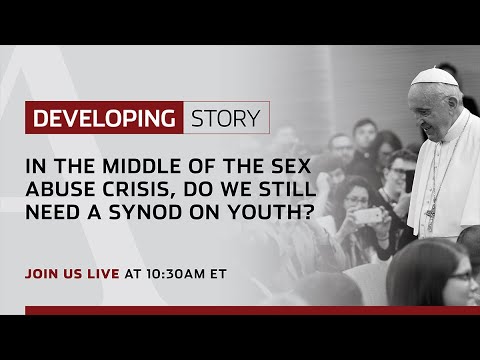
The upcoming meeting of the Synod of Bishops on young people provides an important opportunity for church officials to listen not only to young adults’ expressions of faith but, as Pope Francis has noted, “even your doubts and your criticism.” The move away from religious affiliation and church participation is especially pronounced among younger people, not just in the United States but globally. Yet it is evident that many Catholic youth want the church to be an integral part of their lives.
A working document for the synod cites participants from a meeting of young people in Rome in March, where they voiced the desire for an “authentic” and “credible” church that can “speak in practical terms about controversial subjects such as homosexuality and gender issues” and “engage with and address the social justice issues of our time.” These are reasonable requests. An authentic church is one that maintains faithfulness to its core values but is also seeking to understand lived realities rather than simply condemning them.
An authentic church is one that maintains faithfulness to its core values but is also seeking to understand lived realities rather than simply condemning them.
Authentic engagement is always an interactive process. It requires, as Francis notes in “The Joy of the Gospel” (No. 231), an ongoing conversation about the “tension between ideas and realities”—and for Catholics, an ongoing conversation between everyday lived experience and church teachings. Young Catholics, however, give little attention to church teachings. According to data from the Sixth National Survey of American Catholics (gathered in April 2017), in making up their minds about important moral issues, millennials are far more likely to “always or sometimes” draw on conversations with close family members (83 percent) and trusted friends (79 percent) than on official church sources like the Catechism of the Catholic Church (29 percent), a local priest (25 percent), diocesan websites (17 percent) or papal encyclicals and statements (19 percent).
Even “Laudato Si’,” Pope Francis’ encyclical on the environment, did not make much of a dent on Catholics’ conversations. Despite its political and moral relevance, its accessible language and extensive publicity through secular and social media, one study found that only 24 percent of Catholics were even “aware” of it a few months after its release, and only 18 percent said it had been discussed at their church.
Despite this lack of attention to church sources, in a recent P.R.R.I. poll almost two-thirds of white Catholics and one-half of Hispanic Catholics between ages 15 and 24 said that they do not find it difficult to discuss religion with those who do not share their religious beliefs. This openness to conversation is good news. It not only enriches interpersonal relationships but also offers hope for a civic discourse that might bridge rather than belittle religious differences.
The inaccessibility of natural law is related both to its complexity and to how its arguments are communicated.
The synod meeting on young people is an opportunity for the church to craft a more central place for its teachings in young Catholics’ conversations. At present, however, if youth were to turn to official church sources—especially on sexuality, gender and marriage—they might be confounded by the church’s language and reasoning, particularly its reliance on natural law. The inaccessibility of natural law is related both to its complexity and to how its arguments are communicated. Increasingly, it is perceived as being incompatible with new theories in evolutionary biology.
The meetings of the Synod of Bishops on the family, held in 2014 and 2015, acknowledged that the language of natural law needs a more meaningful and accessible translation, but the bishops’ working groups appeared to struggle to find an alternative vocabulary that would resonate with contemporary Catholics. They have to try harder. A relevant Catholicism—one that necessarily engages with Catholics and with secular audiences—begs for church teachings on sexuality, marriage and gender to be revisited in light of advances in scientific knowledge and understanding of these complex matters. Whether or not any such revisitation leads to more nuanced teachings, church officials must find ways to reframe their arguments so that they can make sense both to increasingly secularized Catholics and to their non-Catholic peers with whom they are in conversation.


On a related topic, the synod would do well to address the conflict between the church’s desire to accompany Catholics whose lived realities do not conform to teachings and its condemnation of “the scandal” to the church from these lived realities. Can the church build bridges to L.G.B.T. Catholics and to cohabiting and divorced and remarried members of the church if it continues to insist that, as Pope Francis noted in “Amoris Laetitia” (No. 297), one “can’t flaunt objective sin” and continue to teach others? The pastoral goal of integrating such Catholics into parish life is in tension with the simultaneous expectation that they conceal either their Catholic or sexual identity, a tension underscored, for example, by their exclusion from parish ministry or the firing of married gay or lesbian teachers in Catholic schools.
Many have negotiated the tension in being gay and Catholic. But it might be harder to persuade young Catholics who do not fully conform to church teachings to manage such tensions. They belong to a generation for whom questions of gender, sexuality and marriage are more about personal authenticity than institutional conformity. They want to be open about who they are, and they want institutions to be open to the diversity of their and others’ realities. If the synod can openly address the tensions between its pastoral intuitions and its doctrinal expectations, it might be a turning point in meeting young Catholics’ search for a credible church. It might also mean that church teachings would become more integrated into young Catholics’ conversations.
This article appears in October 1 2018.


 Politics
 Faith
Faith Culture
 Vatican
 Scripture
 Podcasts