

When my first nephew, Charles, was born 27 years ago, I was suddenly ushered into a new world of infants, babies and toddlers, as well as crying, vomiting and diapers. And into joy as well! Nephews and nieces, as any priest or member of a religious order will tell you, are immense blessings in a celibate person’s life. However, as my sister and brother-in-law will point out, though I was (and am) a faithful and devoted uncle, I never changed a diaper. And never will—there should be some concrete benefits to celibacy!
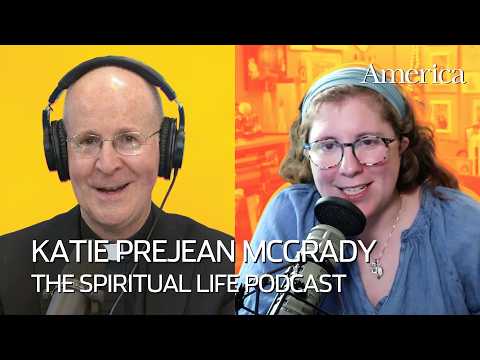
Perhaps because I came from a small family, perhaps because all my cousins were older than me, or perhaps because, in the wake of the Baby Boom, the kids on my street were roughly my age, I had not spent much time around babies. Unlike our guest on “The Spiritual Life” this week, Katie Prejean McGrady, who has written and spoken extensively on a variety of topics—evangelization, young adult ministry and also the spirituality of family life—I had little to no knowledge of what it really meant to raise a young child.
That did not, of course, prevent me from having some definite, if uninformed, opinions!
Chief among these was, if not a frustration, then a simmering impatience at noisy children during Mass. Why, I wondered, don’t these parents simply tell their kids to be quiet? I would never express these negative feelings, since I didn’t want to discourage parents from bringing their children to Mass or make them feel uncomfortable (and children are the future of the church). But I admit that impatience sprang up every time I heard an infant crying loudly and incessantly during Mass.
I had the same judgmental attitude about parents bringing their kids to Mass late. Why, I wondered, don’t they simply leave the house earlier?
Both prejudices were eradicated after my first nephew’s birth. (My second nephew, Charles’s brother Matthew, came a couple of years later.) When Charles was 3, I was staying for the weekend at my sister’s house and, in the morning, she asked, “Would you mind getting Charles ready for Mass?” No problem, I thought. It might even be fun.
“So, Charles,” I said, “What clothes do you want to wear to church?”
“I don’t want to go.”
“Charles, we have to go to Mass. What do you want to wear?”
“I’m NOT GOING!”
You can imagine the rest. It took me 20 minutes to dress Charles, and of course, we were late.
Prejudice No. 1: Eliminated.
A few years later, I was sitting next to his younger brother, Matthew, who was about 1, during Mass at their family’s parish in New Jersey. He started to chatter, rather loudly: “Blah, blah, blah.” So, I thought: Here I am in the situation I always judge others for. And I’ll put into action what I thought every parent should do.
I said: “Matthew, this isn’t the time for talking. If you want to say something, close your eyes and pray to God.”
“OK,” he said, and then he was silent.
I was so happy. Look how easy that was! Why didn’t all parents take their cues from me? Then a few seconds later: “Blah, blah, blah.” Nothing could get him to stop talking. His mother took him, now crying, out of the church.
Prejudice No. 2: Gone.
(Needless to say, at 27 and 21—with one a Fordham grad and the other a Georgetown student—both are now the models of good behavior in Mass.)
The French have a saying: “Tout comprendre, c’est tout pardonner,” loosely translated as: “To understand all is to forgive all.” Even my limited experience with children taught me to be less judgmental, to value the unseen challenges of child-rearing and to appreciate the spirituality of family life. You’ll learn even more from listening to Katie Prejean McGrady.


 Politics
 Faith
Faith Culture
 Vatican
 Scripture
 Podcasts