


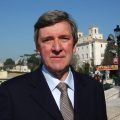
Just over 46 years ago, an 18-year-old Vietnamese man fled Vietnam in a boat with more than 100 other people: Today he is Australia’s first Asian bishop. In this exclusive interview with America, Vincent Long Van Nguyen talks about that perilous journey, his life in a refugee camp in Malaysia and how after arriving in Australia he joined a religious order, was ordained priest and later bishop. He concludes by speaking about his life as bishop of Parramatta, Western Sydney, and the challenges the church faces there and in Australia more broadly.
I met this outgoing bishop on Aug. 26, at his residence in Parramatta next to St. Patrick’s Cathedral Hall, where he had invited Elisabetta Piqué (my wife) and I to speak at a public event about the historic papal transition from Francis to Leo XIV.
As we sat with Bishop Vincent (as he is known here) drinking tea, I asked him to tell us why he left Vietnam and about that boat ride.
“It was the 11th of August 1980, and I took to the sea with more than 100 people in a small boat, probably no bigger than this room, so it was pretty squeezy,” he said.
“I was 18, and there was nobody of my family in the boat except my sister-in-law and her two small children: a boy about two years old, and an infant girl, eight months old. It was risky for all of us, but it was particularly risky for the children because of the elements and the lack of food and water.” He held his little niece in his arms on the voyage “because my sister couldn’t manage both of them, so I ended up having to nurse or to hold the baby girl.”
“It took us seven days, not to get to the shore, but to be rescued by a passing cargo ship and delivered to a refugee camp at Pulau Bidong, off the coast of Malaysia,” he recalled.
He left Vietnam, he said, because “after the communist takeover of South Vietnam on April 30, 1975 with the fall of Saigon, it was very chaotic. The communist regime applied a very strict almost Stalinist style of government. Soldiers and officials of the former government were put in jail; they couldn’t build prisons fast enough to accommodate all these thousands of people who had worked for the former government or fought on the other side.
“Five years later, the Vietnamese were fighting two border wars: one with the Chinese to the north, the other against the Khmer Rouge in the south, and there was the fear of adult males like me being conscripted and sent to the front line. Furthermore, the country was plunged into chaos and embargoed by the American government, people barely survived and then many people were sent from the cities into the so-called new economic zones which is really a euphemism for labor camps where many died of diseases or starvation.
“It was a very turbulent period and there was a great exodus, not just adult males like me, but many children and elderly people too.”
He spent 16 months in that camp with some 40,000 other refugees. Recalling that experience, Bishop Vincent said, “It was a very productive time as far as I’m concerned, even though it was isolated and mentally challenging because you couldn’t communicate freely with your loved ones and you couldn’t go outside [the] parameters of the refugee camp.”
In the refugee camp, he said, the vocation to the priesthood that he had first felt back in Vietnam “was strangely rekindled. I think partly because I experienced the immense suffering of my fellow refugees and I witnessed some of the tragedies that took place.” He came from a Catholic family and had been in a minor seminary in Vietnam up to 1975 before the government closed it, “but for five years after that I never thought about the vocation because the Vietnamese government banned all seminaries and religious houses when they took power, and until the time
I left, no priests were ordained, no seminarians or religious novices were allowed to be accepted; the ban was comprehensive and severe.”
He learned English in the camp and applied first to go to the Netherlands “where my two older brothers were and where my sister-in-law with my niece and nephew had got reunited with them, after a few months in the camp. But the Dutch government had a very restrictive immigration policy: only husbands or wives or young children could be reunited with their respective relatives over there, but not a brother like me.”
A Vietnamese in Australia
“I then applied to the Australian government and came to Melbourne in 1981, where some friends had settled before. There I learned to adjust to the new country and a new environment. I got settled in Springvale where there was a parish run by the Conventual Franciscans, in Southeast Melbourne. I got to know them, and joined the friars shortly after, in 1983, and became a novice not far from here. After my first vows, I was transferred to Melbourne where we had a house of studies. I became an Australian citizen in 1986. Cardinal Pell ordained me deacon, and priest in 1989, and he was co-consecrator at my Episcopal ordination in 2011.”
After priestly ordination, he was sent to Rome for further studies and obtained a licentiate in Christology and Spirituality from the Pontifical Faculty of St. Bonaventure. After returning to Australia, he spent 14 years in parishes, seven in Parramatta and seven in Springvale, and in 2005 he was elected Superior of the Order of Friars Minor Conventuals in Australia. Subsequently, he served as assistant general of his order in Rome from 2008 until 2011 when Benedict XVI appointed him auxiliary bishop of Melbourne.
In 2016, Pope Francis appointed him Bishop of Parramatta, making him the first Vietnamese-born bishop to head a diocese outside of Vietnam and the first Vietnamese and Asian bishop in Australia. Asked what that was like, he replied with a laugh, “It was a bit like breaking the glass ceiling, I suppose.”
He recalled that during the ordination ceremony, “I told the congregation that the Vietnamese were the new Irish in Australia because of the way we came to this country, not dissimilar to the way the Irish convicts came; they also came by boat, and they revitalized the church in Australia. The Vietnamese did something similar, we kind of unwittingly became a force of renewal of the church in Australia.”
There are more than 300,000 Vietnamese living in Australia today, according to official statistics. Bishop Vincent said they constitute the sixth largest migrant group after the Indians, English, Chinese, New Zealanders and Filipinos. “We count for over 2.3 percent of the Catholic population in Australia and the rate of practice of the faith among Vietnamese is very high and vibrant,” he said.
The Australian church now has two Vietnamese bishops: Vincent Long Van Nguyen and Thinh Xuan Nguyen, auxiliary bishop of Melbourne since 2025. They also have around 300 Vietnamese priests, the second largest number of migrant priests in the country after the Indians; all are Australian citizens. Moreover, there are many Vietnamese in Australia’s seminaries.
Generally, the Vietnamese priests “tend to be more pastoral and less ideological,” the bishop said. While it is reported that in some seminaries there is “a tendency in recent decades for some seminarians from Anglo-Irish background to be quite conservative,” he said the Vietnamese seminarians “are more middle of the road, not polarized.”
Life as a bishop
When I asked if he was surprised at being named a bishop, he replied, “I was, especially under Pope Benedict. I often joke that I must have slipped under the radar screen of the late Cardinal Pell, even though he once said that he would like to see a Vietnamese bishop, but he might not have thought of me [laugh].
“I was not a well-known person by any means. I was just doing my work in the [Franciscan] order, and I didn’t make my theological position known one way or the other. So, I didn’t have any baggage attached to me, I suppose. I didn’t have any red flag you might say.”
Since he mentioned Cardinal Pell, I asked how the controversy surrounding the cardinal affected the church in this land. “The late cardinal was larger than life,” he replied. “There are people who loved him, adored him, and people who think that he was divisive for the church in Australia. His style of being very dominant, and even somewhat confrontational, endeared him to some and antagonized others. So, there’s not much in between; he was a polarizing figure. I think that’s a fair description.”
He has been a bishop for around 15 years, so I asked: What were the major challenges he has faced, and what he has enjoyed most?
“I love being with the people. That is probably my greatest enjoyment,” he said. “I think I’m a pastor at heart. I’m not a theologian or administrator. I’m very comfortable with the people in the various situations they find themselves. I love being a parish priest. I was a parish priest for 14 years before I was transferred to Rome to be assistant general [in the order]. That’s my kind of territory, to be with the people and to work with them.
“I still miss being a pastor and while being a bishop is also being a pastor, the opportunities for direct engagement are few and far between. I hardly ever do a baptism, or a funeral, or a wedding, and I hardly ever visit people’s homes. But having said that, I’m most comfortable when I meet people and chat with them. I see my engagements with the people after the liturgies, after the sacraments, as important as the liturgical celebrations, because you spend time talking, listening, and engaging with people.”
Bishop Vincent added, “I also enjoy the role of shaping the direction of the church locally, at least, shaping parishioners’ opinions or attitudes on certain issues.” He had spoken out on the October 2023 Referendum to alter the Australian Constitution to recognize and give voice to its indigenous peoples by establishing a constitutional advisory body called the Aboriginal and Torres Strait Islander Voice to advocate for their way of life and shape public policies. The Maoris in New Zealand have such a platform, but the referendum failed in Australia: 60 percent voted against, 40 in favor. “I was devastated,” he recalled.
“I also had the opportunity to shape public opinion on the national postal survey [in 2017] to change the law to allow couples of the same sex to marry,” he said. 61.6 percent of the voters approved a change to the law. He explained, “I tried not to advocate for one position or another, but I did put a heavy emphasis on the pastoral care, and the recognition of same sex people as befitting the people of the Gospel because, as I pointed out in my pastoral letter, even in the Catholic church they were discriminated against and therefore we have a duty to correct that wrong and to work with our L.G.B.T.Q. brothers and sisters.”

Bishop Vincent was the first to hold a diocesan synod in the era of synodality in Australia. Unlike the way previous diocesan synods were conducted, he said “we celebrated the synod in a way that engaged a very broad range of people. We had listening circles, deanery sessions and so on. Nothing was off the table, so we had a very open and inclusive synod.” He convened the synod in March 2023 and over 5,000 individuals joined consultations and submitted more than 1,000 contributions by July 2023. The plenary assembly was held in October 2023, and the resulting pastoral plan for 2024-2028 was launched in August 2024.
He held a synod because “fundamentally, I see the synodal way as an expression of the ecclesiology of the Second Vatican Council. For me that was a defining council for our time and as the Australian theologian Ormond Rush said, ‘synodality is Vatican II in a nutshell.’ And having embraced the Second Vatican Council’s ecclesiology very personally and strongly, I do believe that synodality is the next gear shift in terms of moving the church forward with the vision of the Second Vatican Council.”
He added, “As Pope Francis said, it is what the Holy Spirit expects of the church in the third millennium. I too see that the synodal journey is really a way of encouraging, promoting greater communion, greater participation, greater vision in the church and by extension eliminating that clericalist approach to being church that was strictly defined by ordination.”
Asked if all the people in his diocese are on board, he replied, “Well, like all local churches or like Catholics across the globe there are people at different stages of synodality or even people who are opposed to the vision of a synodal church. I know Parramatta is no different in that kind of diversity of viewpoints.”
He noted that in Western Sydney there is a large concentration of Eastern Catholics that are usually more conservative than the Latin Catholics. “We have people who are on board with the synodal journey, and people who vehemently oppose it. In fact, when we held the diocesan synod, we had an opening Mass and a candlelight procession from the Cathedral to the CommBank Stadium [the venue of the synod], and there were a dozen young men dressed menacingly in black, handing out pamphlets opposing the synod and denouncing me as a heretic for the synodal journey and opposing my leadership in the diocese, and interestingly they were not Latin Catholics.”
As bishop, he has encountered opposition for his leadership of the church, but he remarked, “I think it comes with the territory. I mean you have to discern every opposition or criticism or complaint directed at you, so I wouldn’t put them all in one basket and dismiss them offhand. But having said that, I guess that being vocally supportive of the synodal journey and embracing unambiguously the Second Vatican Council did put me in a sort of unenviable situation at times.”
Bishop Vincent met Pope Francis “several times” and recalled, “he was very kind, affirming and generous to me.” He said he will never forget the Jesuit pope’s encouraging words at their last meeting, when Francis told him, “Vincent, I know your situation. Be prudent. Go forward and do what you’ve been doing for the people of God. You have my support. You have my support.”
Although they were in Rome at the same time, Vincent Long as assistant general of his order and Robert Prevost as prior general of the Augustinians, they never met during that period. They did however meet a few times when Prevost was prefect of the Dicastery for Bishops, and Bishop Vincent recalled, “He struck me as a very sincere, kind person with a gentle, engaging demeanor. I felt he had a very empathetic listening ear; he listened to me like a brother to a brother.” Since Prevost became pope, he said, “I follow him, and I’m very impressed with his leadership. I think he’s the right person for the right time.”
Challenges facing the church in Australia
Asked how he sees the church in Australia today, Bishop Vincent said, “I think the church in this country, like most Western societies, is under tremendous pressure. Despite talk of a surge in new converts, that doesn’t take away the fact that most rank-and-file Catholics are not in the pews. In Australia, roughly only 10 percent of Catholics come to church on a weekly basis; that’s a phenomenon difficult to reverse. So that’s one of the challenges.
“If it wasn’t for immigrants, the Vietnamese, the Filipinos, the Indians, and others who make up the bulk of the church at the coalface, we would have had a very different reality. Moreover, when you look at the clergy, more than half, maybe two thirds in some places, are from overseas. It’s another sign of the church at a critical juncture,” he said. Furthermore, “when you look at religious life, there are some which are in the phase of completion; they are resigned to diminishing and coming to an end. That’s another raw reality.”
He believes synodality is a way to address this situation. “We need to revitalize the church in new ways. and I think the synodal way is one that promotes the greater participation of all people. We are seeing that kind of transition in some of our agencies. For instance, the healthcare agencies that were once the works of religious orders are now almost entirely in the hands of lay people. The same is true in the field of education.”
I concluded by asking how he, a former refugee, views the situation today—where the United States, a country of migrants that once advocated for his freedom, now treats migrants without dignity and deports them, and Australia, a country of migrants, now fears their arrival. He said: “When we came to Australia as refugees, the country was more sympathetic towards its former ally [Vietnam]. Australian soldiers fought in Vietnam alongside the Americans and other allied countries, so that relationship was kind of the catalyst for the public acceptance of Vietnamese refugees. But that acceptance tapered off towards the ’90s and beyond because the world didn’t want to see the exodus of refugees continuing endlessly.”
“But,” he said, “especially after 9/11, the antagonism towards refugees from the Middle East especially, from the point of view of the Western countries like Australia and America, is more complex than before. They are seen not through the lens of humanitarianism, but through the lens of Islam versus Christianity, East versus West. On top of that, you have the far right and populist movements in the U.S.A., Europe and Australia, and the strong tendency to scapegoat people from certain backgrounds.
“I believe the church as a conscience of society has quite a job to do and, hopefully, we will rise to the occasion. We must.”

 Politics
 Faith
Faith Culture
 Vatican
 Scripture
 Podcasts