

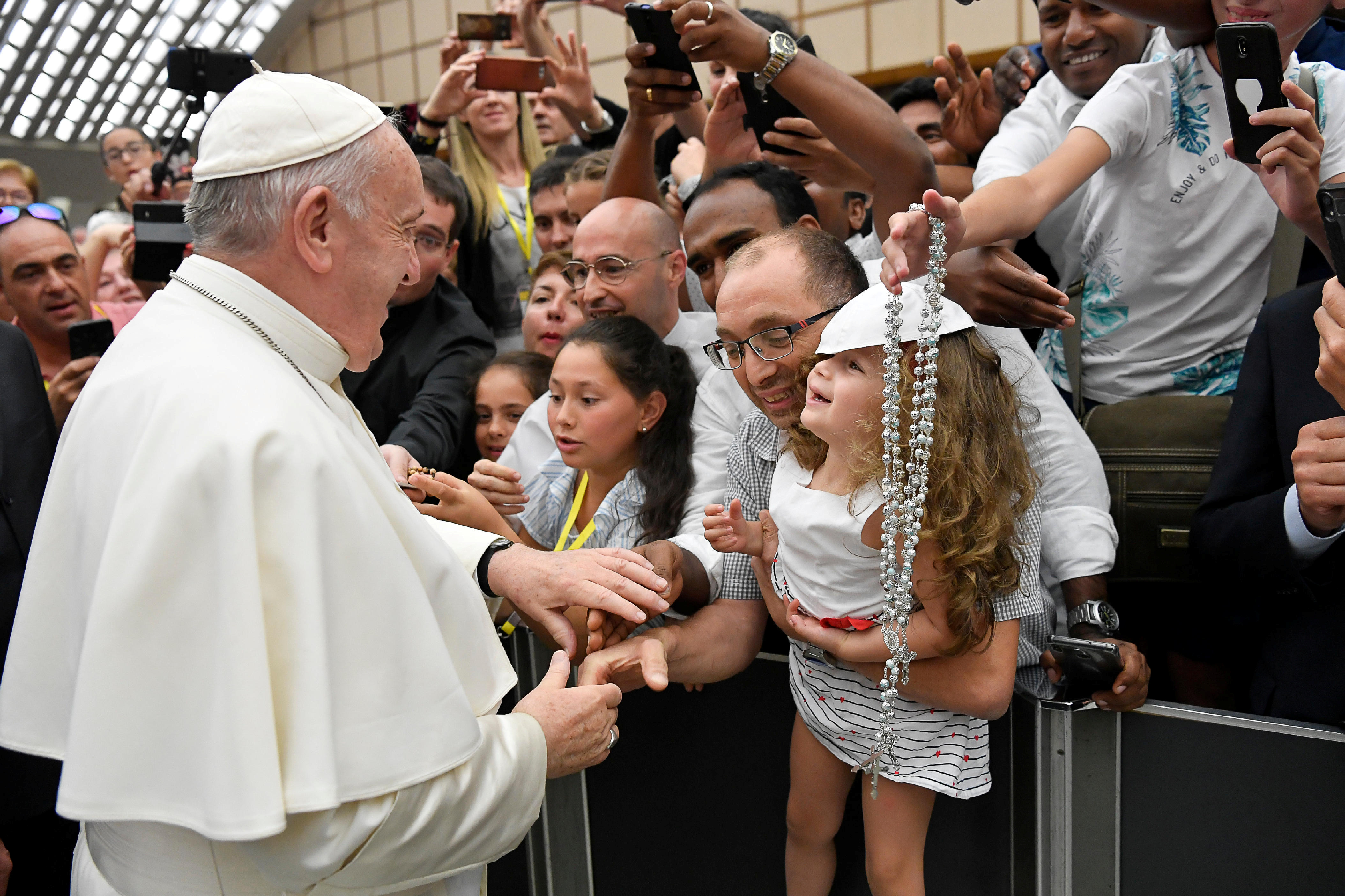
Pope Francis has again warned against “us first” or “sovereignist” ideologies advanced by political leaders in some countries today, and in an Aug. 6 interview with the Italian newspaper La Stampa, he said they could lead to war. These countries would appear to include Italy and the United States, though he did not name either.
“I am concerned because we hear speeches that resemble those of Hitler in 1934. ‘Us first, we...we….’ These are frightening thoughts,” he said in the interview published this morning by the Italian daily, in which he also speaks about migrants, climate change and the importance of next October’s Synod on the Amazon.
Pope Francis: “I am concerned because we hear speeches that resemble those of Hitler in 1934.”
Speaking to Domenico Agasso Jr., the newspaper’s Vatican correspondent, Pope Francis expressed his concern for the European Union in the light of populist movements that threaten its fragmentation. He may have had in mind Matteo Salvini, leader of The League, a xenophobic and anti-immigrant party in Italy with the slogan “Italians first.” (Mr. Salvini is now threatening to bring down the coalition government in which his party is a partner.) Pope Francis’ remarks were read by observers in Rome as also alluding to the politics of U.S. President Donald Trump and his “America first” policies.
Francis sought to distinguish between “sovereignism” and “sovereignity,” explaining that “sovereignism reveals an attitude toward isolation” and means “being closed.” He said, “Sovereignty must be defended, but relations with other countries, [such as] with the European community, must also be protected and promoted.” He warned that “sovereignism is an exaggeration that always ends badly: It leads to war.”
He said the same is true of “populism.” Francis said, “[it is] one thing is for people to express themselves, [but] another to impose a populist attitude on the people.”
“Sovereignism is an exaggeration that always ends badly: It leads to war.”
Pope Francis also said, “Europe cannot and must not break apart.” He expressed hope for renewed unity after the elections for the European Parliament in May, which put a brake on the populist movements in many countries (though not in Italy). He expressed confidence that the new president of the European Commission, Ursula von der Leyen, “can be the right person to revive” the European Union because “women know how to bring people together.”
One of the big challenges facing Europe today is the influx of migrants from Africa and the Middle East. Asked about this, Francis said, “Never neglect the most important right of all: the right to life. Immigrants come here above all to escape from war or hunger, from the Middle East and Africa.” He added, “the African continent is the victim of a cruel curse: In the collective imagination, it seems that this continent should be exploited. Instead, part of the solution is to invest there to help solve their problems and thus stop the migration flows.”
He added: “Criteria should be followed. First: to receive, which is also a Christian, evangelical duty. Doors shall be opened, not closed. Second: to accompany. Third: to promote. Fourth, to integrate. At the same time, governments must think and act prudently…. Those in charge are called to think about how many migrants they can take in.”
The Amazon synod and “Laudato Si’”
Asked about the importance of October’s Synod on the Amazon, Pope Francis declared the event “the child” of “Laudato Si’,” also known as “On Care of Our Common Home.” He said, “Those who have not read it will never understand the Synod on the Amazon. ‘Laudato Si’’ is not a green encyclical, it is a social encyclical, which is based on a ‘green’ reality, the custody of Creation.”
Asked why the synod is focusing on the Amazon region, Francis said, “It is a representative and decisive place. Together with the oceans it contributes decisively to the survival of the planet. Much of the oxygen we breathe comes from there. That’s why deforestation means killing humanity. And then the Amazon involves nine states, so it doesn’t concern a single nation. And I’m thinking of the richness of the Amazonian plant and animal biodiversity. It’s wonderful.”
Indeed, when asked what he fears most for the future of the planet, Francis said, “The disappearance of biodiversity,” along with “new lethal diseases.” More broadly, he warned of the “devastation of nature that can lead to the death of humanity.”

He said he was “shocked” by “Overshoot Day”: “On July 29th, we used up all the regenerative resources of 2019. From July 30 we started to consume more resources than the planet can regenerate in a year. It’s very serious. It’s a global emergency.”
But he said that the October synod “is not a meeting of scientists or politicians. It is not a parliament; it is something else. It was convened by the church and will have an evangelizing mission and dimension. It will be a work of communion guided by the Holy Spirit.”
Asked if the ordination of married men as priests in the Pan-Amazon region would be a main theme of the synod, Francis responded: “Absolutely not. It is simply a topic of the [working document]. The important thing will be the ministries of evangelization.”



Maybe looking out for yourself can end up helping others. Real progress requires cooperation. The Pope should be more worried about China, Iran and Russia. The reference to Hitler is so over the top that it demeans any argument he makes.
Is the Pope pushing for a world government with socialism? That seems to be a common theme in his words. The Jesuits just admitted he is proposing something like communism on their video cast, Jesuit Autocomplete, as he is a hard core liberation theologist.
The Pope is not pushing for a World Government with socialism. But what do you call that form of life of the First Christians who held all things in common? The word is not important. But the Church has always taught the universal destination of the goods of the earth, as a principle prior to private property, and which puts limits to the right to private property. Russia is not a communist country, and neither is Iran. With regard to China, I believe that the Church is significantly worried about the persecuation of the Moslem populations in Western China, which constitute a truly horrendous violation of the principle of religious liberty. The Holy Father has condemned such persecuations in Myanamar. But one only has eyes for such things when one goes beyond that US FIRST mentality. When has Trump spoken out against human rights violations against Moslems? Never. Why? Because it doesn't speak to his base. When has he spoken out against Putin's murderous treatment of his political enemies? Only when protocol demanded it. Otherwise Putin is his pal. With regard to Hitler: Hitler did teach US FIRST, so it is not over the top to say that he did teach that, and to see its consequences. And if you said to a Nazi that that Nazism was racist, they would have said to you that what they are teaching is science, the scientific facts about race, about genetics, we would say. Just like when people say that you can call Baltimore a rat infested mess, and you are not being racist, and what you are really talking about is liberalism, when the fact is that you are really talking about is race and your pretended right to hate. The nazis would have really loved Steve Bannon's turns of phrase according to which the US FIRST mentality becomes "economic nationalism" in which you come up for your own country, except for Baltimore which is infested by vermin-like black people who need to go back where they come from and fix their own problems....which you say not because you have any interest in problems being fixed, but because hate rhetoric is red meat for your base. Hitler spoke like that too. We should not judge anyone, but it is necessary to see red lights flashing when they are flashing.
You are confusing living in a small religious community with how a successful society can function. An economics professor once taught us that socialism can work as far as the eye can see but no further. Even that is not true as socialism only worked one place in history and then was abandoned after one generation. Socialism requires a voluntary giving up of one’s freedom which most religious orders require. The Catholic Church has never preached a vow of poverty for its members.
For those who believe socialism is possible, read Heaven on Earth: The Rise, Fall, and Afterlife of Socialism by Joshua Muravchik
https://amzn.to/33tTB5Y
Socialism requires a suppression of freedom and individual effort to improve oneself. Both of which are against how God made us. If everyone imitated St. Francis as is often recommended, there would be no one to beg from since everyone would be a beggar. You need producers for the small number who want to live in common.
But I did not say that socialism is the way; the Church has always rejected socialism, but that has not stopped her from teaching the universal destination of the goods of the earth. To understand the Church's social doctrine (of which socialism is a perversion) one has to begin withe the principles of solidarity and subsidiarity. Socialism opend the door to totalitarianism by turning functions over to the government which should belong to intermediate bodies; Capitalism offers no defense of the individual against the mechanisms of the consumerist/individualist/throw away marketplace. Solidarity and subsidiarity ensure a strong and well structured society which fosters virtue and guarantees freedom and human rights. Exponents of Catholic Social Doctrine: Leo XIII, Pius XI, John XIII, Paul VI, John Pau II, Benedict XVI, Francis, G.K. Chesterton, Dorothy Day (not so much for teaching Catholic social doctrine as LIVING it.)
You are now sounding like a free market capitalist. Beware of Church social doctrine. For over 1500 years its ideas led to suppression of the common person. That is why Latin America has been a mess. Subsidiarity and solidarity sound nice but are too vague to mean anything. Subsidiarity which by definition can be over written on a whim is the opposite of what the Pope preaches in his bid to establish world control over things. It sounds like he would not pay much attention to it.
The only economic system in the history of mankind that has led to progress for the masses is free market capitalism which by definition is an extension of freedom for the common man. What is missing from this is morality, not social policy. The problem comes because we are so unequal by design that a few individuals are often able to thwart free market capitalism by government fiat or by control of economic resources. Any government intervention should be to prevent this. Establishing a social policy will invariably lead to a suppression of the masses. This does not mean that the government or private individuals cannot provide relief for certain individuals so they can thrive.
But I did not say that socialism is the way; the Church has always rejected socialism, but that has not stopped her from teaching the universal destination of the goods of the earth. To understand the Church's social doctrine (of which socialism is a perversion) one has to begin withe the principles of solidarity and subsidiarity. Socialism opend the door to totalitarianism by turning functions over to the government which should belong to intermediate bodies; Capitalism offers no defense of the individual against the mechanisms of the consumerist/individualist/throw away. marketplace. Solidarity and subsidiarity ensure a strong and well structured society which fosters virtue and guarantees freedom and human rights. Exponents of Catholic Social Doctrine: Leo XIII, Pius XI, John XIII, Paul VI, John Pau II, Benedict XVI, Francis, G.K. Chesterton, Dorothy Day (not so much for teaching Catholic social doctrine as LIVING it.)
Removed as repetition.
While others live differently and they are free to do so, but we Christians live by the Word of God. If anyone wants to attack us, she/he is welcome to do so; criticize and attack our faith, our Christian faith and faith in a living God of love, unity, joy, mercy, kindness and hope. But such criticisms will not deter true Christians from living the faith, walking the faith especially with the marginalized as Jesus Christ did during his public ministry. True Christians do not just mouth the faith, they walk it as our Lord commanded us to do.
So based on John 17: 20-23 (the Word of God), the Pope is correct to be worried about human greed and divisions in the world that produce (i) antisemitism which led to the evil of the Nazi Holocaust of the Jewish people in Hitler's Germany, (ii) the transatlantic slave trade that enslaved Africa and peoples of African descent , racism everywhere including the evil of racism against African Americans and tribalism in the world, (iii) aggression against our common home and abuse of our common home-the environment, God's environment. The Holy Bible is the living guide of we Christians.
Thank you Pope Francis. May God continue to enable and strengthen Pope Francis, the servant of all servants of the living God- in his service to God and God's people all over the world.
Globalism was a failed experiment that enriched only the globalist elite and crushed the western economy’s middle class and culture ... get over it, it’s dead.
Apart from being primarily founded on an economic system, Fascism is politically founded on a political narrowness, on jingoism (race, ethnic, class), on nativism, which eventually produce evils such as racism, ethnic cleansing, Nazi Holocaust, genocide etc.
An example of such growing narrowness, such as nativism, such as jingoism, such as tribalism here in the United States of America is the violence by racists and fascists in Charlottesville where they shouted "Jews Shall not replace us." "You will not replace us." 'You" means those who do not look like members of the fascist and Nazi groups. That is classic jingoism-race and ethnic. An extension of this narrowness is the famous statement from the racist god father to the Charlottesville fascist violence-"there are good people on both sides."-which means fascists and racists to the racist god father are "good" people.
But given the evil it represents, fascism is dead. The good people of the world will not allow it to raise its evil head.
However, the important thing which Pope Francis is talking about is the nature of our faith, Christian faith. The political jingoism, tribalism, narrowness, nativism that produced evils such as racism and fascism have no place in the house of God, they have no place in Christianity. They have no place in the universal Church. If you are a Christian and you believe that that political jingoism, parochialism, nativism, tribalism and narrowness that often produce fascism and racism have a place in Christianity, in the universal Church, kindly let readers know. And when you do this, please show us how such evils have a place in Christianity and in the universal Church. God Bless.
Pope Francis is going to get steamrolled on this issue...
Steamrolled against which criteria or framework? To have a useful and intelligible conversation on any issue no matter how difficult or challenging the first intellectually sound thing one must do is for one to state one's criteria or framework-okay?
Let me help you. For example my framework is Christianity, the Christian faith as deposited to us through the Apostles-okay? I am a Christian, so I write from that perspective. And I defend Pope Francis using the Christian framework. Given the nature of the Christian God, this explains why one can never reconcile evils such as fascism, racism, holocaust caused by political nativism, jingoism, narrowness with Christianity and still be a Christian. For example, you cannot be a racist or fascist and be a Christian, it is not possible. You either hold to your racism and fascism and drop Christianity. If you are Christian, and you are a racist or a fascist, you have to be born again and drop your racism, and fascism.
Now Pope Francis uses the Christian framework. So if hypothetically speaking I take you seriously, the question is: from which framework will Pope Francis be "steamrolled" according to you? God bless your soul.
Like a roadrunner cartoon...you’ll be pancaked ;-)
Okay I see! Your post is helpful. It has clarified a lot of things including how the country got to this unfortunate racist juncture. When the racist god father tweets the garbage he tweets, the gullible base fall in line because the tweets of the racist god father are the only things they know and can understand. Truth is thus the first casualty in such situation with such tweets. The capacity to even have intelligible conversation is extinguished for the base because there is no rational framework outside empty, knowledge and ethics challenged tweets of the racist god father. May God bless your soul!
Road pizza
“Sovereignty must be defended, but relations with other countries, [such as] with the European community, must also be protected and promoted.” What is sovereignty and how does a country go about defending itself?
“women know how to bring people together.”
I can’t believe he actually said this to the point America Magazine would actually print this as an example of something cool. In this age of political correctness and gender is just a “social construct” he might lose some woke points with the college kids. Sorry your Holiness, no jazz hands for you on this mis-gendering point either.
You have a poor understanding of what Fascism and/or Nazism is. Hint: nationalism, Communism, Nazism and Fascism are all rooted in the glorious French Revolution. They are all based on identity politics. The only difference is that while Communism pushes class identity, Fascism and Nazism favors national identity. Do some research, happy learning!
Antony P.
An intense and passionate display of equally intense exhibition of deep illiteracy and groundbreaking ignorance-Tragic, sad and bad!
Sorry, Antony P America Magazine is not a right wing propaganda machine such as Fox News and Breitbart News.
I hope you understand what you wrote. :)
You seem to confuse badly used partisan-political identifiers with rational arguments. An often used method by all political ideologues and racists.
Antony P,
Hm hm hm I hope that you are not an internet bot part of the Russian/DJT internet trolls. But if you are real-then yours is a continued display of intense but tragic ignorance.
Again this is America Magazine. This is not right wing Trump TV. America Magazine is not Trump tweets fit only for the rightwing and nativist base. America Magazine is not a knowledge challenged space. America Magazine is inclusive. America Magazine is not a right wing propaganda machine such as Trump tweets, Trump TV, Fox News, Breitbart News and OAN-okay? Hope this will help you. Think bot if you are not internet programed. Think bot if you can. Think!
As I said, you keep confusing personal characterizations/attacks with arguments :)) Also, I am amazed, how political ideologues so bravely assume to have a complete knowledge of someone, they never met. :) And, of course, as those driven by identity politics do, they never desire to have a real encounter with anyone, because they prefer to box people in by their selective attributes, which is a common practice by proponents of both Communism and Nazi/Fascism, but also of racism and all the other 'isms'. :)) In short: Whose only tool is a hammer, everything looks like a nail. :))
Also, you seem to talk so much about Trump ... you must really like the guy :)) Good luck :))
Antony P.
Hm hm hm continue your passionate display of ignorance my dear internet bot propelled by Russian/DJT internet troll machine!
Antony P.
My dear internet bot propelled by Russian/DJT internet trolling machine, please keep entertaining us. We need some comic relief! Where else can we get a comic relief if not from right wing internet bots with completely illogical pre-programmed posts!
It must be a hard life ....
For you...
Self-deleted as repetition.
Self-deleted, as repetition.
When prior to every flight, the flight attendants go through their safety routine, they always say: In case of emergency, put on your own oxygen mask first, before you assist anyone else. The same safety norm, in different context, is known to all healthcare worker as well.
I wish Francis would talk less, and when he does, he should be more careful and thoughtful of what he says. When he makes these kinds of rushed/hasty generalizations. he is undermining his own credibility and, more importantly, credibility of his office.
We all know about the Pope's affection for centralised, Davos-lite government. That scares me way more than populism. Also, his Hitler analogy is insulting.
Tell me about the Pope's affection for centralized, Davos-lite government. I have never heard of that.
The Davos-lite comment may be off the mark. However Francis has no problem with the notion of nation states ceding some authority to s supranational body: "The nation state cannot be considered as an absolute, as an island with respect to the surrounding context. In the current situation of globalization not only of the economy but also of technological and cultural exchanges, the national state is no longer able to procure the common good of its populations alone. The common good has become global and nations must associate for their own benefit. When a supranational common good is clearly identified, it is necessary to have a special authority legally and concordantly constituted capable of facilitating its implementation. We think of the great contemporary challenges of climate change, new forms of slavery and peace."
Francis' Hitler reference is embarrassing. He starts to sound more and more like an average political groupie or activist. With these cliche statements he only degrades his credibility. Someone should tell him that.
So, will he also refer to Hitler when commenting on anti-animal cruelty laws (Hitler introduced the first ever such laws in history)?
finally--we hear Francis talk some sense about uncontrolled migration--"part of the solution is to invest there [Africa] to help solve their problems and thus stop the migration flows.......governments must think and act prudently…. Those in charge are called to think about how many migrants they can take in.” Take that, you bleeding heart Open Borders folk-- overseas investment plus a rational controlled legal immigration policy that is sane and realistic. Amen! are you listening Angela Merkel?
He has been saying it all along, why weren't you listening?
I agree with everything Pope Francis said, and I believe that anybody who does not hear in Trump’s rhetoric echoes of Germany in the 1930’s and beyond simply doesn’t want to.
There is often a palpable ignorance and deliberate distortion on display when some people with deep seated immutable religious, cultural and political bias respond to Pope Francis. I do not for one moment assume that this will convince this group of people. But here is Pope Francis and his position:
1. Pope Francis' framework in his pronouncements is Christian. It is Catholic. He relies on the bible and uses the Christian framework. So he speaks and writes using a Christian and Catholic framework.
2. Based on this framework, Pope Francis does the following-(i) he articulates and defends the public ministry of Jesus Christ, (ii) he centers the Gospel of Christ, (iii) he defends the poor, the economically, politically, culturally invisible in our world, the marginalized-those Jesus Christ ministered to (iv) he defends our common home-the environment, God's owned environment.
Whoever is not happy with these Christian and Catholic claims and beliefs is free to attack Christianity, and the Christian God. It is your constitutional right if you so desire to do so, to attack our faith, the Christian faith-if you so wish. You are even free to distort (for political reasons)-what the Holy Father-Pope Francis is saying. But since America Magazine is an inclusive Christian journal, no one can distort the Christian faith without a response from some of us. We do this in defense of Christianity, the Christian faith. God Bless you.
Thank you Adeolu for supporting the faith and the Vicar of Christ., To the dissenters, if distorting the truth to put forth a non Catholic position is necessary, you know there is a problem with the theory. If someone wants to disagree with the pope, fine, but at least be honest with what he says.
Pope Francis is like Trump , he is aiming at the masses every time and is not afraid to seem simplistic, If his speech is filled with less worldly finesse than trump it is cos he is less finessed
His hope of rolling the world over with the old slave morality is deluded , he is perhaps less christian at this stage than the shyster from queens , trump at least winks at his audience
Pope Francis doesnt even realise that the crowd are moving out and his papacy is already looked on as sixteenth century for sheer debauchery
Oh he knows it David, but his purpose is to speak the truth, not to win a popularity contest with those so certain they are the holders of the keys. Sad what pride can do. Blind otherwise intelligent, good people.
I am not so sure the pope's intentions are so pure;He often seems motivated by swaying media favour , for example his actions with regards the sexual abuse cases were closely aligned with media interest;Once the major media showed an interest Pope Francis was far more contrite , without the major media interest he was quite frankly vicious with the chileans , i lived in both argentina and chile for a year so i know a little about it .I think it is exceptional for a person today not to be conditioned by the media , pope John Paul was obsessed by the media and how he was portrayed he would have made trump look naive , from insisting on being photographed alone to never wearing glasses , to retaking pics that his photgrapher had failed to get the first time (lech welwesa ), Pope Ratzinger was a welcome relief from this but even he lied in 2002 about the pedophile thing being "overblown " by the media , the popes are human in the case of some they even stoop to levels your average layman would not dream of , but i quote jay z "never knock the hustle"
As a Brazilian, a Catholic convert and a conservative, I hope that our government keeps its eyes very close to that "Synod". To those grey-haired people from Liberation Theology, which drew millions to apostasy and to Protestantism, that's the last chance to change the Church in Latin America. They want it for political reasons only. They will, nonetheless, fail, because people are starving for the gospel, not to that mumbo-jumbo syncretism. The Amazonian people will find Jesus preached by protestant churches more trustworthy than that Tupã like Jesus.
This is a political magazine not a religious one. There is definitely some religious articles but they are in the minority.
Salvation is rarely mentioned here. It does not seem to be an objective of the Jesuits. Xavier must be turning restlessly in his grave.