


“What kind of bird are you?” are the first words Sam (Jared Gilman) says to Suzy (Kara Hayward), the 12-year-old protagonist of Wes Anderson’s “Moonrise Kingdom” (2012). Sam has snuck backstage at a church performance of Noye’s Fludde, composer Benjamin Britten’s opera for children about Noah’s Ark, where Suzy sits in a row with other girls adorned in feathers and papier-mâché beaks. The others’ are colorful, but Suzy’s is pitch black. “A raven,” she says.
You could be forgiven for forgetting that Noah even had a raven; the dove usually gets more attention in retellings. But the raven was sent out first to see if the waters of the Great Flood had subsided and life could begin again. Unlike the dove, it never returned. It simply “flew back and forth until the waters dried off from the earth” (Gen 8:7). Why would it? The raven was only sent, commentators say, because it was a ritually impure animal, unfit for sacrifice or eating. The raven had no place in the new world Noah would establish; it had to find its own.
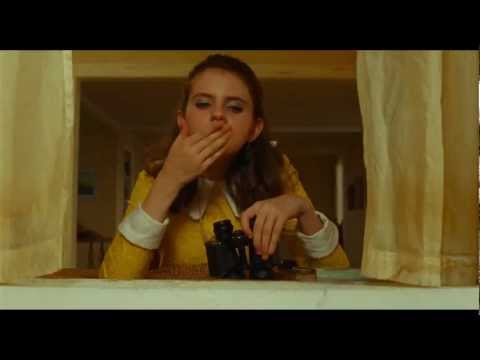
As we get to know Sam and Suzy, we realize that they feel much like that raven. Both are more mature than their peers (and many of the adults around them) but they are also, to borrow a phrase from a book Suzy’s parents unhelpfully leave lying out, “troubled.” Sam is an orphan growing up in foster care, strange, solitary. Suzy lives with her unhappily married parents, both lawyers (Frances McDormand and Bill Murray), and alternates between sullen silence and explosions of rage. She spends her days reading fantasy books about orphan heroines who realize they’re meant for other, more magical lands and watches the world through a pair of binoculars. “It helps me see things closer,” she tells Sam, “even if they’re not very far away.” For instance, she knows that her mother is having an affair with Captain Sharp (Bruce Willis), a local policeman.
After their first meeting, Suzy and Sam write to each other frequently and make a plan to run away together. Suzy lives on the small island of New Penzance, somewhere in New England. When Sam’s Khaki Scout troop comes to the island for summer camp, he and Suzy meet up in the wilderness and escape to a remote inlet. Sam and Suzy know there’s no place for them in the world they left behind; so they make their own.
Early in the film we see Suzy and her brothers listening to Benjamin Britten’s The Young Person’s Guide to the Orchestra, in which a young voice explains every instrument and how they work together in harmony. Harmony is exactly what our young heroes see missing in the world around them. Their peers are cruel and careless. Every adult they know either is woefully unprepared for, or completely abdicates, their responsibilities. Confronted with a difficult situation, Suzy’s father moans during a storm: “I hope the roof flies off, and I get sucked up into space.” Sam’s Bible-thumper foster parents wash their hands of him as soon as they hear he’s run away. Even the most well-meaning adults are ineffectual, like Captain Sharp and Scout Master Ward (Edward Norton). The people who are supposed to be keeping the world in harmony are letting it slip into disarray.
Sam and Suzy’s inlet is Edenic—including, it should be mentioned, some near nudity and largely innocent discovery of sexuality; the film is about young children, but might not be appropriate for them. But there’s a reason that the film refers more directly to Noah and the flood than the Garden. This isn’t the start of something totally new; it’s a do-over. Their paradise is a response to a broken world, an attempt to rebuild it from scratch without making the mistakes of the past. They’re following the dream of Suzy’s books: that, secretly, they were always meant for a better world than this one.
The dream fades eventually, just like childhood, just like summer. The old world intrudes, another paradise lost. But the love they shared is real, and powerful enough that it inspires even the defeated adults to regain their spirits, to reach for something greater. Because while Sam and Suzy’s escape might seem foolish to the adult mind, they’re really inspired by a deeper, more innocent kind of wisdom. It’s wisdom that we all had, once, before life’s struggles and disappointments buried it. But children and dreamers remember: Our place is not in this world. We were meant for somewhere else.
“Moonrise Kingdom” is available to rent or buy on Amazon Prime and Apple TV+.


 Politics
 Faith
Faith Culture
 Vatican
 Scripture
 Podcasts