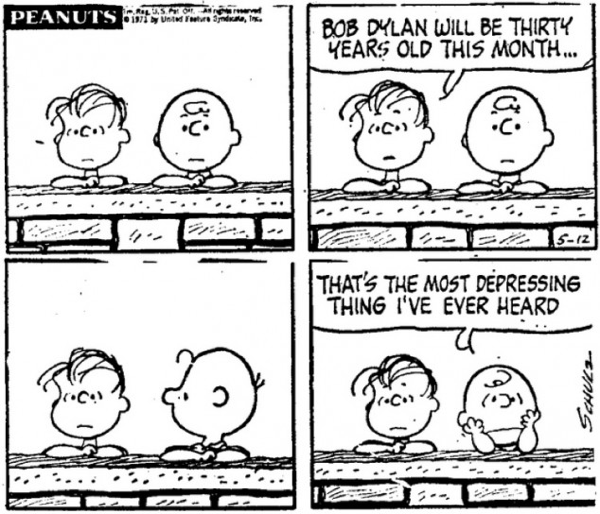
Fifty-five years ago this week, the world’s most popular comic strip, “Peanuts,” ran an iconic panel. It showed Linus (sans blanket) hanging out with Charlie Brown. Linus says, “Bob Dylan will be thirty years old this month.” Charlie Brown turns and looks at him, then replies bleakly, “That’s the most depressing thing I’ve ever heard.”
Bob Dylan did indeed turn 30—identified in American counterculture as the age after which no one could be trusted—the day the strip ran, May 24, 1971. Which means that this weekend, he’ll turn 85. He was so much older then; he’s older than that now.
Despite Dylan’s status as the nation’s premier songwriter (or is it Rodgers & Hammerstein?) and at times its national conscience—and the winner of the Nobel Prize for Literature—America’s engagement with him over the years was fairly scant, sometimes surprisingly so. For example, neither his antiwar ballads from the 1960s nor his Christian devotional songs from the 1980s earned much mention in the magazine. That is probably for the best: One can only deal with so many Jesuits and professors triumphantly closing a tedious article with “as the man says, ‘the times they are a’changin’.” 🥺
In the same vein, on March 11, 1967, America literary editor Paul K. Cuneo—it’s always the literary editor—remarked on the “teen-age culture, which is circumscribed by phenomena such as the Stones (Rolling, that is), shades (big sun glasses), the Lovin’ Spoonful, garrison belts, Dylan Thomas and epaulets.” Huh? Dylan Thomas had been dead for 14 years.
A few weeks later, a letter to the editor arrived with a quick question: “Can Bob Dylan be the name you are groping for?”
“No, no! We meant D. T.,” the editors doubled down. “The Times They Are a-Changin’ away from Bob.”
The thing is, they weren’t entirely wrong. Dylan (who, born Robert Zimmerman, long denied he had borrowed his stage name from Dylan Thomas) had vanished from the public eye eight months earlier after a famous motorcycle accident near his Woodstock home. But let’s be honest here: The editors also confused Bob Dylan with Dylan Thomas.
Three years later, the occasion of a perhaps ill-advised special issue of the magazine, “Youth ‘liberates’ America,” proved too much for them to resist. An introductory note included the following:
To listen to these young people is not to buy their ideas, any more than America’s opening its pages to their pens is a blanket endorsement of what they write. But listening is essential. For the aspirations of the young are a sign of the times, and, as Bob Dylan notes, “the times, they are a-changin’.”
Womp womp. These days, though, America has a number of editors and contributors who are eager to write about a Dylan whose words are not always part of the zeitgeist anymore, whom they don’t consider part of pop culture and whom they never knew as a young man. (In fact, I think the most clicked-on article I ever wrote was “Bob Dylan Is Not Dead,” entirely because for years it was the first thing that popped up when people searched “Is Bob Dylan dead?” on Google.)
Over the years, we’ve reviewed some of his books, including his autobiographical Chronicles: Vol. 1; a lot of books about him, including one sussing out scriptural references in his songs; a musical based on his lyrics; a movie tracing his rise to fame; and so much more. In fact, later this week, longtime America contributor and Dylanologist Rob Weinert-Kendt will review a new book on Bob Dylan and the Beatles.
Not all of the mentions over the years have been positive. The aforementioned review of Chronicles mentioned Dylan’s habit of treating his own audiences with something approaching contempt. And writing in praise of Frank Sinatra and Audrey Hepburn in 1998, America editor in chief George W. Hunt, S.J., wrote that because of Dylan, “not even singers needed good voices thereafter.” In 1978, an article on education quoted one man as saying his education “had been largely wasted because his teachers gave in to students’ demands for relevance and allowed history periods to be used for rap sessions about the works of Bob Dylan.”
And in 1996, a liturgist writing about the changes in parishes after the Second Vatican Council remembered Masses featuring “home-grown eucharistic prayers and creeds, tie-dyed chasubles, and”—you guessed it—“parish song books including texts to be sung to the tune of Bob Dylan’s ‘Blowin’ in the Wind.’” (He should travel a bit in Latin America these days; still a staple!)
But most of the time, the prophet was honored even in his own country. The scholar Grant Kaplan, writing in America last year, linked Dylan’s songs about Woody Guthrie—and his relationship with the musician in his dying days—to Kaplan’s own eventual understanding of what the communion of saints is all about. Another America contributor once wrote that though he had been raised Catholic, he first experienced transcendence by listening to Dylan’s music.
One of the best essays in the magazine on Dylan, by longtime contributor Damian Costello, came on the occasion of Dylan’s 80th birthday. Dylan, Costello noted, has had many different incarnations over the years: folk star, country musician, rock-and-roller, Christian evangelist, pop star, bar band creature and, through it all, curator of what Greil Marcus once called “the old, weird America.” Reflecting on that multifaceted career, Costello wrote:
Dylan’s longevity and repeated reinvention means he stays with you. The search for dignity often doesn’t turn out the way you hope. Youth fades—and you are hurled into other paths. Dylan doesn’t disappear—but shapeshifts you into another form for each new stage of the journey. This world might feel like a series of dreams—but Dylan reminds you: You hold cards from another world. The end of a road doesn’t mean the end but a rebirth, the often painful shedding off of one more layer of skin.
When Dylan did finally accept his Nobel Prize for Literature in 2016 (to the surprise of no one, he was a jerk about it and emailed the committee his acceptance speech, part of which he was later accused of plagiarizing), one of the formative texts he reflected on was the “Odyssey.” In a reflection that was otherwise often understated and dry, it was the short time when Dylan was speaking of the journey of many-wiled Ulysses that he was at his most eloquent—perhaps because he seemed to be talking about himself:
In a lot of ways, some of these same things have happened to you. You too have had drugs dropped into your wine. You too have shared a bed with the wrong woman. You too have been spellbound by magical voices, sweet voices with strange melodies. You too have come so far and have been so far blown back. And you’ve had close calls as well. You have angered people you should not have. And you too have rambled this country all around. And you’ve also felt that ill wind, the one that blows you no good. And that’s still not all of it.
A few minutes later, Dylan concluded his speech with Fitzgerald’s translation of the famous first line of the “Odyssey,” a few short words that also capture Dylan’s career in a way:
I return once again to Homer, who says, “Sing in me, oh Muse, and through me tell the story.”
Happy birthday, Bobby Zim. I don’t trust anyone over 30. Under either.
•••
Our poetry selection for this week is “One” by Julia Alvarez. Readers can view all of America’s published poems here.
Other recent Catholic Book Club columns:
- ‘Gaudium et Spes’ and the optimistic final days of Vatican II
- Remembering Cyprian Davis, a giant of Black Catholic history
- Michael Harrington, the ‘pious apostate’ who championed socialism in America
- Phyllis Trible, who challenged our image of God as male or female
- Trump, Pope Leo, William F. Buckley and John XXIII
Happy reading!
James T. Keane


 Politics
 Faith
Faith Culture
 Vatican
 Scripture
 Podcasts