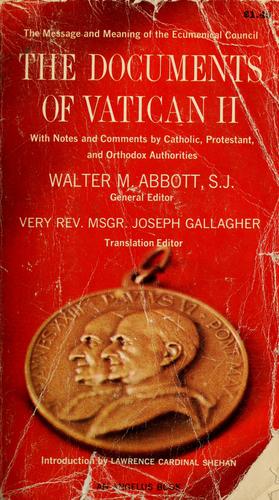
When the Second Vatican Council formally ended on Dec. 8, 1965, theologians and scholars immediately undertook a new (and ongoing) task: interpreting the council and providing the faithful with the texts in translation and with commentary. Barely a month went by before the first such compendium was announced at the beginning of 1965: The Documents of Vatican II, published by America Press. Its red cover, featuring a picture of a coin with the profiles of Pope John XXII and Pope Paul VI, remains instantly recognizable to Catholics of a certain age, and battered original versions (America Press didn’t splurge on quality paper in 1966, to say the least) still hold pride of place on many a Catholic shelf today.
The compendium, with an introduction from Cardinal Lawrence Shehan, offered commentaries after each translated Vatican II document, but from a surprisingly ecumenical variety of sources, some of them daring for the time. The subtitle told the tale: With Notes and Comments by Catholic, Protestant, and Orthodox Authorities. The editor was a 43-year-old American Jesuit who just three years before had been an associate editor of America: Walter M. Abbott, S.J.
Though The Documents of Vatican II remains Father Abbott’s signature achievement in the eyes of many Catholics, the publication was just one moment in a lifetime of notable work on behalf of the church and the world in fields ranging from Scripture, ecumenism, racial justice and spirituality.
Father Abbott was born in Somerville, Mass., in 1923, one of five children. After attending Boston College High School, he entered the Society of Jesus in 1941. After many years of training and several years as a teacher, Father Abbott was named an associate editor of America in 1957. He wrote often on Scripture, especially in book reviews, with a special interest toward ecumenical approaches to the Bible (including a 1960 article on reading the Bible in public schools co-authored with Robert F. Drinan, S.J.).
Father Abbott played an unexpected role in the development of America that his training surely had not prepared him for. Editor in chief Thurston N. Davis, S.J., asked him in the early 1960s to head up efforts to find a new residence and office for the magazine, then located at West 108th St. in Manhattan. A real estate agent called him with news of a dumpy former fraternity house and hotel on West 56th St., a nine-story building with 45,000 square feet of space. Father Abbott undertook the task of fundraising for the new community, finding a generous benefactor in Cardinal Richard Cushing of Boston, who funded much of the purchase of America House, where the editors of the magazine would live and work for the next five decades.
Father Abbott was also an outspoken opponent of segregation and a regular speaker on racism in the early 1960s. After the great pioneer for racial justice, John LaFarge, S.J., died in 1963, America established the John LaFarge Institute in his honor to work for racial progress. Father Abbott was named its first director. That same year, speaking at a civil rights Mass in New York on the first official feast day of the newly canonized St. Martín de Porres, he told the congregation that the canonization of the Peruvian saint was “the Church’s infallible answer to racists who would be Christians.”
In 1962, Father Abbott later told an interviewer compiling oral histories from New England Jesuits, he published an article in America on ecumenism and the Bible. It attracted the attention of Cardinal Augustin Bea, S.J., a prominent figure in ecumenism and interreligious dialogue at the council, who “put the topic on the agenda of the council and included the article among the preparatory material for the council’s document on divine revelation,” according to America associate editor Dennis Linehan, S.J., in a 2008 article. “The upshot was that he was called to Rome to be on Cardinal Bea’s staff and to be part of the efforts of the council, often sitting next to John Courtney Murray, S.J., in the council assembly in St. Peter’s.”
After the council and at Cardinal Bea’s urging, Father Abbott became the executive secretary of the Office for Common Bible Work at the Secretariat for Christian Unity (now the Dicastery for Promoting Christian Unity) at the Vatican, a position he would hold for more than a decade. In 1967, he undertook a worldwide fact-finding tour to see how the council’s “Dogmatic Constitution on Divine Revelation,” “Dei Verbum,” was being implemented and to study chances for ecumenical Scriptural work with other Christian churches.
Among Father Abbott’s proudest accomplishments in his time at the Secretariat for Christian Unity was his work organizing an unprecedented meeting in 1971 between Pope Paul VI and W. A. Criswell, the president of the U.S. Southern Baptist Convention. Both leaders endured flak from more suspicious compatriots—some of Dr. Criswell’s fellow Baptists accused him of apostasy—but the meeting made headlines in the religious press around the world.
In 1977, Father Abbott’s colorful life story gained another wrinkle. Two years previous, he had fallen down a marble staircase in Rome and fractured his skull; a resultant brain hemorrhage caused him to lose sight in his left eye. After he and many Jesuit confrères prayed for the intercession of Kateri Tekakwitha, the famous “Lily of the Mohawks” whose cause for sainthood had long been associated with the North American Jesuits, he regained sight in the eye two years later.
Father Abbott considered the cure miraculous, and turned his medical documentation and personal testimony over to the Sacred Congregation for the Causes of Saints in Rome. St. Kateri Tekakwith was beatified three years later in 1980, and was canonized by Pope Benedict XVI in 2012.
Long after his time in Rome, one of Father Abbott’s assignments was as a spiritual father at the Boston novitiate of what was then the New England Province of the Jesuits in the 1990s. “He was a kindly presence in the novitiate,” wrote America editor at large James Martin, S.J., in a 2008 remembrance upon Father Abbott’s death, and was always telling stories “of his days working at a frenetic pace with his magnum opus, his interactions with various church personages, and his time at America.”
Father Abbott died on March 2, 2008, at Campion Center, the Jesuit retirement home in Weston, Mass. America still offers his famous compendium of Vatican documents as an ebook, though there are those among us who still treasure our battered old red paperbacks.
•••
Our poetry selection for this week is “Kateri Tekakwitha,” from 1939, by Walter J. Ong, S.J. Readers can view all of America’s published poems here.
In other news, we still have a few spots left for our pilgrimage to Ireland in April 2026. Led by myself and America editor in chief Sam Sawyer, S.J., the trip, “The Land of Saints & Scholars: A Journey into the Heart & Soul of Ireland,” will be from April 19 to 28, 2026. We promise a lot of spiritual insights and a lot of absolute blarney.
In this space every week, America features reviews of and literary commentary on one particular writer or group of writers (both new and old; our archives span more than a century), as well as poetry and other offerings from America Media. We hope this will give us a chance to provide you with more in-depth coverage of our literary offerings. It also allows us to alert digital subscribers to some of our online content that doesn’t make it into our newsletters.
Other recent Catholic Book Club columns:
- Monika Hellwig and the vocation of the theologian
- Father Georges Lemaître and the Big Bang
- The patron saint of undergraduate philosophers: Frederick Copleston
- Jerry Garcia and the Grateful Dead’s reluctant spiritual ministry
- Anne Carr, the ‘founding mother’ of Catholic feminism in academia
Happy reading!
James T. Keane


 Politics
 Faith
Faith Culture
 Vatican
 Scripture
 Podcasts