

 This month, on newsstands and in bookstores, you’ll find a terrific new book, which I highly recommend. To coincide with the centennial of the birth of Mother Teresa, Time has published Mother Teresa at 100: The Life and Works of a Modern Saint.
It’s a fantastic introduction to her life, written by the veteran religion reporter David Van Biema, and includes an unlikely but moving introduction from the mega-pastor and bestselling author Rick Warren. Filled with gorgeous full-color photographs spanning her life, the book is that rare combination of a great read and a beautiful look. It’s perhaps the best short introduction to the life of the “Saint of the Gutters” around.
There’s just one tiny problem. In the middle of an essay called “Teresa of Jesus,” about her entrance into a religious order, her life as a Catholic sister, and her amazing spiritual experiences, you’ll stumble upon a surprising sentence:
For the vast majority of sisters, brothers, and priests, a “call” manifests itself as a simple heartfelt desire, much as someone else might be attracted to the life of a physician or a lawyer. Yet a call to become a Catholic sister does imply a somewhat higher level of commitment.
That means that being a Catholic sister is a “higher calling” than being a physician or a lawyer. And that’s something that I categorically reject.
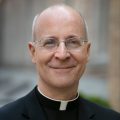
Ironically, that sentence comes in an essay authored by “Father James Martin, S.J.” I could say, “Reader, I wrote that,” but that would be false.
Apparently, an overzealous soul, after reading my comment about the “call” being similar in many lives, added the notion of the “somewhat higher level of commitment.” By the time I spied what was probably thought to be a benign addition, it was too late. The hardcover edition had already winged its way to the printer.
The irony is that this is not only something that I don’t believe (and have written about at great length in several books); it’s also something the Catholic Church doesn’t believe in. Since at least the Second Vatican Council, which convened in the 1960s and stressed the “universal call to holiness,” Catholics have been reminded that everyone has a vocation. Everyone’s call is to be holy — no matter who you are.
To be blunt, that means that the work of a Catholic sister is no holier than the work of your sister — who might be a mother, a lawyer or a physician. (Or all three.) That doesn’t mean that your sister is necessarily a saint, but that she could certainly become one!
That’s not to detract from the manifest holiness of Mother Teresa, who I consider to be one of the greatest saints ever. (She vaults into that category because of her unshakeable fidelity to her call even in the midst of her “dark night” of prayer, when God felt absent to her for years and years.) Rather, it’s to remind people that the young mother who wakes up in the wee hours of the night to care for her child is every bit as saintly as the Catholic nun who spends hours and hours teaching children in an inner-city school.
Your own mother might be just as holy as Mother Teresa.

 Politics
 Faith
Faith Culture
 Vatican
 Scripture
 Podcasts