


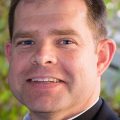
South African Cardinal Stephen Brislin has slammed President Donald J. Trump because of his comments about Pope Leo XIV, saying that the “Catholic Church should never be a platform for political theatre.” The archbishop of Johannesburg and president of the Southern African Catholic Bishops’ Conference said in an op-ed for the South African online news source Daily Maverick on April 13 that attacking “the sanctity of the church and the papacy, and the deeper moral vision they represent, is not acceptable and cannot be met with silence.”
The cardinal, responding to Mr. Trump’s attack on the U.S.-born pope, added, “While the church does not seek quarrels with political leaders, neither can we remain silent when innocent people are being killed on immoral grounds, and when political players make bad decisions.”
He said that Mr. Trump is “entitled to his views,” but went on to warn that “with influence comes responsibility. Words shape not only opinions but also the moral climate in which societies live. When public discourse descends into caricature or hostility, it erodes the very possibility of genuine dialogue—the kind of dialogue our fractured world so desperately needs.”
“The church does not ask political leaders to agree on every matter. We do, however, call upon them to engage with truthfulness, seriousness, honesty and respect for others and human life itself,” he said.
Cardinal Brislin also issued a letter on April 14 along with the other bishops of the S.A.C.B.C. to express the conference’s displeasure with Mr. Trump’s comments and to “reaffirm our communion with Pope Leo and with his concern for the rights and well-being of migrants, of the victims of war, and the immorality of bowing to the false gods of power and money.”
The bishops added: “We are grateful to the Holy Father for his fidelity in proclaiming the Gospel and we support him as he prophetically speaks truth to power. We too, with Pope Leo, urge all people, especially the perpetrators of war, to listen to the cry of the children and heed the pain of those suffering from the violence.”
This is not the first time Cardinal Brislin has called out the president of the United States. Late last year, in response to the president’s insistence that white Afrikaners were being targeted and that the United States would offer them asylum, Cardinal Brislin said that there was no white genocide taking place in South Africa. “President Trump has his reasons for adopting this rhetoric, despite all evidence to the contrary,” he said then.
Cardinal Brislin knows what it means for the church to speak truth to power and the possible consequences. The headquarters of the Southern African Catholic Bishops’ Conference in Pretoria was bombed by the government in October 1988. The bombing was carried out by the apartheid security police in an act of intimidation meant to silence the church’s vocal opposition to the regime.
He has, in recent years, praised the church’s collective stand against apartheid and said that its courage has been insufficiently recognized. Cardinal Brislin, who grew up during South Africa’s apartheid regime, has spoken of the “terrible days” of discrimination, exclusion and oppression the church faced in South Africa, as well as the attacks endured on Catholic education and Christian principles. He is often a voice encouraging nation-building and reconciliation in a country that carries the deep wounds of apartheid.
Cardinal Brislin, who was one of the cardinal electors who elected Pope Leo XIV last year, also refuted Mr. Trump’s assertion that Leo was elected because he was American and because President Trump was in the White House.
“The one thing I can attest to is that those of us gathered in the Sistine Chapel did not consider any particular political leader as a factor when we elected the Holy Father. Nor did we consider the nationality of the future pontiff.”
“Under the guidance of the Holy Spirit,” he said, “we elected the person who was best suited to become head of the church, who could best respond to the era we live in, and who would best serve all the peoples of the world.”
According to Cardinal Brislin, since then, Leo has demonstrated that he has been the right choice through his advocacy for the church’s position on issues that beset the world: how migrants are treated, climate issues, the need for truth in an era of artificial intelligence and disinformation and the pope’s opposition to violence and war.
“These are not the pope’s personal positions. It is the stance of the Catholic Church as a whole that we all represent and defend,” he said. “The papacy is not merely an office of governance. It is a witness.”
“From the Apostle Peter to the present day, the bishop of Rome has been called to speak to the conscience of the world—uncomfortably, often prophetically. And that witness has never been contingent on political approval,” he said. “Indeed, the gospel most often unsettles those who wield power.”
The cardinal pointed out that the church has endured emperors, revolutions and ideological storms, and it will endure this moment, too. But, he says, “endurance is not the same as indifference.”
Cardinal Brislin said that sharp criticism has its place in a free society. He alludes to times when the church has endured strong critiques, noting that, at times, they were warranted. The church “has benefited from criticism and scrutiny,” he said. The cardinal insisted that “what is at stake here is not a policy or political disagreement, it is the temptation to recast moral teaching as partisan provocation.”
He warned that the pope never advances a political agenda, but, as a shepherd, when speaking about the dignity of migrants, the demands of justice or the responsibilities of nations toward the vulnerable, “is articulating principles rooted in the Gospel and with concern for those whose voices are often not heard.”
Cardinal Brislin expressed his hope that there will be a “rediscovery of civility” and a “renewed commitment to the common good and peace.” He said that “beyond politics lies a deeper question, one that confronts every leader and every citizen alike: How do we achieve peace and the moral reset that our world so desperately needs?”

 Politics
 Faith
Faith Culture
 Vatican
 Scripture
 Podcasts