


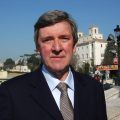
“The pope is coming home, among his own people, and I imagine his heart is full of joy, too,” Lizardo Estrada Herrera, the new Augustinian archbishop of Cuzco, told America in an interview in Spanish and by email on the eve of Leo XIV’s visit to Peru.
“The pope’s arrival has brought joy and hope everywhere, and although there are differences in the country, at this moment Peru is united, like one big family awaiting the pontiff: a brother, someone who knows its reality,” the archbishop said. “Everyone wants to hear him; they want his blessing for their families, their work and their future.”
Originally from the Cotabambas Province in the Apurímac highlands region of Peru and of Quechua origin, archbishop Estrada Herrera, 53, has been close to Robert Prevost even before he joined the Augustinians. “He was a brother, a friend and a guide,” he said. America has learned that Prevost taught him to drive, and he remains close to him today.
Estrada Herrera became the new archbishop of Cusco on Oct. 30, when his predecessor, Archbishop Richard Daniel Alarcón Urrutia, died after a long illness on the eve of the pope’s visit. Pope Francis named Estrada Herrera auxiliary bishop of Cusco in 2021, and Leo appointed him co-adjutor on Aug. 29, so the succession was automatic. He has been secretary general of the Latin American and Caribbean Episcopal Council since 2023.
This transcript has been edited for length and clarity.
As an Augustinian, you have known Robert Prevost for many years. When and where did you first meet him?
Father Robert helped me a great deal as I discerned whether to enter the Order of Saint Augustine. After I entered the seminary and studied philosophy in Apurímac, and as soon as I had finished the novitiate, I went to Trujillo to study theology. When I arrived, Father Prevost was in charge of formation; this was in 1996–97. What I remember of those years is that there were many of us from many places (Iquitos, Chulucanas, Piura, Cusco, from all over Peru) studying and each going deeper into his own vocation. Father Prevost was my teacher and director of studies, and at the same time, a committed pastor serving as a parish priest. Most of all, he was a brother, a friend and a guide. He listened: always, and with great attention. He made a point of knowing how each of us was doing. And I particularly remember his patience. We traveled together to several cities around the country. He urged us to be good missionaries, good pastors, good brothers; he sought the integral good of the seminarians. Father Prevost always encouraged everyone, like a close older brother.
How would you describe Robert Prevost?
As an Augustinian friar, deeply committed to and steeped in the teachings of St. Augustine. His life bore witness to the Augustinian call to tend the interior life, to pray and to commit oneself to the good of one’s neighbor.
The witness of his life showed that prayer leads us to find God not only in our own personal search, but also in living alongside the poor, the sick, the elderly and prisoners: the most vulnerable.
Prevost is someone who listens without prejudice, and who always seeks the good of everyone. The most important lesson that has stayed with me, though, is something he always told everyone: “Wherever you go on mission, find God in the poorest people by listening to them.”
Were you surprised that Cardinal Prevost was elected pope?
Yes, I was surprised, like everyone else, because at first no one thought he was on the minds of the cardinal electors.
I am convinced that the election of the Holy Father is, first and foremost, the fruit of the Holy Spirit’s inspiration in the conclave. At the same time, I have to say that, in hindsight, he certainly had a very significant record of service in the universal church.
Has your relationship with him changed since he became pope? If so, how?
My relationship with Father Robert, now Leo XIV, has always remained alive, through many moments and circumstances. As secretary general of the Latin American and Caribbean Episcopal Council, I was received by him in audience several times to discuss various matters. Our mutual trust has endured, and I have been honored with several appointments during his pontificate: as a member of the Dicastery for Promoting Integral Human Development and of the Dicastery for Communication.
How would you describe the current political, economic and social situation in Peru today? And in what ways has it changed most since Robert Prevost left the country in 2023?
Peru is a country where poverty persists, affecting about a third of the population, especially in the Andean and Amazonian regions. It is a country where democracy is fragile; education has not reached every part of the country; health care is poor or almost nonexistent in the highest and most remote regions; there is a great deal of corruption and far too much polarization in politics; and we need to strengthen care for our common home in the face of climate change, extractivism and the illegal economies that run rampant.
As for the political climate, President Keiko Fujimori won by a very narrow margin, so the country remains polarized. There is no violence in the streets, but there is rampant insecurity that the government has been unable to control. Congress recently granted the executive legislative powers. This has led to a significant drop in public approval of the government’s performance, as well as that of the bicameral Congress.
The pope will find a nation with its sufferings but also its hopes, where faith and popular piety run deep, and where solidarity among the poorest, reciprocity and resilience are part of daily life. People here do not face difficulties and problems passively; they want to move forward and forge a path to development through solidarity.
How would you describe the religious situation in Peru today, and what are the main challenges facing the Catholic Church?
First, there is great popular devotion, expressed in many forms, and this devotion is something that unites the country. In the south, for example, huge processions or pilgrimages take place once a year, even if many of those who take part may not go to Mass every Sunday. For people, the church is an institution they trust. They feel its closeness and value its social works in education and health care. But above all, they regard it as a place of listening, of hope and of prayer, with a family spirit. The ideal we aspire to does not always match what we really are, and in some cases, harmful content spread on social media shapes how people think. Even so, there is a great deal of hope that we can move forward, and that is why we need to form consciences, people’s critical thinking and their commitment to fraternity and solidarity.
Despite its mistakes, most people believe in the church, listen to and value its teachings and, in many places, take part in annual religious celebrations, with their traditional dress, songs and their own dances. A relationship with God clearly exists, and people take part in social ministry, yet there is still little prayer. We need to pray more and to deepen the preferential option for the poorest, our solidarity with them and our care for our common home.
The church has also been confronting the abuse that has sadly occurred; the church is faithful to the pope’s call for “zero tolerance” of abuse. There is an effort to shape a national pastoral plan grounded in the synodal coordination of the various specific ministries.
What are you hoping for from Pope Leo’s visit to Peru?
Expectations are high, and people have been preparing for the pope’s visit.
In pastoral terms, too, the bishops’ commissions and ecclesiastical jurisdictions have been preparing spiritually, studying some of the pope’s addresses as well as the apostolic exhortation “Dilexi Te” and the encyclical “Magnifica Humanitas,” to understand his thought and his message better.
The pope is coming home, among his own people, and I imagine his heart is full of joy, too. At the same time, I think back to the road I have traveled with him: as a seminarian, in my priestly formation and later as a bishop. I am very happy to be able to meet him again and to hear in him the voice of God telling us how to face today’s challenges in Peru, Latin America and the Caribbean; how to hear and respond today to the cry of the earth and the cry of the poor; how to promote unity at every level; and how to be builders of peace and of integral human development.
During his visit, Pope Leo will surely emphasize the unity of the church and of all Peruvians, men and women, so that we may be builders of an unarmed and disarming peace.
With that in mind, I believe the pope will urge us bishops to carry forward the legacy of St. Toribio de Mogrovejo, who traveled to the most remote and difficult places, always concerned for the most vulnerable.
In his meeting with the bishops, Pope Leo XIV urged them to live a real and heartfelt communion among pastors, and between them and the people of God, overcoming divisions, self-promotion and every form of isolation.
I believe he will insist on simplicity, courage and total openness to being led by the Lord, guided by the commandment of love, and on making the heritage received from Sts. Toribio, Rose, Martin and John Macías, among so many others, bear fruit in the church in Peru today. Let us remember that when Pope Francis visited Peru in 2018, he called it a “land of saints.”
Without a doubt, the pope’s words, his visit and the events we will share with him will give us fresh evangelizing momentum. We are called to draw up a program of integral mission and pastoral ministry in response to the realities that challenge us, such as migration, poverty and corruption, but also solidarity. His presence will be very important, because he is our shepherd and our guide. He will help us stay united and give us direction on how to orient ourselves toward the common good and the building of peace with justice; how to improve the formation of priests, bishops and laypeople; and how to be a church that goes forth, a poor church for the poor, caring for people and for creation.

 Politics
 Faith
 Culture
 Vatican
 Scripture
 Podcasts