


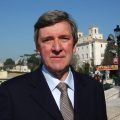
Cardinal Blase Cupich, the archbishop of Chicago, said he was “shocked” when the Vatican broke the news on Tuesday evening, Oct. 13, that Pope Leo XIV was diagnosed with lung cancer.
But he told America in this interview that he is now “confident” that the Chicago-born pope can quickly recover from this setback because of recent advances in cancer treatment and Leo’s good physical condition. Moreover, he thinks that after recovery, the first American pope will have even greater credibility among the people because of this experience of fragility.
The cardinal, who is close to Pope Leo, said this in an interview with America on Wednesday evening, Oct. 14, after the “Amoris Laetitia” meeting on the family had concluded in the Vatican.
The following transcript of the interview has been edited for length and clarity.
You came for the “Amoris Laetitia” meeting at the invitation of Pope Leo, but he was the big absentee at that meeting, and we now know that it was for health reasons. The doctors said he has cancer. Are you worried?
He was there for the first day, Oct. 7, so we did see him then. I guess my first reaction when I heard the news was shock because he is so fit, he is in good condition, so you never would think that he was suffering from this. And yes, I am concerned, because anytime someone has cancer, we know that it can go in different ways.
I know the people in Chicago are very concerned. I gave a couple of interviews this afternoon as a means of just comforting people and asking them to continue to pray. We are now waiting for more [medical] reports to come. I applaud the Holy See and the Holy Father for the transparency that they have shown in this moment.
You are the archbishop of Chicago, his hometown and birthplace. Have you had contact with him recently?
The night before he went into the hospital, I sent a message to him that we will be praying for him, and he thanked me for that.
It seems that with this sudden surprise, a new phase of the pontificate begins. We all believed that after Francis, and that last very fragile year of his pontificate, we now have a fit pope who does sports and is very active. We thought we would have a long pontificate. How do you see this new phase of Leo’s pontificate? Do you think this will change his way of governing?
I think it depends on what the prognosis is after they get more results from the tests. I am told that this kind of cancer is common and very treatable and that they have developed ways to treat it so that it doesn’t become a factor in compromising the longevity of someone’s life.
I think we just have to wait and see. I believe that his good physical condition is a plus at this moment, and my hope is that he’s going to be able to turn the corner on this, and then he can go on from there.
We learned from the biography American Pope [by Scott Detrow and Daniel Burke], and from other sources, too, that the pope’s father, Louis, and his mother, Mildred, had cancer before they died, and we also know that his elder brother, Louis, is being treated for myeloma, also a type of cancer. So isn’t this genetic factor worrying in Leo’s case?
I think it is a factor, and maybe that was why tests were done, to make sure that he was not a subject of that kind of illness. Maybe that’s why they did more tests on him, because they were concerned about his family history. I don’t know that. At the same time, we know there are really important developments for treating cancer. And I know that he has confidence in his medical team here [in Rome].
At the beginning, we all thought that he was having this operation now because his intention is to do this trip to Uruguay, Argentina and Peru from Nov. 6-17. But it seems now that he did it so quickly because there was really a suspicion that it was a malignant tumor. Do you think he will be able to do this trip?
My reading of the situation is that the decision will be made on whether he can fly, because if the compression of air and the altitude in some way compromise his ability to breathe, then I think a decision would be made on the basis of that.
He has a total of 14 flights in three countries, including two by helicopter, in 12 days. It’s a very demanding trip and scheduled to start on Nov. 6—that is 24 days from now! Do you think they will postpone it?
I think he would be disappointed if he could not keep the schedule. I have no inside information on whether they’re going to postpone it. I think they’re going to pay attention to the doctors.
We all knew Pope Francis was, let’s say, a rebellious patient. Can we expect Pope Leo to be more obedient?
Yes, he’s going to be [more obedient]. He’s an objective thinker. He respects science. He’s a mathematician. He knows there are consequences to actions. So he will be very disciplined, and he will pay attention to his doctors. If his doctors say, “You should not make this trip,” I think that he will go along with that.
When you read the medical report released by the Vatican last night announcing the cancer diagnosis, what was your reaction?
I found it shocking.
Were you more shocked by that medical bulletin or by his announcement at the Sunday Angelus?
With the bulletin, because at the Angelus, he downplayed it a bit. He said it was small, it was localized, contained, and that they were just going to take it out. But then when I heard they took out part of the lobe of the lung and that it was malignant, that was more shocking and more concerning. I could feel that in the audience hall today [where the “Amoris” meeting was taking place] when we were visiting with each other, there was genuine concern about the health of the Holy Father. I think people are very concerned and even worried about this but hoping for the best.
People now see that because he has cancer, Pope Leo, too, is fragile like everybody else. Do you think they will feel that he’s very much one of them now?
Every family knows someone who is suffering in some way with cancer or with other kinds of debilitating illnesses and diseases. So, yes, I think to see that the pope identifies with their families is going to draw them closer to him.
As one journalist already pointed out, many times when people have setbacks in health or in some other way, and they overcome them, that strengthens their position and makes them even more acceptable to people and credible as an individual who can speak in a way that’s going to have credibility with people. And that could happen as well.
The pope, we hope, is cured of this illness. I believe that once that happens, he will be in a stronger position to relate to people simply because he has gone through this trial.

 Politics
 Faith
Faith Culture
 Vatican
 Scripture
 Podcasts