


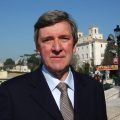
In this exclusive interview with America, Archbishop Timothy Costelloe, S.B.D., president of the Australian Catholic Bishops Conference, spoke about the challenges facing the church in Australia—and in particular about building structures and changing the culture to eliminate sexual abuse, and its commitment to being a synodal, missionary church in a country where multiculturalism, social cohesion and improving the situation of its aboriginal peoples are all works in progress.
The 72-year-old Costelloe, a member of the Salesian order of Don Bosco, has been archbishop of Perth in Western Australia since 2012. Earlier this year he was elected for the third time as president of the Australian Bishops Conference.
He granted me this interview at the archbishop’s residence in Perth, where John Paul II stayed during his 1986 visit to Australia, and where I met the archbishop together with my wife Elisabetta Pique during our visit to Australia in August at the invitation of the University of Notre Dame Australia’s Global Center for Catholic Leaders.
As archbishop, he leads “a very big diocese geographically speaking.” He said, “It takes me seven hours to drive from the center of Perth to the furthest parish in the diocese, and technically, that would only be halfway across the diocese because the diocese goes right to the South Australian border, but there are only kangaroos on the far side of the other city—Kalgoorlie, a big rural center in Western Australia—and east of that there are some scattered farms.”
Some 20 percent of Australia’s 28 million people are Catholic, and the same is true of Perth. The archdiocese has some 500,000 Catholics, served by 150 priests in 100 parishes. The religious orders of women “have been very significant in this archdiocese and in Australia generally,” he said. He mentioned the Josephite Sisters of St. Mary MacKillop, the Good Samaritan sisters, the Presentation sisters, the Mercy sisters and the Dominican sisters. “They have done extraordinary work, but their numbers now are diminishing and many are quite elderly.”

He recalled that one of the Josephite sisters from Western Australia, Irene McCormack, R.S.J., was executed after a sham trial, along with four Peruvians, by the communist Sendero Luminoso (Shining Path) guerilla movement in Huasahuasi, a remote mountain village in the Peruvian Andes on May 21, 1991. Her murder, for working with the poor, had a big impact on the Catholic community and people of Western Australia, he said.
As metropolitan archbishop, Archbishop Costelloe’s mandate extends to the Diocese of Broome, where the former bishop, Christopher Saunders, was recently found guilty of 13 sexual abuse offenses against two young Aboriginal men and is awaiting sentencing. The archbishop described the situation as “challenging” and recalled that following the church’s protocols in Australia, the church investigation of the case then underway was “put on hold” when the police investigation started, so as not to compromise the latter. He informed the Vatican offices involved about the trial’s outcome, and presumes the church investigation will resume after the sentencing, unless Bishop Saunders appeals the verdict.
Synodal leadership
Archbishop Costelloe has played a leading role in promoting synodality in the church in Australia, first as president of its plenary council (October 2021 and July 2022), and subsequently in assisting the Vatican prepare for the synod on synodality (2023-2024), to which Pope Francis appointed him as one of its presidents. He is now engaged in its implementation as president of the conference and an elected member of the synod council.
Questioned about the role of lay people in the church, he said, “The involvement of lay people in the church in Australia has been very significant for a long time, particularly in areas like education, healthcare, and social outreach.” As archbishop, he has promoted lay people in Perth, and in July 2025 appointed Daniel Lynch, a married layman, as chancellor and C.E.O. of the archdiocese. Moreover, he noted, “Melbourne archdiocese has a laywoman as chancellor, and the same is true in Sydney.”
He highlighted the fact that “the promotion of laypeople was already happening in the church in Australia before the synod on synodality and was given a boost by the plenary council.” When I asked about the followup to that council, the first one held in Australia since 1937, he said he sent “the final acts” to the Dicastery for Bishops for the Holy See’s “recognition” but still today, three years later, that has not yet come. He intends to raise the matter when he goes to Rome in October.
I asked Archbishop Costelloe what he identifies as the main issues facing the church in his homeland. “One of the main challenges and projects that the whole church in Australia is engaged in is precisely this transformation into a more synodal missionary church. That’s what the plenary council called us to do, and it’s what the universal synod called us to do,” he said.
He added, “Australians tend to be a very practical sort of people, so we haven’t yet created massive structures around this synodal journey but in each diocese; the bishops are reading the situation in their own context and responding appropriately.”
Indeed, “there would be very few dioceses in Australia who since the Plenary Council and the Synod on Synodality haven’t had diocesan assemblies or diocesan synods or other formal processes in order to try and engage more broadly and deeply the whole people of God.”
Antisemitism and social cohesion in Australia
A second issue is the fact that “we’re in the midst of a Royal Commission on Antisemitism and Social Cohesion,” he said. The commission was established following “the terrible tragedy of the antisemitic massacre in Bondi Beach, Sydney,” on Dec. 14, 2025, in which 15 people and one of the terrorists were killed, and some 40 wounded. The issue is “big” for the Catholic Church, he said, “because the Jewish community in Australia, and certainly in Perth, would see the Catholic Church as one of their key natural allies.” Although the Jewish community is small (according to the 2021 census, there were 116,967 Jews in Australia and 6,347 in Perth), he said it has “contributed enormously to the cultural and legal life of the country.”
Given that there are 250,000 Lebanese (mainly Maronite but also Melkite Christians) and between 15,000 and 50,000 Palestinians in Australia, I asked if the Catholic Church here was also giving attention to the dramatic situation in Lebanon, Gaza and the Holy Land—an issue some had raised with me during our visit. The archbishop replied: “At the moment, I think the church, like the rest of our society, is particularly focused on antisemitism because of the horrors of this terrible massacre. Australia is facing a significant problem with antisemitism, and so that has become a major concern for us, but it’s not that we’re ignoring anything else.” Indeed, he said, “the Christian Middle Eastern presence in Australia is very strong, and we are sensitive to what is happening in their homelands.”
The 2021 census recorded that there are 813,392 Muslims in Australia, and the census just taken is expected to show there are more than one million. I asked the archbishop about their situation here: “Generally speaking, I think Muslims are well respected and well-integrated into our society but again, this is where issues overseas can get imported into Australia, and this is where a lot of unease comes from.”
Multiculturalism
During our visit to Notre Dame University in Fremantle, a port city near Perth, we learned that it is becoming more difficult to get visas—not only for migrants but also for foreign students. “The whole issue of multiculturalism here in Australia has become another big political topic. There are some in the political sphere who are using the issue of migration and refugees coming to Australia to promote certain political positions,” Archbishop Costelleo said. “I think the first thing to say is that we’ve always been a country from the time of European settlement that has had people from all around the world forming part of Australian society. There’s nothing new about that.”
After the Second World War, there was “massive migration” to Australia from Eastern Europe and other parts of Europe, including Italy, he said, and after the Vietnam war, large numbers of Vietnamese came to Australia. “We’ve always prided ourselves in Australia at being able to manage this very successfully, and in general we have. I think it’s partly why the Royal Commission is not just about antisemitism, it’s also about social cohesion and making sure that as we continue to be a country that welcomes people from everywhere we continue to do our best to help them to live with deep respect for each other.”
Archbishop Costelloe avoided using the word “integration” because he felt it has become somewhat politicized; he preferred “to talk about the fact that we live with deep respect for each other, even though we might come from different cultural backgrounds, different religious backgrounds; you know, that’s the nature of Australia.” He added, “we often talk about tolerance, but a good friend of mine—the retired chief rabbi in Perth—often said to me, ‘Tolerance is not enough. What we need to be developing in Australia is respect for each other.’”
Asked how he viewed relations between the Catholic Church and the government in Australia, he said, “Generally speaking, there’s a deep sense of the proper distinction between church and state in Australia and the church is free to be itself, but from time to time, issues do arise.” He cited issues like abortion, voluntary assisted dying and others “where the government makes policies which we would see can tend to curtail the freedom of Catholics to practice their religion freely.”
Indigenous poverty
Since Australia appears to be a prosperous country, I asked if there is much poverty in Perth. He noted that one can see “people sleeping rough” around the cathedral and “that’s a growing problem here in Western Australia, as it is right across the country.” But he added, “You’re right, Australia is a very prosperous country, and Western Australia, because of the mining wealth, is a very prosperous part of the country. But there is a growing problem of poverty, certainly, and one dimension of this is related to the challenge of properly walking alongside our Indigenous people.
“And particularly in the remote areas of the country, the living situation of many of our Indigenous people is dreadful. It’s really shameful how, with the best will in the world, the Australian government hasn’t yet found a way to deal with this,” he continued, referring to the more than one million Aboriginal peoples and Torres Strait Islanders that make up about 3.8 percent of the total population.
“So that’s another big challenge for us in Australia, that in such a prosperous country, that one part of the nation should be so disadvantaged is a disgrace.”
Working with Pope Leo
When I asked if he was surprised at the election of Robert Prevost as pope, he replied, “I was surprised only because I had accepted what everybody said, that the cardinals would never elect an American. But then I was a little bit amused when people would follow it up by saying, ‘but of course, he’s the least American of all the American cardinals.’”
He went on to reflect on the election of the recent popes: “John Paul II, the first non-Italian in 455 years, was a surprise. Benedict perhaps wasn’t such a surprise, but Francis seemed to come out of nowhere in terms of the perception of who might be the next pope, and Leo has been the same.
“So, I think for all the attempts at explanation, we have to make room for the presence of the hand of God in all of this. It’s quite extraordinary to see that, certainly in my lifetime, the person who’s been elected pope has seemed to me to be the right person at the right time for the needs of the church. And that’s the work of God, I’m convinced.”
Archbishop Costelloe said he does not know Leo well. He met him a few times when the latter was prefect of the Dicastery for Bishops “to discuss issues here in Australia,” and was then “very encouraged by the fact that he was a very attentive listener to what I had to say.” He believes that Leo is on the same track as Francis “on the big issues.” He’s been “particularly struck” by three things that stand out with Pope Leo so far.
First, “Leo’s emphasis from the beginning on the importance of the unity of the church, communion.” Archbishop Costelloe said, “that would be a conviction that I’d share very strongly: that the role of the pope, the role of a bishop in his diocese, the role of a priest in his parish is to be a man who creates communion, who enables communion and maintains unity. “
Second, Leo “is very focused on the need to keep calling for peace, even when everybody else seems to be calling for something very different.”
The third aspect is Leo’s “focus on synodality.” Archbishop Costelloe said, “I’ve been particularly struck by his insistence on what he’s called the style of synodality. I interpret ‘the style’ as meaning a way of conducting our relationships with each other, our engagement with each other, that readiness to listen deeply to others, not so much to judge whether or not they’re smart enough to agree with me, but to hear what the Holy Spirit might be wanting to say to me through what that person is saying.”
Archbishop Costelloe will travel to Rome in October for a conference on “Amoris Laetitia,” Pope Francis’ post-synodal exhortation on the pastoral care of families, ten years after its publication. He concluded our interview by sharing how he views that event:
I think the very fact that the pope has called the presidents of the bishops’ conferences together is an indication of the importance he places on the family as an essential part of what it is to be the church. It’s an invitation to go back to that document, and I’ve had to go back and read it more closely in preparation for this meeting, and to see the depth that is in there about what Christian love is really all about and about what it means to try and live according to the ideals of Christianity, in this regard, in the world in which we live.

 Politics
 Faith
Faith Culture
 Vatican
 Scripture
 Podcasts