


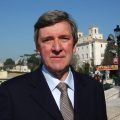
The Vatican today responded to a misrepresentation of the pope’s role by the U.S. ambassador to the Holy See, Brian Burch, by reaffirming that “the pope always speaks as a shepherd…. Even when he speaks about war and peace, migration or how to remain human in the age of artificial intelligence, the Successor of Peter remains, above all, a spiritual leader.”
It did so in an article published by Vatican Media and written by its editorial director, Andrea Tornielli, headlined “The Pope always speaks as a shepherd.” Editorials of such importance are always approved at the higher levels in the Vatican, and America has learned that today’s text was no exception, even if, for diplomatic reasons, it does not mention the ambassador by name or role.
The Vatican editorial came in response to a July 9 report in The New York Times based on two interviews with Ambassador Burch conducted over two weeks. Mr. Burch, The Times reported, “argued that when the pope spoke out against the war, he was not doing so as the leader of the Roman Catholic Church, the vicar of Christ, but only as the sovereign political leader of the Vatican City State.” Moreover, it quoted him as saying, “When the pope acts as the sovereign leader of the Holy See, he is coequal with world leaders.”
The article, headlined in the July 11 print edition as “Trump and Pope Leo ‘Very Much Aligned,’ Envoy to Vatican Says” and written by Elizabeth Dias and Motoko Rich, also reported Mr. Burch as saying that “declaring the Iran war unjust is not a judgment the pope can make because he has access to only ‘a set of limited facts.’” It added that “Mr. Burch said that even if the pope declared the war unjust, he didn’t mean it.”
Today’s Vatican editorial explains that “the fact that the Bishop of Rome, by virtue of the Lateran Pacts of 1929…is also the sovereign of the world’s smallest state—less than half a square kilometer in the heart of the Italian capital—does not mean that he acts or speaks as a politician when addressing issues concerning the affairs of humanity.”
It recalled that Pope Paul VI explained this well in his address to the U.N. General Assembly on Oct. 4, 1965, when he said that “the one who is speaking to you is a man like yourselves. He is your brother, and even one of the least among you who represent sovereign States, since he possesses—if you choose to consider us from this point of view—only a tiny and practically symbolic temporal sovereignty: the minimum needed in order to be free to exercise his spiritual mission and to assure those who deal with him that he is independent of any sovereignty of this world.”
It said Paul VI also explained that the pope “has no temporal power, no ambition to enter into competition with you” but only seeks “to serve you in the area of our competence, with disinterestedness, humility and love.”
Today’s Vatican editorial recalls that “to guarantee the absolute freedom of the Vicar of Christ, it was established nearly a century ago that there would be a tiny patch of land where the Bishop of Rome and Shepherd of the Universal Church would also be sovereign—and thus head of state. But this was, and remains, an arrangement designed to recognize precisely this need for independence from any other state, and not an affirmation of a dual mission.”
The editorial emphasized that “any glorification or exaggeration of the Pope’s role as head of state, any emphasis on the importance of this role, is therefore misleading because it comes at the expense of his one true mission as universal Shepherd. A Shepherd who speaks to Catholics, Christians, believers, and all people of good will with the sole intent of proclaiming the Gospel—his message of love, brotherhood, and ‘unarmed and disarming’ peace.”
The editorial concluded by seeking to provide further clarification on how to read the pope’s statements on some of the important issues of our day and to avoid further misunderstanding of his role. It said:
When he [the pope] calls for human life to be respected and protected at every stage of its existence, when he speaks of peace with the good of all peoples in mind and calls for an end to the mad arms race—even going beyond the concept of a “just war”—when he calls for dialogue and negotiation by invoking the Magisterium of Social Doctrine, when he calls for migrants to be regarded as people to be welcomed, without ever forgetting their human dignity; when he reminds us that the poor are at the heart of the Gospel and that we must build more just and equitable societies; when he defends the right to religious freedom; when he emphasizes the importance of caring for Creation so that we may pass it on to our children and grandchildren—the Successor of Peter is not speaking as a head of state. He is simply proclaiming the Gospel.
One senior church prelate with diplomatic experience, who did not wish to be identified, told America soon after the article was published: “I think the ambassador doesn’t realize exactly to whom he has been accredited. He should know that the pope is never ‘only the sovereign political leader of the Vatican City State’ and that diplomats are accredited to the Holy See and not to the Vatican City State.”
America has also learned that the New York Times interview with Ambassador Burch has raised questions among both diplomats and church leaders in Rome, and many of them think it is unlikely that Mr. Burch would have ventured such a misinterpretation of the pope’s role without knowing he has support for it from higher levels of the Trump administration.

 Politics
 Faith
Faith Culture
 Vatican
 Scripture
 Podcasts