


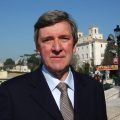
“Pope Leo is widely seen in Cameroon as a deeply inspiring and unifying spiritual leader, whose presence evokes strong emotional and religious fervor among the faithful,” Jean Luc Enyegue, S.J., the superior provincial of the Jesuits in 14 French-speaking countries of West Africa, told America in Yaoundé on Friday, April 17, the last full day of the pope’s visit to the majority-Christian country.
To better understand the situation in Cameroon and the impact of Pope Leo’s visit, I emailed Father Enyegue several questions and later sat down with the Cameroonian Jesuit for a lengthy conversation the evening after the pope visited the Catholic University of Central Africa, where the Jesuits are in charge of the largest faculty.
Father Enyegue was born in 1979 in Awaé, Cameroon, and studied history at the University of Yaoundé before entering the Society of Jesus in 2002. His Jesuit studies and formation took him to Rwanda, the Democratic Republic of Congo, Togo, Spain and the United States, where he earned a licentiate in theology from Boston College in 2012.
Ordained a priest in Yaoundé in 2012, he went on to obtain a doctorate in church history and hermeneutics from Boston University in 2018. Father Enyegue was then missioned to Hekima College in Nairobi, Kenya, where he taught church history. He coordinated the Ignatian year celebrations for the West Africa Province in 2021 and was elected procurator of the province. The superior general of the Jesuits, Arturo Sosa, S.J., appointed him provincial for West Africa, effective Jan. 3, 2026.
The following interview, conducted by email, has been edited for clarity and length.

How would you describe the situation in Cameroon today from a political perspective?
A diagnosis of the political situation of Cameroon can be found in the March 28, 2025, pastoral letter of the National Episcopal Conference of Cameroon, titled “If the Lord does not build the house, in vain do its builders labour” (Ps 126:1). In this letter, the bishops portrayed a tense and fragile political climate in which the then-upcoming [October 2025] elections risked lacking credibility due to certain ills: insecurity, mistrust and governance challenges.
Speaking of insecurity, the bishops pointed specifically to the ongoing conflicts in the Anglophone regions and the far north of the country. They also highlighted growing fears of electoral fraud among Cameroonians, perpetuated through intimidation and weak transparency, which, they believed, could prevent genuinely free and fair voting. They returned to their traditional targets against corruption, rampant poverty, tribalism and political exclusion. In this context, they called for peaceful participation, responsible leadership and credible electoral processes, emphasizing that without security, justice and respect for the common good, the elections may struggle to reflect the true will of the Cameroonian people.
This is not a poor country, yet we see so many poor people, so much inequality. How would you describe the situation, from a socio-economic perspective?
Pope Leo XIV rightly described Cameroon as “Africa in miniature,” drawing from late Cameroonian Jesuit Engelbert Mveng, who first coined the expression in the 1960s. From a socio-economic perspective, the situation described by the Cameroonian bishops in recent letters, sermons and public declarations reflects an African reality. As far as Cameroon is concerned, it points less to absolute national poverty than to structural inequality and an uneven distribution of resources. Cameroon, like many African countries, possesses significant economic potential (natural resources, agriculture and a diversified economy), yet widespread poverty persists because wealth and opportunities are concentrated in limited segments of society, while corruption, weak governance and clientelism distort redistribution and public investment.
It is also important to notice that ongoing insecurity in strategic regions further disrupts economic activity and deepens regional disparities, while unemployment and a high cost of living erode household welfare. In this sense, the country reflects a pattern where growth does not translate into broad-based development, leaving a large share of the population excluded from economic gains and reinforcing visible inequality despite underlying national wealth.
Everywhere we see so many young people. Pope Leo, in his talk yesterday, spoke about unemployment and many young people leaving the country but also their deep spirituality. The pope also spoke about the situation of women in the country. How do you see it?
Young people in Cameroon represent both a major potential and a growing frustration: They are numerous, energetic (Cameroonians play and love football [soccer]) and often deeply religious. However, they also face high unemployment, limited opportunities and a lack of hope for their future, pushing many to emigrate or disengage. While their strong spirituality can be a source of resilience, it also reflects a search for meaning in a context where economic and social structures fail to integrate them.
Likewise, and even more so, women continue to play a central role in family and economic life, but their situation remains marked by inequality, limited access to education (especially in rural areas and some urban centers), a lack of economic resources and decision-making power. As a result, despite their contributions, they are not fully recognized or empowered within society. The pope’s visit to Cameroon might also have convinced many observers of what Dorothy Hodgson rightly called The Church of Women. Though her book focused on the Masai women in Eastern Africa, it also helps highlight the fact that seven out of 10 Catholics in Cameroon are women, serving the church in liturgy, social services, material support and their maternal care for the most vulnerable in our families, parishes and communities. There is no church in Cameroon without women. Synodality offers an opportunity for them to be more involved in decision-making processes.
How is Pope Leo seen in Cameroon?
We love our pope! We genuinely pray for him and consider him a Holy Father. In Cameroon, Pope Leo is widely seen as a deeply inspiring and unifying spiritual leader, whose presence evokes strong emotional and religious fervor among the faithful. I retain the image of this blind woman at the Nsimalen International Airport in Yaoundé, who was greeted and blessed by Pope Leo. She stayed behind, shouting to the Lord: “I have greeted the pope! I have greeted the pope!” Or that little girl in Bamenda—I am told she is the daughter of a catechist—who ran as the pope was about to enter his car, to find the Holy Father ready to hug and embrace her, almost kneeling. She has become a symbol for her community and the entire nation.

That’s Africa! That’s Cameroon! A living incarnation of the joy of the Gospel, or what Pope Benedict XVI called the “spiritual lungs of humanity,” and Pope Francis remarked as “certain joie de vivre” amid enormous struggles and challenges.You can see it everywhere, the remarkable enthusiasm shown during this visit: the massive crowds, joyful celebrations and a clear desire from the people to see the Holy Father prolong both his stay and his eucharistic services. All of that reflects not only a profound respect for his person but also a deep hunger for spiritual connection and guidance. Many Cameroonians perceive him as approachable, compassionate and attentive to their realities, which strengthens their attachment to him and amplifies the significance of his visit as a moment of national pride and religious renewal.
What impressed you most about his speech at the palace?
In Cameroon, Pope Leo is received as a direct, reassuring and prophetic voice, especially evident in his first speech, where his words resonate with clarity and moral conviction. Cameroonians hear in him a shepherd who speaks plainly to their realities, who addresses their hopes, struggles and faith with sincerity and authority, while offering reassurance grounded in compassion and trust in God. His message carries a prophetic tone, calling for justice, unity and renewed spiritual commitment, which deeply moves the people and explains the extraordinary enthusiasm surrounding his visit.
Can the pope help open the path to peace in the Anglophone crisis?
Pope Leo is from the United States, which could potentially play a powerful role in the Anglophone crisis by leveraging both symbolic and institutional influence. His American background might carry weight in Yaoundé’s political calculations, since the United States is an important diplomatic and economic partner, and a pope with that origin could indirectly amplify international attention on the conflict while maintaining the Vatican’s traditional posture of neutrality and dialogue. At the same time, as leader of the Catholic Church, he has a powerful pastoral platform to address Cameroon’s deeply rooted Catholic communities, including those in the northwest and southwest regions, where English-speaking Catholics are directly affected by the crisis. By speaking in English and consistently calling for reconciliation, justice and protection of civilians through sermons, pastoral letters and local episcopal coordination, he could strengthen peace-oriented voices within both the church and civil society. This combination of diplomatic symbolism and grassroots moral authority would not resolve the conflict on its own, but it could help sustain pressure for dialogue and create more space for negotiated solutions.
What is the situation between Christians and Muslims in Cameroon? Can they together help the peace process as the pope seems to suggest in his speech in Bamenda?
In Cameroon, relations between Christians and Muslims are generally characterized by coexistence and everyday cooperation, even though the population is regionally diverse. In moments of national tension, including the Anglophone crisis and broader governance challenges, both Christian and Muslim leaders have at times played constructive roles by calling for peace, condemning violence and encouraging dialogue.
The involvement of Christian, Muslim and even traditional religionist leaders can be useful in peace efforts because they have moral influence and deep community reach. However, it is important that any solution remains inclusive in a civic sense rather than primarily religious. Cameroon is a secular state in principle, so peace-building, although inclusive of religious leaders, should be anchored in institutions, law and equal citizenship. In that framework, the most sustainable approaches tend to be those that bring together all communities—religious and nonreligious alike—while keeping the state’s neutrality intact, ensuring that no single religious perspective becomes a substitute for political negotiation or institutional reform.
How do you see the situation of the Catholic Church in the country?
The church in Cameroon today is growing fast; it is strong and experiencing an unprecedented expansion of its clerical and religious personnel, as well as social and educational infrastructure. This reflects both vitality and deep-rooted presence. As a post-Vatican II church, it displays active and fervent participation of all the faithful, particularly women, whose liturgical roles continue to expand and whose involvement in decision-making is gradually increasing, even if more progress—such as greater inclusion in formation structures—may still be needed.
At the same time, the church often appears misunderstood: Some critics expect a more forceful stance against corruption and poor governance, and interpret its cautious approach as a sign of internal institutional dysfunction or moral shortcomings, a lack of courage. Yet despite these wrong perceptions—for there is written evidence attesting the opposite—the church remains arguably the most devoted and socially engaged organization in the country, reaching remote and underserved areas where the state has limited presence. Indeed, without its extensive network of schools, hospitals, spiritual, sacramental and social services, the social fabric of Cameroon would be under far greater strain. For this reason, the church’s impact is better measured by its sustained actions and service to society than by the tone or frequency of public statements some might wish it to adopt.
Any final thoughts about Pope Leo’s visit to Cameroon?
From the very beginning, Pope Leo’s visit to Cameroon inspired a sense of amazement—an enormous success marked by a powerful and heartfelt message that resonated deeply with Cameroonians, especially on urgent issues of justice, corruption, peace and reconciliation. His words to the academic community were equally striking, calling on them to be both learned and virtuous in their mission to educate the youth, urging them also “to train pioneers of a new humanism in the face of the digital revolution.” He extended this challenge to students and their professors alike, encouraging them to study here in Cameroon, remain here and commit themselves to transforming their own country.
Equally moving was his presence in war-torn English-speaking parts of the country, particularly Bamenda, where he stood as a messenger of peace and reconciliation. Altogether, these moments have left many with the profound feeling that this Easter season has brought an almost unbelievable wave of hope and positive emotion, something Cameroon has not experienced in a long time. And so the lingering question remains: Was this visit the symbolic removal of the heavy stone from the hearts of Cameroonians and their leaders, opening the way for a true national resurrection, or was it instead a kind of viaticum—spiritual sustenance—for a longer, more difficult journey ahead, especially if his message does not yield the tangible fruits of peace, justice and meaningful change? Yet, in his final homily, Pope Leo invited Cameroonians not to be afraid as they embrace this present time and an uncertain future.

 Politics
 Faith
Faith Culture
 Vatican
 Scripture
 Podcasts