Popes like citations. You don’t need to read a papal encyclical to recognize this; everything from an apostolic constitution to a motu proprio to a published homily that comes from the pontiff’s pen will inevitably include dozens and perhaps hundreds of references to the church’s intellectual patrimony. Scripture or church documents usually dominate, and for the last half-century, the documents of the Second Vatican Council have often taken pride of place in the footnotes.
Sometimes popes go rogue. Pope Francis liked to reference the English priest and novelist Robert Hugh Benson as well as Fyodor Dostoevsky. As is the case with any pope who reigns for more than a few years, the documents of the latter years of Francis’ tenure also had a lot of references to his own papal oeuvre. (If you want to get technical, even St. Luke liked that move: What’s the opening line of Acts of the Apostles? “In my first book, Theophilus…”) And Pope Benedict XVI liked to include Plato and other classical Greco-Roman authors as much as he did any church father.
What no pope has ever done until now, however? Quote Bob Dylan.
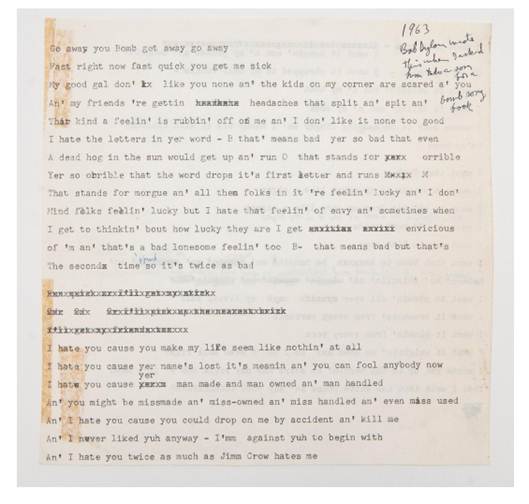
But here we are. In the foreword to a new book collecting his writings on peacemaking, Disarmed and Disarming: Peace Is a Gift, the pontiff quoted a 1963 Bob Dylan song, “Go Away You Bomb,” citing a line Dylan directed at nuclear weapons: “I hate you cause yer man-made and man-owned an’ man-handled.”
If you’ve never heard of the verse or the song, you’re not alone: “Go Away You Bomb” was never recorded by Dylan. He seems to have written the song in a day in 1963 at the request of Izzy Young of the Greenwich Village Folklore Center, and it only exists as a typewritten manuscript. The lyrics have the same tone and feel as “Masters of War,” the classic song released the same year on “The Freewheelin’ Bob Dylan,” but Pope Leo didn’t cite that famous track: Instead, he dug deep, like a hipster tossing aside “Bob Dylan’s Greatest Hits” for a vinyl B-side of something terrible from “Self-Portrait.”
To be fair, Dylan isn’t the focus of the foreword, which also mentions Dorothy Day, Giorgio La Pira and Blessed Floribert Bwana Chui as important examples of peacemakers. And Leo has surprised us before: “Magnifica Humanitas” included a quote from Gandalf in it. Wizard! But the inclusion of an unpublished Dylan song raises the possibility that this American-born pope, at least in his days as Bob from Chicago, was a serious Dylan head. It is also a reminder of a curious history of interactions—actual and virtual—between Dylan and the popes of the last half-century.
The most famous example is no doubt Dylan’s performance in front of 300,000 youths and Pope John Paul II himself at the International Eucharistic Congress in Bologna, Italy, in 1997. Dylan played “A Hard Rain’s Gonna Fall,” “Forever Young” and “Knockin’ on Heaven’s Door.” The pope’s speech that night repurposed the lyrics of Dylan’s famous anthem, “Blowin’ in the Wind,” in what feels today a bit like an attempt to baptize the song. According to press reports, when referencing the question of “how many roads a man must walk down before he becomes a man,” the pope said “there is only one road for man, and it is the road of Jesus Christ, who said, ‘I am the Way and the Life.”’ The pope also said that the proverbial “answer” was not “in the wind that blows everything away into nothingness, but in the wind that is the breath and voice of the Spirit, the voice that calls and says, ‘Come.’”

The press loved it. “It’s the stuff of which legends are made,” Candice Hughes of The Associated Press wrote. “The rebel who’s been knock, knock, knocking on heaven’s door meeting the man with the keys to the kingdom.” Not everyone in the Vatican was so pleased, including the future successor to Pope John Paul II, Cardinal Joseph Ratzinger.
In a 2007 book, John Paul II: My Beloved Predecessor, Ratzinger (by then Pope Benedict XVI) wrote that he opposed Dylan’s appearance and tried to prevent it. “The Pope arrived tired, worn out” at the Eucharistic Congress, he wrote. “Just at that moment Bob Dylan, the ‘star’ of the young, and others whose names I do not recall, turned up. They had a message completely different from that to which the Pope was committed. There was reason to be sceptical—which I was, and in a certain sense still am—to doubt whether it was really right to involve ‘prophets’ of this type.”
Fair enough: No one ever held up Joseph Ratzinger as a champion of pop culture, and his own musical tastes ran more to classical. And he’s in good company. Pete Seeger tried to derail a Dylan concert once, too.
Benedict’s successor, Pope Francis, never mentioned or met Dylan, but it didn’t stop the two becoming unexpectedly linked after the pope’s death in 2025. The day after Francis died on April 21 of that year, various news outlets and social media posts began quoting Dylan’s eloquent and heartfelt tribute to the beloved pontiff:
Pope Francis was a voice of mercy in a time of noise. He walked with humility, spoke with fire, and dared to love the unloved. He reminded the world that compassion isn’t weakness, and faith doesn’t have to shout to be heard. May he rest in the eternal peace he so often preached.
A beautiful farewell. Except Dylan never wrote it. No one knows how the quote ever came to be. However, it most certainly went viral in the weeks following, and still today perdures online as a strange example of the Mandela effect.
And now we have Pope Leo hinting that he’s a Dylanologist of the first order. How did we go in just 20 years from a future pope who didn’t even want to allow Dylan to perform to a pope who quotes his most obscure work?
Despite a brief and extremely controversial conversion to evangelical Christianity in the late 1970s, Dylan has never publicly been much of a fan of organized religion. Remember “It’s Alright Ma (I’m Only Bleeding),” his fiery 1965 broadside against the hypocrisy of modern life? If you were a Catholic bishop in the United States (then or now), you might feel like you were catching some strays in Dylan’s lyrics:
While some on principles baptized
To strict party platform ties
Social clubs in drag disguise
Outsiders they can freely criticize
Tell nothing except who to idolize
And then say God bless him.
However, Dylan has found fans over the years in some prominent Catholics in the United States. Bishop Robert Barron of Winona-Rochester has called Dylan one of his heroes and praised his lyrics for their biblical and spiritual resonances. (Here’s his cover of Dylan’s “You’re Gonna Make Me Lonesome When You Go.”) And in Robert Hudson’s 2018 book The Monk’s Record Player: Thomas Merton, Bob Dylan, and the Perilous Summer of 1966, the author noted that Thomas Merton, despite never meeting or corresponding with Dylan and being twice his age, nevertheless admired the iconoclastic singer and longed for his imprimatur. In 1966, Merton wrote the following in his journal:
Should a hermit like Bob Dylan? He means at least as much to me as some of the new liturgy, perhaps in some ways more. I want to know the guy. I want him to come here, and I want him to see one of my poems, he might even use it.
It is of course a distinct possibility that if Merton ever had met Dylan, the latter would have ruined it by acting like a total jerk. It happens. But there is no question Merton felt a connection there as least as strong as that he felt with Romano Guardini or the other intellectual powerhouses of the church of his time.
Back then, of course, Dylan was a young man and a hero of the youth-led antiwar movement. Even in 2007, Pope Benedict was still remembering him as “the ‘star’ of the young.” (Though Dylan was 57 at the time and had almost died a few months before of pericarditis.) No one thinks of youthful rebellion anymore when they are citing this 85-year-old wizard who long outlived Merton and has now survived seven popes, so perhaps his status as an elder statesman makes him more palatable to popes and bishops and spiritual writers as well as their readers and listeners.
Perhaps, too, the culture really has changed, and not necessarily with the disastrous consequences Pope Benedict associated with the popularity of singers like Dylan back in the day. Robert Prevost was 7 years old when Bob Dylan wrote “Go Away You Bomb.” American pop and rock music have been part of his life since infancy. And he seems to have turned out all right, ecclesiastically speaking. So, too, did most other church leaders who grew up listening to his tunes and resonating with Dylan’s lyrics.
Next year marks 30 years since John Paul II met Dylan. How fitting would it be for Bob from the Midwest to sing a few songs for another Bob from the Midwest? I vote for “Tryin’ To Get To Heaven.”


 Politics
 Faith
Faith Culture
 Vatican
 Scripture
 Podcasts