


The insulting shouts are met with cheers from within the town hall.
At the microphone, a man yells at the life-size cardboard cutout of Eli Crane, our U.S. Representative from District 2, who had not responded to the invitation to the town hall from his constituents in Flagstaff, Ariz.
“Eli Crane does not care about his constituents! He is a self-centered disgrace, who doesn’t even live in his district!”
The room sends forth an uproar of agreement. I squirm in my seat. As a Catholic who is active in environmental and creation care advocacy, I also don’t agree with many of Eli Crane’s policies, but this moment felt uncomfortably emblematic of the way I’ve noticed our country falling deeper into division and hatred.
About a month before that, I had been driving the winding roads through the mountains of the Gila River wilderness area in New Mexico. As I ascended to the high point, a view of jagged rolling mountains as far as I could see made my jaw drop. After about an hour of driving through the epic mountain scenery, I arrived at a campground where people were setting up tents.
This was the weekend of the Gila Community Campout, a gathering for the community surrounding the river to connect with one another and discuss protecting their beloved wilderness. I was attending as the representative for the National Religious Partnership for the Environment, an organization where I had served as a “Laudato Si’” intern, advocating for the environment from a Catholic perspective.
The next morning, a group of about 20 people gathered for a hike.
“Let’s do introductions!”
I felt my muscles tighten. I knew that many people in the environmental movement were not fans of organized religion. I wondered how they would respond to a faith-based organization being a sponsor for this event. In addition, I had driven eight hours from Arizona, so I wasn’t a part of their community. I felt like an outsider.
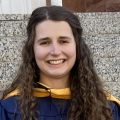
“I’m Megan Quinn and I am the representative from the National Religious Partnership for the Environment.”
There were a few nods, a few eyes that widened and some blank expressions.
The hike began by us all crossing the Gila River. After we had laughed about our now-wet shoes, a woman approached me.
As we hiked, she told me about how she had grown up in a Mormon family in Utah but was not religious anymore. She told me that environmental protection was not talked about when she was growing up. Salt Lake City was then one of the most polluted cities in the United States, and she said she had bad asthma as a child, but no one ever made the connection.
“But, lately, I’ve noticed that some of the churches are taking action. I’ve noticed one church in the community being a big advocate for clean air.”
Our guide stopped us to point out we were walking through a burn scar from a fire that had burned through the Gila Wilderness some years ago.
My new friend continued: “I think the work you are doing is very important. You are the person who can be the bridge between different groups of people and get us all working to protect the earth.”
In each of the conversations I had with different people throughout the hike, I could feel the Holy Spirit moving among us. Each person shared their different experiences with religion, and I was able to share how my Catholic faith is what inspired me to care for the earth.
This building of relationships across differences of background, faith, race and age—surrounded by the peace of God’s beautiful creation, even the land that had been scarred—felt like a sort of healing.
After a day of splashing in the river and listening to stories from the Native Apache people, we sat together under the stars of the night sky.
The park ranger told us about DarkSky-designated cities and wilderness areas, which have made special efforts to fight light pollution, and how the park staff had changed the lights on their buildings to do the same.
“It’s helpful for animals migrating, like birds,” he said. “And we all can enjoy looking at the stars.”
The sky was indeed littered with stars, so many that they made me feel small. The ranger pointed out the planet Mars with his laser pointer, and we all stared in awe at its slight red tint.
At that moment, I felt as if the stars were bringing us all together in a shared moment of connection. Their vast expanse was reminding us of the power of our deep interconnectedness as people on God’s earth.
My favorite “Laudato Si’” quote came to mind: “Human life is grounded in three fundamental and closely intertwined relationships: with God, with our neighbour and with the earth itself” (No. 66).
As evidenced by the nervousness I had felt at the beginning of the campout, sometimes it has been hard for me to find a home in the environmental advocacy space. At my church, I feel I am one of the few people who cares so deeply about creation. In my environmental career and among my peers, I feel that the way my faith drives my care for the environment is not totally understood.
But in this moment underneath the stars, I felt wholly connected to God, to my neighbors around me and to God’s creation. I felt God bringing a new dimension of purpose to my creation care work.
As a person of faith, I can be a listening ear and builder of bridges, creating space for people to connect with God, his creation and other people. I believe it is through authentic, deep connections like those that I experienced at this community campout that we can bring God’s reconciliation, healing and resurrection to a divided world.
As everyone took turns looking through the telescope, I prayed.
I gave thanks for the healing I found in other people.
I gave thanks for the way God showed me his love in the vastness of the night sky.
I gave thanks for the way this community had come together to connect and take action to protect their local land, their dark skies and the life-giving water of the river.
I prayed that all the world may come to know this healing power of relationship.
Back at the town hall, I stepped up to the microphone. I took a deep breath.
I shared my worries about how wildfire was affecting my community and how I am concerned it is damaging our safety and national security. As I spoke, I remembered the moment under the stars and the connectedness I felt to God, my neighbor and creation.
As I drove home that night, I looked up at the stars. I am lucky enough to live in a city with little light pollution and continue to receive God’s hope and love every time I look at the night sky. Now the sky is a constant reminder that as a Catholic, I am called to create space for people to reflect on their own stories, connect with God’s creation and work together to bring healing to our hurting world.
This article appears in May 2026.

 Politics
 Faith
Faith Culture
 Vatican
 Scripture
 Podcasts