


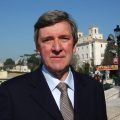
“The central message” from the Pan-Amazonian synod of bishops to the world is this: “Our common home is at risk; the situation is urgent. Climate change is scientifically proven. If global warming goes much beyond two degrees, there will be [the risk of] catastrophe in the oceans.” That is the synodal takeaway of Cardinal Carlos Aguiar Retes, the archbishop of Mexico City, described to America in an hour-long interview, conducted in Spanish, on the eve of the conclusion of the three-week-long synod.
He said that if global warming goes much higher, then “there is the risk of desertification” in various parts of the world, including the United States, because of the lack of water, as rivers and lakes dry up. He said the church “has to ring the alarm bell. It must make people aware of this crisis situation,” and it can do so “together with young people.”
The Mexican cardinal said “integral ecology” and the need for “ecological conversion” have been central points of the synod. “We all agreed that the church should be a factor for wakening consciences to care for the common home,” he said.
He said that is quite understandable that resistance to all this idea comes from economic and political interests.
It has always been the case in the history of humanity: those who command are those who have the money. The real problem is that those who have the money impose the rules; this has happened down the centuries. But the governments should regulate for the safeguarding of the environment against those economic interests. As church, we cannot do it, but we can raise awareness. I think that is the task of the church: to awaken consciences.
He thinks this is possible especially in Latin American countries because the church has “moral authority” in most of them, but it can have the same influence elsewhere in the world.
“Integral ecology” and the need for “ecological conversion” have been central points of the synod. “We all agreed that the church should be a factor for wakening consciences to care for the common home,” he said.
The 69-year old Mexican cardinal is an important figure in Latin America, having been president of both CELAM, the Latin American Episcopal Council, and the Mexican bishops’ conference. He was elected to the team that would draft the synod’s final document, but he turned down that role because he felt he did not know the Amazon region well enough, a gesture that was much appreciated by the synod fathers from the region.
This polyglot biblical scholar spent nine years in Rome, where he studied under the renowned Jesuit cardinal, Carlo Maria Martini, S.J., at the Pontifical Biblical Institute. He has participated in other synods. But this one was “different,” he said, because its composition was “strongly Latin American” and its theme was one “that, sadly, in many places, is not yet seen as part of the mission of the church.”
Pope Francis called the synod “because it’s evident that the mission of the church is to bring the Gospel and to help people understand why they have to be good stewards of creation,” a task that is of the greatest urgency in the Amazon region. He noted that the synod generated various reactions, provoking joy among many people, “including non-Catholics and non-Christians” who share its ecological concern.
But there has also been opposition to the synod, including from not a few Catholics who still have difficulty in seeing the care of creation as part of the mission of the church in today’s world. Asked how he read this opposition, the Mexican cardinal said, “It’s because we come from a 19th-century spirituality that is rather self-absorbed”—“muy intimista’ in Spanish—“or ‘individualistic,’ one might say.”
But, he said, “starting with the Second Vatican Council,” the church has seen its mission as a mission “to serve the world, to serve humanity and not just the individual.” He recalled that the council’s two major texts were “Lumen Gentium,” which looked at the Catholic Church from the inside, and “Gaudium et Spes,” the document on “The Church in the Modern World” that emphasizes the service the Catholic Church must give to fulfill its mission in the world. When the council ended, he said, “these two contrasting visions existed.”
“If the decision is taken to ordain ‘viri probati’ then it should be done in a gradual way, starting with the permanent diaconate… and then one has to see if this permanent deacon is able to be a pastor.”
He agreed that the famous Brazilian bishop, Dom Helder Camara, who made a major contribution to the “Gaudium et Spes” text and is now on the path to beatification, was an expression of this new way of being church.
The cardinal-archbishop of Mexico City acknowledged that this synod could be described as “revolutionary” compared to the two previous ones—one each on the family and on young people. He recalled especially that the synod on young people revealed their “great sensitivity to the ecology question” and remarked that “this is an opportunity for the church to come close to them.” Indeed, he said, “we must try to come close to young people, to accompany them and let them know that we too are working on the issues that concern them most.”
Like other synod fathers, he saw two different mentalities or visions emerge at the synod but declared that “the Second Vatican Council’s [vision] prevailed in this synod because the Latin American church has worked much on these themes [at the plenary assemblies of CELAM] in Medellin, Puebla and most recently in Aparecida,” whereas “the resistances [in the synod] are found more in Europe,” including “many, though not all of those in the curia” who “struggled to understand these issues because they follow a more traditionalist mentality.”
He was particularly appreciative this time to come “to know Amazonia from within, this territory of 9 million square kilometers and its more than 300 different peoples, with distinct ethnic groups, cultures and languages, that do not have a common language, that are ‘atomized’ and have a nomadic style of life that is friendly to the forest, and know how to keep it alive.”
He felt personally enriched “from a social and cultural perspective” by what he heard.
He considered it “very important from an ecclesial perspective that for the first time that all the bishops of the Amazonian region met together in synod; it brought together members of the seven bishops conferences of nine countries.”
He recognized that if the church does not provide the Eucharist for a community except on very rare occasions, then it risks “protestantizing the Catholic communities.”
At the synod, Cardinal Aguiar Retes said “participants spoke with great freedom,” and on the question of the ordination of mature married men from the indigenous communities, “they expressed positions in favor and against.”
Having listened to these, he thought at times that some participants were looking for “an immediate solution” without having first sufficiently engaged in a pastoral push for vocations among young indigenous people. He felt there were “risks” attached to providing immediate solutions.
For example, a community could be left with the same priest for his lifetime since he may not speak another language to move elsewhere where a different language is spoken. He revealed that in the Spanish language group in which he participated an indigenous person from Ecuador said his community preferred a priest who was not married and did not have a family, as has been the case up to now. As a result, thee cardinal remarked that the question is not a simple one.
At the same time, he recognized that if the church does not provide the Eucharist for a community except on very rare occasions, then it risks “protestantizing the Catholic communities,” as some have said. He recalled, however, that when the first missionaries came to Mexico they did not celebrate the Eucharist immediately: Instead they sought a path of evangelization by trying to connect with the culture of the indigenous people.


The cardinal archbishop of Mexico City, who has also served as bishop in two other dioceses, told America, “I am not in favor or against ordaining ‘viri probati.’ I only say that one should not do it precipitously; there should be a well-studied procedure and it should be guaranteed that the priest is not ordained to remain for the rest of his life at the head of that community, otherwise the community could take on his style [of being church]. There should be rotation, perhaps of missionaries with viri probati.” He said he felt this way because of the difficulty he has experienced as a bishop in trying to move priests from a parish where they had been for many years.
Recognizing, however, that tomorrow the synod fathers could vote in favor of the ordination of married men and then ask the pope to discern if they should go that path, the Mexican cardinal said, “If the decision is taken to ordain ‘viri probati’ then it should be done in a gradual way, starting with the permanent diaconate… and then one has to see if this permanent deacon is able to be a pastor.” He advocated “a scrupulous, microscopic” selection process of candidates for ordination, adapted to each person and each community and said there should be “no generalizations.”
Questioned about how he read the synod’s discussion on the role of women, the cardinal said, “there is consensus that women are already doing lay ministries” including “the established ones of lector and acolyte,” but he felt the church must avoid “the risk of clericalizing” lay ministries and emphasized that “what we need is to revitalize the church” and “not just give titles” or link new ministerial roles to “salaried jobs” or making women “functionaries.”
Cardinal Aguiar Retes is very close to Pope Francis. He first met him in 2001 when Jorge Mario Bergoglio was made cardinal. He met him again at the 2001 synod, when they were in the same language group, and he worked closely with him at the Fifth Plenary Assembly of CELAM in Aparecida in 2007. Francis made him cardinal in November 2016, and a year later appointed him as archbishop of Mexico City.
Asked what has struck him most about Pope Francis in these years, he said: “His transparency, cordiality, affability, sense of humor.” He describes him as “one who is always ready to make relations with people,” all qualities that have been evident at this synod, he noted.

 Politics
 Faith
Faith Culture
 Vatican
 Scripture
 Podcasts