


Maybe it’s too obvious to write about “1776” on the semiquincentennial. Peter H. Hunt’s 1972 adaptation of the Broadway hit written by Peter Stone and Sherman Edwards is one of the best known movies about the American Revolution, although there are shockingly few of those. Its reputation has also dimmed a bit over the last decade, as it went from being the American Revolution musical to being the other American Revolution musical. “Hamilton” is so dynamic and contemporary that “1776” can’t help but feel a little stuffy in comparison, with its powdered wigs and mid-Atlantic accents.
But “1776” is a much more lively and complicated work than its latter-day reputation suggests. And as we celebrate the 250th birthday of our country, it is the perfect time to delve back into our nation’s founding myth and discern what it can say to us today. “Myth” is the operative word: Far from a staid hagiography, the film asserts that from the very start American democracy was messy, compromised, contentious—and worth fighting for. This isn’t the John Trumbull vision of America’s birth. But it’s probably closer to the truth.
The founding fathers of “1776” are fallible, complex human beings. John Adams (William Daniels) is abrasive and stubborn; Ben Franklin (Howard da Silva) egotistical and flighty; Thomas Jefferson (Ken Howard) more focused on returning to bed with his new wife, Martha (Blythe Danner), than work. They and their colleagues in the Second Continental Congress are motivated by idealism, but also pride, lust, greed and cowardice.
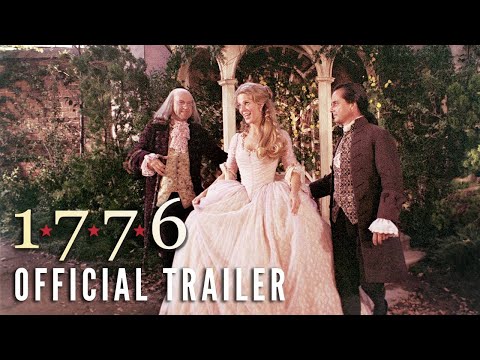
One representative is constantly drunk, another constantly eating. George Washington sends morose letters from the front that further sour the mood. Philadelphia swelters in the summer heat and the State House (present-day Independence Hall) is overrun by flies and stray dogs. The men tasked with governing the colonies can’t even agree on whether or not to open a window, much less to secede from England. When musing over the possible plagues that God could have sent to torment America, Adams concludes: “But no, You sent us Congress! Good God, Sir, was that fair?”
It shouldn’t be revolutionary to say that the founding fathers were human, but even in a post-“Hamilton” world many Americans tend to treat them more as icons than real people. Bring up Washington’s or Jefferson’s slaveholding, for instance, and you may be met with pearl clutching (even our government seems intent on erasing that part of our history). Those responses come from fear, I think. Our forebears, national and religious, must have been perfect, must have gotten it right in one try. Otherwise, they fear, the foundations of our society will become terribly shaky.
But “1776” reminds us that America was an experiment, and experiments often lead to surprising results. In the film we see Adams, Franklin and Jefferson make the blasphemous compromise to concede on the issue of slavery in order to secure Southern votes. When Adams says that they will never be forgiven by history, Franklin replies: “[W]hat would posterity think we were? Demi-gods? We’re men, no more no less, trying to get a nation started against greater odds than a more generous God would have allowed.”
This doesn’t align exactly with history: Jefferson did originally include a condemnation of slavery in the Declaration of Independence and it was removed, but not until after the vote on independence had already happened (and with the support of Northern as well as Southern colonies). But the point stands: American democracy isn’t the work of angels but human beings, doing the best they can within their limited means and, quite often, getting it wrong.
As “1776” tells it, the flaws of American government were there from the beginning: partisan squabbling, catering to the wealthy, a shameful disconnect between the people who order the wars and the people who fight and die in them. Marginalized people are almost completely absent from the film and the government. (Abigail Adams, portrayed by Virginia Vestoff, is the only woman allowed to make her mark on the proceedings—and then only indirectly, through her husband.)
But there is a gift in accepting that America’s foundations weren’t perfect: It means that our potential hasn’t been totally spent yet. The hope that animates Adams and company, the dream of a truly representative government founded on principles of liberty and justice, is still alive. To look at our current system and say “This is the best it could ever possibly be” is defeatist. John Adams, as portrayed in “1776,” might even call it un-American.
250 years later, we are still striving, still dreaming, still a work in progress. Democracy is messy, and there is both frustration and grace in that. Believing in America means embracing the mess while holding onto your ideals, and keeping faith in what this great, strange experiment could still be.
“1776” is streaming on Tubi.


 Politics
 Faith
Faith Culture
 Vatican
 Scripture
 Podcasts