


Once, in an attempt to reach beyond my comfort zone, I joined an improv comedy class. I knew nothing of the improv form, not even the fundamental rule of “yes, and…,” designed to foster collaborative lunacy. The experience was a revelation. If you want to accelerate the formation of trust and fellowship among a small, heterogenous group of adults, throw them in a room to play make-believe every Saturday afternoon.
A memorable game was Make Me Laugh. One person stands in the center, everyone else surrounding them in a stone-faced circle. Whoever is “it” moves from classmate to classmate, trying anything in their arsenal—faces, sound effects, one-liners—to elicit a stifled snort. The exercise had a twofold benefit: When you were it, you practiced creative silliness; on the receiving end, keeping a straight face. The natural byproduct of improv is laughter, but as a performer, you’re supposed to stay in character. “Break” too easily and you puncture the invisible bubble that surrounds the stage, preserving the absurd atmosphere of the performers’ pretend reality that is so much lighter than the world around it.
That term, breaking, flits through my mind as I contemplate the meaning of “Saturday Night Live” in 2026. Some of the most popular compilations of the 51-year-old show that you will find online are of cast members and guest hosts breaking—losing control in the middle of a sketch. From the early days of “S.N.L.,” show creator and producer Lorne Michaels let it be known that he expected his players to be disciplined and stick to the script. Over the years this rigidity has eased, to the point where breaking has been effectively built into sketches. To “break” ostensibly comes from theatrical concepts of “breaking character” or “breaking the fourth wall,” which point to a sudden, even violent destruction of the audience’s illusions. These terms also suggest deliberate intent.
But breaking, as the term applies to live comedy, is involuntary, and this is largely what makes it delightful, at least in moderation. Performers “break” the way you break a glass that slipped out of your hand. A break is a trip-up, a failure that shouldn’t have happened, officially. And yet it’s the ultimate crowd-pleaser. Momentarily, the line between performer and observer dissolves, reminding both that we are all floating in the same bubble of absurdity, together.
Why It works
“S.N.L.” is sketch comedy, not improv, but cast members are largely recruited from improv troupes and have been from the beginning. From the beginning, too, they broke things.
An incisive early review by New Yorker TV critic Michael J. Arlen was originally headlined “A Crack in the Greasepaint” and hailed the show as an overdue acknowledgement by network executives of trends in comedy toward the personal and the psychological that had been taking root since the 1950s. Reading it reminds you just what a span five decades represent. Arlen’s analysis, contrasting the “conventional professionalism” exhibited by comedians like Bob Hope with the authenticity and human connection offered by a new generation, is by now a bona fide historical document. It suggests that “S.N.L.,” by shaking up a hoary set of expectations around TV comedy, was pivotal in redefining what’s “ready for prime time.”
Simultaneously, it underscores that “S.N.L.” at 51 is the antithesis in some ways of its 1975 incarnation. Not merely established but legendary, how well does it—can it—continue to deliver surprise, freshness and renewal, the chief qualities it represented when it began? “It’s not really the gross tonnage of jokes in the skits which makes ‘Saturday Night’ worth looking at,” Arlen wrote. “What is attractive and unusual about the program is that it is an attempt, finally, to provide entertainment on television in a recognizable, human, non-celebrity voice—and in a voice, too, that tries to deal with the morass of media-induced show-business culture that increasingly pervades American life.”
Michaels erred most notably when he veered from this approach. He left the show for five years in the early ’80s, and his return in the 1985-86 season marked a popular and critical nadir, likely because he bent to “show-business culture” by stacking the cast with well-known actors (Randy Quaid, Joan Cusack, Anthony Michael Hall) instead of non-celebrities steeped in improv and stand-up. In 1986 he again drew from the latter realms, adding quintessential cast members Dana Carvey, Phil Hartman, Jan Hooks and Kevin Nealon, and kicking off another era of classic sketches.
There are many reasons why improv training translates to strong cast members. If you have regularly winged it in front of a live audience, performing scripted scenes live is generally less daunting. You have inventive instincts in place that can serve you well in an on-stage snafu. And early in each week of a show like “S.N.L.,” when the staff brainstorms concepts for skits, habits of unrestrained imagination come in handy.

In short, improv performers are used to high-pressure situations, of which they get plenty on the set of “S.N.L.” Yet at the risk of sounding sadistic, I crave a version of the show that makes room for purely improvised scenes. This is because I have noticed that the laughter generated from even mid-level improv is different in quality from the laughter that world-class scripted and stand-up comedy excites: It’s more spontaneous and free. There are no expectations because there has been no labor. No one has prepared a feed line or punch line and stood back, waiting for you to laugh. Instead the players jump into a scene with trust in the moment and in their own sensibilities. No one in the room knows what will happen next, so everyone is primed for surprise. It’s not fine dining but foraged meal, attuned to the bounty around us.
Arlen lauds how new comedy, embodied by “Saturday Night Live,” tries to integrate aspects of performers’ genuine selves and the stuff of actual experience. In doing so, he says, it refuses to leave audiences “out in the cold.” Putting aside that “S.N.L.” standby tickets are procured by literally waiting outside 30 Rockefeller Center, often in the cold, this refusal encapsulates the intent and effect of improv: Audiences co-create the joy. An entire long-form performance of 30 to 60 minutes begins with a word shouted by a person in the crowd. More than that, performers join the audience as co-observers and appreciators of the cooperative genius revealing itself from moment to moment.
Brimming with delight
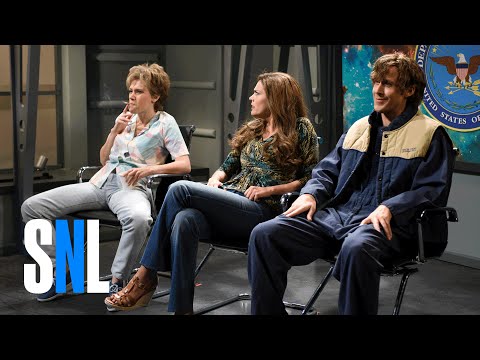
Which returns us to breaking. A hopeless cynic might construe the popularity of “S.N.L.” sketches like “Alien Encounter,” full of unplanned laughter, as schadenfreude—enjoyment at seeing performers blunder. I see these instances, at least the best of them, as moments when the same spirit that animates improv floods into the show. The script remains, but it’s temporarily forgotten, submerged in the abundance of the moment. Live performance asserts itself as an aspect of the present, and of presence: impossible to anticipate and brimming with delight.
Breaking is a moment of radical humility, and this confronting of limitation opens the door to God’s grace in the form of greater unity between people. All our shortcomings have the same potential, as Pope Leo writes in “Magnifica Humanitas”: “For an algorithm, an error is a flaw to be corrected; for a person, however, an error can be a catalyst for profound change.” I can think of few arenas other than improv where error’s link to grace is so immediately, consistently, mirthfully shown.
Pope Leo’s words in the encyclical make me suspect that what “S.N.L.” offers us today might be more powerful than what it offered in 1975. Reflecting on the pope’s warning that “a technology that merely classifies and optimizes what already exists can, however unintentionally, become an obstacle to change and growth,” one pattern that comes to mind is Hollywood’s barrage of sequels and reboots, force-fed comfort food that young people, at least, don’t want.
“S.N.L.” is not part of this particular problem. Its popularity has waxed and waned, but the very fact that viewers are forever comparing it unfavorably to previous versions and seasons points to its anti-nostalgia format. Though it predates most originals that have undergone recent revivals (from “He-Man” to “Top Gun” to “Saved by the Bell”), “S.N.L.” keeps evolving, shedding cast members and recurring skits and acquiring new ones that, though they may take time to find their groove, tend eventually to deliver something distinctive.
In an age when most TV is consumed asynchronously, viewers still stay up late to watch a fresh episode. In an era that puts every archive at your fingertips, this program that has recorded 1,000 episodes and counting is only truly experienced in its “Live, from New York” (and, this year, “Live, from London”) form: in progress, ephemeral, non-replicable. Anniversary retrospectives and YouTube compilations notwithstanding, the show is defined by whatever is going on this week in and around Studio 8H. Enthusiasts gather in midtown Manhattan, forming memories and bonds. Shocking statements and mini-scandals have arisen precisely because a measure of control must be surrendered to broadcast something as it happens.
It’s worth it, because hit or miss, there’s a current running through “S.N.L.” It’s less product than event, and its ongoing existence is not forced comfort but the real reassurance that we take from a light in a window: Here are humans, still now.
Accepting finitude
Paradoxically, meaningful comfort springs from that which cannot be promised to us beyond the present. “Magnifica Humanitas” identifies this poignant predicament as an avenue to compassion: “Finitude, when truly accepted, does not diminish us but opens us to recognizing the face of God and others…. In this same experience, we remain capable of intuiting a fraternity greater than ourselves and of perceiving injustice as a scandal. Authentic culture and art preserve this spark, resisting the normalization of evil.”
Here and elsewhere, Pope Leo continues a dialogue with cultural figures that his predecessor cultivated. In 2024, Pope Francis reached out to comedians specifically, summoning them to the Vatican, where he discussed their role in public discourse and classified them explicitly as artists. He took seriously their role in combating the normalization of evil. “You remind us that homo sapiens is also homo ludens!” he told the assembled humorists, whose number included several “S.N.L.” alumni. “You denounce abuses of power; you give voice to forgotten situations…. You do this without spreading alarm or terror, anxiety or fear, as other types of communication tend to do; you rouse people to think critically by making them laugh and smile.”
There is a narrowness to the path of proper humor as Pope Francis defined it, though: It “is never ‘against’ anyone, but is always inclusive, purposeful, eliciting openness, sympathy, empathy.” In practice, to highlight abuse and injustice comedically while remaining inclusive is, if it is possible at all, at minimum, a black diamond challenge.
Consider, for example, Melissa McCarthy’s turns as Sean Spicer, then the White House press secretary, in 2017. Spicer’s days at the time were spent belligerently championing policies like the travel ban on citizens from predominantly Muslim countries. When McCarthy emptied full boxes of gum into her mouth, shouted puerile insults at reporters and careened around on a motorized podium, was she mocking the ban, Spicer, or the folly in his loyalty? Is it possible to separate these things? Can a political sketch be funny without pointing to truths that might give its subjects a sting?
“S.N.L.” is far from a deeply political show; most of its most beloved hits are character studies with little or no connection to partisanship or controversy (think the Church Lady, Gumby, Stefon, Bronx Beat). But its longevity alone gives it weight as a player in our politics. The show has been exaggerating and skewering the crude, bumbling and audacious, the silly and outrageous, across nine presidential administrations.
When it premiered, Gerald Ford was in office and Chevy Chase memorably portrayed him as a klutz through a series of slapstick gags. Following President Ford’s death, the veteran CBS journalist Bob Schieffer recounted his own role in cementing that reputation for clumsiness: He dutifully filed stories every time the president stumbled. During the 1976 campaign, after logging one such incident, Schieffer knocked himself unconscious by walking carelessly into an overhead luggage rack. He felt honor-bound to confess this bump to Ford, who “laughed out loud and said, ‘By God, I just wish I could have been there to see it.’”

It’s not original to note how crucial both bold journalism and fearless comedy are to a healthy democracy. What is noteworthy in Schieffer’s story is the reminder that a president might be relatively thick-skinned, certainly respectful of the Bill of Rights, and nonetheless possessed of an ego that wearies at having every trip, literal or figurative, catalogued and parodied.
Schieffer’s impulse to share his own foible was surely appreciated, an olive branch that momentarily transcended the two men’s disparate assigned roles. But in a democracy, the powerful can’t expect ready access to the sympathy and empathy Pope Francis invoked. We require them to be large enough to absorb slings and arrows without losing their balance, threatening to shut down jokes they don’t like, or—like the 18th-century English lord played by John Malkovich in a 1989 skit—declaring, “I will not be mocked!”
A comedian is the authoritarian’s antithesis, in that a comedian is successful to the extent that they will make themselves ridiculous for a laugh. It seems no coincidence that Volodymyr Zelensky, perhaps the most prominent embodiment of anti-authoritarian resolve in the 21st century, made his name creating political satire. I haven’t seen his work, and couldn’t understand the language if I did, but I would be amazed if his performances showcased his personal poise and gravitas. In improv, performers are asked to “go big”: to be as unselfconsciously outlandish and cartoonish as possible. Making light of yourself first, you show that your spoofing of others is not a zero-sum game, but part of the spirit of joy—what Pope Francis, in his remarks on humor, called “the best antidote to selfishness and individualism.”
In the circle of the Make Me Laugh game, there were no winners or losers. Making someone laugh, usually by tossing aside any semblance of coolness, was the object. But the person who had broken hardly lost. They were, after all, laughing.


 Politics
 Faith
Faith Culture
 Vatican
 Scripture
 Podcasts