


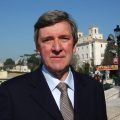
Pope Leo XIV has appointed the Lebanese-born Maronite Catholic archbishop Christophe-Zakhia El-Kassis as the Holy See’s new Permanent Observer to the United Nations in New York. He succeeds the Italian archbishop Gabriele Caccia, who had served in that post from 2019 until the pope appointed him as nuncio to the United States in March of this year.
The Vatican announced the appointment of Archbishop El-Kassis, 57, on Saturday, July 25. At the time of his appointment, he was serving as nuncio to the United Arab Emirates and Yemen and as the Holy See’s apostolic delegate to the Arabian Peninsula.
Born in Beirut, Lebanon, on Aug. 24, 1968, Archbishop El-Kassis was ordained a priest in 1994. After gaining doctorates in both civil and church law, he entered the Holy See’s diplomatic service in 2000 and served in its diplomatic missions in Indonesia, Sudan and Turkey before being called to Rome to serve from 2007 to 2018 in the second section of the Vatican’s Secretariat of State, which deals with the Holy See’s relations with states and international organizations.
A polyglot, Archbishop El-Kassis is fluent in Lebanese, Arabic, English, Spanish, French, Italian, German and Indonesian. His episcopal motto in Latin is “Scis Domine, quia amo te,” meaning “Lord, you know that I love you,” and is a reference to Peter’s words to Jesus in the Gospel of John (21:17).
Pope Francis appointed him as nuncio to Pakistan in 2018 and elevated him to archbishop in that same year. Francis then appointed him nuncio to the U.A.E. in 2023; he was made nuncio to Yemen and apostolic delegate to the Arabian Peninsula in 2024.
He becomes the eighth representative of the Holy See to the United Nations in New York since the Holy See became a Permanent Observer State in 1964. The only other Permanent Observer State in the United Nations is Palestine. As a U.N. Permanent Observer State, the Holy See has “the right to participate in the general debate of the General Assembly, the right to make interventions and the right of reply. The only explicit limitations to the role of a Permanent Observer State compared to a Member State concern the right to vote, the right to initiate resolutions and the right to put forward candidates for various U.N. and U.N.-related posts,” according to a post on the website of the Permanent Observer of the Holy See to the United Nations.
In that same post, Archbishop El-Kassis’ predecessor, Archbishop Caccia, described the role as “helping the Holy See assist the United Nations in renewing its commitment to the pillars of its Charter, preventing the scourge of war, defending human dignity and rights, promoting integral development, and fostering respect and implementation of international law and treaties.”
Other appointments announced by the Vatican today included seven board members of the Supreme Tribunal of the Apostolic Signatura, the Catholic Church’s highest court. Among the seven are two Americans: Archbishop Salvatore Cordileone, 70, of San Francisco and Bishop Edward M. Lohse, 64, of Kalamazoo in southwest Michigan.
Both bishops have doctorates in canon law from the Pontifical Gregorian University in Rome. Archbishop Cordileone gained his in 1989 and later worked as an assistant at the Apostolic Signatura from 1995 to 2002. Archbishop Cordileone was appointed an auxiliary bishop of San Diego in 2002 and the bishop of Oakland in 2009. Three years later, he was appointed Archbishop of San Francisco by Pope Benedict XVI.
Bishop Lohse obtained his doctorate in 2016 after working in the Vatican’s Congregation (now Dicastery) for the Clergy from 2010 to 2015. He was named Bishop of Kalamazoo in 2023 and apostolic administrator of the Diocese of Steubenville in Ohio in 2024.
Their appointments as members of the Vatican’s top tribunal is for a term of five years; both remain as bishops in their dioceses.

 Politics
 Faith
Faith Culture
 Vatican
 Scripture
 Podcasts