


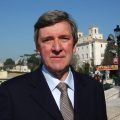
Cardinal José Cobo Cano, the archbishop of Madrid, will act as host when Pope Leo XIV visits the Spanish capital, June 9-12, accompanying the pope at all the religious events during his sojourn.
They know each other well, not only because they were both made cardinals together by Pope Francis in September 2023 but also because they worked together in the Dicastery for Bishops, when then-Cardinal Robert Prevost was prefect and Cardinal Cobo was a member.
In this interview with America, conducted by Zoom on the eve of the pope’s visit, the 60-year-old cardinal, whom Francis appointed as archbishop of Madrid on June 12, 2023, spoke about how the pope’s visit is being welcomed in Spain, not just in the church but also in the wider society. He spoke, too, about the work of the church in addressing, together with the government, the plight of migrants and the issue of sexual abuse.
Cardinal Cobo confessed that he is experiencing “very great stress” in preparing for the visit, as he works with a core leadership group of 300 people and some 18,000 volunteers. This involves dialogue with the state authorities and a great deal of coordination, especially for the Mass and procession on the feast of Corpus Christi, Sunday, June 10, where one million people are expected to participate.
At the same time, he revealed that he is experiencing “great joy” in this work of preparation because “although I thought I was going to run into many difficulties, many obstacles, instead I keep finding good people. Not just within the church, but outside it, too. People who say: ‘Whatever you need, we’ll make it easy for you.’ It was wonderful because, honestly, amid so many accounts of society being very broken, very polarized, I can truly say I have encountered a very warm regard from society, from so many good people in politics, in the economy, in culture, in public administration. So it seems to me that, alongside the stress, there is also that undercurrent of: How good people are! And how wonderful that the pope brings out the best in us.”
The following interview, conducted in Spanish, has been edited for clarity and length.
Gerard O’Connell: How is Pope Leo perceived in Spain, and what is expected of his visit?
Cardinal Cobo: This is an important moment of encouragement. We live in a time when we can see that people are discouraged and very worried about their own small concerns. And suddenly, when we announced that the pope is coming, the surprise was great. There is enormous expectation. We knew this would be normal within the Catholic community, but we’ve suddenly noticed that society at large also shows a great deal of expectation.
At its core, what we all need is to do something together, something that transcends politics, that transcends ideologies, that transcends narrow interests. Doing something together inspires people and is bringing out the best in people, and they want to contribute in some way.
This is something that the pope is provoking by his coming. For the Christian community, he is coming to confirm the faith, and this is important; that is the mission of the successor of Peter. But beyond confirming the faith, he is also confirming hope because many people are mobilizing around this.
How is Pope Leo seen here? Has President Trump’s criticism of him and his way of responding to it made him popular?
He holds the position that the church has always held about war. And this position is not new; it’s just that the same voice seems new in different settings. But there’s more: I think that starting from [his visit to] Africa, he is gradually claiming his space. He has been in office for a year, and on the world stage, his voice is taking up a special space and keeps gaining ground. He’s a man who says what needs to be said at the right moment, and as he speaks, he is claiming space in the media, claiming international space, claiming space in the political arena.
You knew Pope Francis well; he made you a cardinal. What difference do you see in how Spaniards related to the Argentine pope and how they relate to Pope Leo? Has the resentment that Francis never came to Spain faded?
I think Spaniards get over things quickly. The resentment is over. Another pope comes along, and they’ve already forgotten what came before. I think Pope Francis truly had a very clear “visit policy”: He wanted to go to the marginalized places that needed global attention. So he went to Lesbos and to North Africa, to other specific places to say: “There is a problem here, and this is where the church needs to be.”
Pope Leo is a different pope. He has a long pontificate [ahead] and different criteria. He already has a very large travel agenda, and one of the places he wants to visit is Spain. For Spaniards, I think the joy that the pope is coming has simply made them forget what came before.
Pope Leo will become the first pope to address the Spanish parliament, and do so at a polarized and politically complicated moment in Spain, including for the government of Pedro Sánchez, hit by corruption scandals. What do you expect from that speech?
I think it will bring out the best in the politicians and in politics. We have the opportunity to lift our gaze, as the motto [for the visit] says, and look at politics and give thanks to politicians because there are good politicians, and there are people giving their lives to politics. That is the virtue the church has: to suddenly elevate the gaze. The church extends its hand to all those working for the common good and building a better society.
Pope Leo arrives at a moment in which the church and the Spanish bishops’ conference have had to deal with the abuse issue—a deep wound. Is it expected that he will meet with victims, even if it’s not in the official program?
The abuse issue is a wound for the entire universal church, and also for the church in Spain. It is a topic we have been working on for a long time. But the private meetings the pope may have [during a visit] are always disclosed after they take place. He comes with a very demanding schedule, and we don’t know how he can respond to everything.
The Archdiocese of Madrid has had a victim support project for eight years, which I believe has led us to look not only at minors who were victims of sexual abuse but to address the entire scope of victimization—including abuse of conscience—and all its ramifications. And it is demanding an integral care for people. The pope is aware of all this.
[On June 5, the Vatican confirmed that Pope Leo “will meet with some victims of abuse by members of the clergy in Spain.”]
Another key topic will arise on the final part of the visit to the Canary Islands: the drama of immigration. I understand the church has backed the government’s proposal to regularize the status of migrants.
The matter of the regularization of migrants has been a long-standing project for the church. For four years, the church, together with other institutions, has been supporting a legislative initiative to make this happen. Why? Because within the migration crisis—which is very serious and a much larger reality—there is a sector of people who are already building citizenship, who are paying taxes, who are working here and have no rights whatsoever; people who came and are building our cities and our country. What do we do with them? This was a glaring injustice. These are the people caring for our children, caring for our elderly, taking them to school. And they have been here for a long time. What do we do with them?
This is not the whole migration agenda, but it was a reality that seemed to us glaringly obvious for four years. At this point, the government has taken a step to legislate for this situation. And, of course, we support it, knowing that this is not the entire migration problem.
The church—and certainly since Pope Francis—has confronted the migration challenge very directly as a reality of our century. And it is a reality we call upon governments and politics to address in the most humane way possible.
What are the other great challenges facing the church in Spain today?
In Spain, we have a long list, and I think the first is the polarization of everything. The church has a role to play here in lifting people’s gaze and prompting reflection on the meaning of the common good, which we perhaps tend to forget. Here in Spain, we talk about the “general interest,” meaning the interest of the majority, but the common good is so much more. How do we work for the common good, for human dignity, for a vision of society grounded in human dignity, at a moment when human rights are beginning to be restricted and democracy is beginning to be eroded on many fronts?
These are issues we can effectively raise, and naturally also the issue of the most vulnerable. The church is always working with them and is always the place that advocates for them.
You’ve met the pope several times. How would you describe him as a person?
A great Augustinian, a deeply spiritual man; the Augustinian spirituality is very much integrated into who he is. He is a man who knows how to listen very well. He listens and puts himself in the other person’s place. He is a man of great reflection: that is to say, when you tell him something, you have the sense that he is absorbing it and truly understanding it; and if he doesn’t, he asks. And he is a very courageous man: He knows how to make decisions at the right moment, as a pastor, as a man of God and as a man of government too. He has a formidable vision of the universal church.
Has the church in Spain changed much since Pope Benedict last came in 2011, and if so, how?
Like all of European society, things move very fast, and I think the church in Spain, too—the church and society—has changed a great deal since Benedict’s last visit. The church that Pope Leo is going to encounter is a different church from the one Benedict found. It is a different generation. We have been through Covid-19. We have also been through a democratic evolution. We have also been through a sense of despondency that we can see growing. So society is changing, and so is the church.
I think what remains—and in Spain this is genuinely true—is enthusiasm for the pope. That runs a little in our culture. And if it holds, I think he will encounter the same enthusiasm that greeted Benedict.
Could you name one or two strengths of the church in Spain today?
I think the church in Spain has a point of strength in a revitalization of the search for transcendence. That is a real strength. Another strength is the presence of the church through parishes and through popular religiosity; it is a presence very deeply embedded in society and culture. Another strength is the desire to go further. I think there is a very strong hope now that is awakening.
As for weaknesses or difficult areas: a transmission of the faith that has failed us. We were assuming that faith was transmitted through the family, through education, and that is no longer happening. I think another difficulty is dialogue: that is, how the church engages with our world. Our language fails us, or we still lack the capacity to change our language and be present in the language of our world.
And we face yet another difficulty: We need to strengthen our communities. That is, not just to have individuals speaking, but to embody the church’s proposal of fraternity in the midst of our world. At the time of the first [Christian] communities, people would say, “Look how they love one another,” and that was what converted people and inspired them. Perhaps what we need now is to revitalize those communities that are sometimes very weak and let us down.
At the start of the interview, you said many people desire the pope’s visit, that there is an expectation. What is the expectation?
I haven’t really mapped out a precise expectation for this visit, but I think it is this: When the pope comes, he helps us grow in Christian identity and in faith—that is, he gives Christians a stronger sense of identity and helps us grow in our experience. And for society, he is able to bring out the best in society, underscoring the good that exists in our society. Because there are many people who may not be believers but who want to look to the believing experience. And we can extend our hand to them and say to those who seek truth, “We stretch out our hand to begin a journey alongside you.” I think that is the one thing the pope will do: help us build bridges toward those who seek truth and meaning in life.

 Politics
 Faith
Faith Culture
 Vatican
 Scripture
 Podcasts