


Pope Leo XIV will begin his 10-day visit to Africa next Monday by stopping first in Algeria, Africa’s largest country, April 13-15. Although he has visited the country twice before—in 2001 for the International Colloquium on St. Augustine and in 2013 for the blessing of the restored Basilica of St. Augustine in Annaba (formerly Hippo)—as prior general of the Augustinian order, he is the first pope ever to visit this land. Algeria, with its predominantly Muslim population of over 45 million people, is where St. Augustine, whose inspiration gave rise to the religious order to which Leo belongs, was born and once served as bishop.
As pope, Leo comes as a messenger of peace to Algeria, as reflected in the motto for his visit: “Peace be with you!”
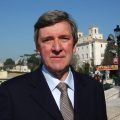
To understand the significance of the visit, earlier this week I interviewed by email Diego Sarrió Cucarella, the 54-year-old Spanish-born priest of the Missionaries of Africa, widely known as the White Fathers, and an Islamic scholar, who is the bishop of the Diocese of Laghouat, one of the four Latin dioceses in Algeria, and one of the largest in the world in terms of size. The bishop pastors a tiny flock of a few hundred Catholics—within a population of about 6.2 million, almost entirely Muslim—assisted by 14 priests, 19 women religious, and 5 men religious, according to the 2026 Church of Algeria yearbook.
After joining the Missionaries of Africa, founded in Algeria by Archbishop Charles Lavigerie of Algiers in 1868, Sarrió Cucarella studied philosophy at the Faculty of Theology of Madrid and theology at Tangaza University in Nairobi. He also spent two formative years in Sudan, 1995-97, before the country was divided by civil war. Ordained a priest in 2001, he then worked for two years in the Diocese of Laghouat, and later served in Egypt and Tunisia. He gained a licentiate at Rome’s Pontifical Institute for Arabian and Islamic Studies (P.I.S.A.I.) in 2006, and a doctorate in Islamic studies from Georgetown University in Washington, D.C. He went on to serve first as dean (2014-17) and then president (2017-24) of P.I.S.A.I., where I got to know him. He took a sabbatical at the end of his term at P.I.S.A.I. and was working as a priest in a parish in Muscat, the capital of Oman, when he received the news in January 2025 that Pope Francis had named him bishop of Laghouat, where his predecessors were also White Fathers.
The interview has been edited for clarity and length.
What is the significance of Pope Leo’s visit to Algeria?
The visit of Pope Leo XIV to Algeria is, first of all, a grace. It is not simply an event to be measured in terms of visibility or immediate impact but a moment of encounter that carries a quiet and profound meaning.
It is significant because it is a visit to a small and discreet church, living its faith in simplicity within a predominantly Muslim society. In a country of about 45 million inhabitants, this Christian presence is very modest. In that sense, the importance of this visit does not lie in numbers or public display but in relationships—those patient, everyday relationships that form the fabric of our life here.
It is also a sign of esteem for Algeria itself. By coming here, the Holy Father recognizes a country where, despite its complexities, a certain way of living together is possible—marked by respect, hospitality and a shared sense of human dignity.
For the local church, this visit is a quiet encouragement. We are a church of presence, not of prominence—called to live the Gospel through friendship, service and what we often call the “dialogue of life.” The pope’s presence confirms that this humble way of being church is not secondary but essential.
Finally, the visit carries a message that goes beyond Algeria. In a world marked by tension and misunderstanding, it points to another path, one grounded not in power or visibility, but in trust, encounter and fraternity. If this visit helps even in a small way to deepen these attitudes, then it will have borne lasting fruit.
What are the most important events of this visit?
Each moment of the visit has its own importance, less because of its scale than because of what it expresses.
The meeting with the civil authorities is significant, as it situates the visit within a relationship of respect and dialogue between the Holy See and Algeria.
The encounters with Muslim representatives, and in particular the visit to the Great Mosque of Algiers, are also central. They give visible expression to a dialogue that is not abstract but lived here over many years through relationships of trust and friendship.

For the Catholic community, there will be two particularly strong moments: the gathering at the Basilica of Our Lady of Africa on April 13, and then the eucharistic celebration at the Basilica of St. Augustine on April 14. Not because of numbers—we are a small community—but because these moments will bring together people who are usually very scattered across a country as vast as Algeria.
The visit to Annaba—the ancient city of Hippo, where St. Augustine was bishop—also carries a particular symbolic weight. It connects the present reality of the church in Algeria with a very ancient Christian heritage, while also resonating with the deeper historical layers of the country, shaped over time and expressed today within a predominantly Islamic cultural context.
And personally, I am very attentive to what the Holy Father will say in his public address to the Algerian people at the beginning of the visit at the Martyrs’ Memorial (Maqam Echahid). That moment may well set the tone for everything that follows.
How is his visit being seen in the country? Is it getting visibility in the media?
The visit is receiving real attention in Algeria, particularly in the national media, where it is being presented as a significant and even historic event. The emphasis is less on the church itself and more on what the visit represents for the country: a gesture of peace, dialogue and international recognition.
Beyond the media, one also senses a more personal and spontaneous curiosity among people. Many Algerians may not be familiar with the details of the Catholic Church, but they recognize in the pope a moral and spiritual figure, a man associated with peace.
How is the Catholic community receiving the visit?
For the Catholic community, the visit is first of all a source of deep joy and gratitude. It is experienced as a grace for such a small and discreet church to receive the Holy Father.
At the same time, this joy is lived in a very simple and sober way. The church in Algeria is not accustomed to large public expressions and remains attentive to its context. The reception of the visit is therefore marked not by outward display but by an interior encouragement and a strengthening of communion.
Many experience this moment as a confirmation of their vocation: to be a church of presence, living the Gospel through friendship, service and the simple sharing of daily life with others. The pope’s visit does not change that vocation; rather, it strengthens it quietly.
There is also a certain awareness of responsibility—that this visit is not only for the Catholic community, but for the whole country. In that sense, it is received with humility and with the hope that it may contribute, even modestly, to deeper trust and understanding between people.
How many Christians and Catholics are there in Algeria today, and are they mainly foreigners?
The Catholic Church in Algeria is very small—only a few thousand faithful in a country of about 45 million inhabitants. If one considers all Christians more broadly, including different denominations, the number is somewhat higher. There are no precise figures, and estimates vary widely, but Christians represent only a very small presence within Algerian society.
In the great majority, Catholics in Algeria are foreigners. They include university students, particularly from sub-Saharan Africa, migrants, expatriate workers, members of the diplomatic community, and, of course, religious—priests, sisters and others—who have come to serve. There are also some Algerians who have discovered the love of God in Christ, but they remain relatively few.
What is striking, however, is not so much the number as the diversity. The church is made up of people from many countries, cultures and languages. One of its challenges—and also one of its graces—is precisely to become a community despite this diversity, to “be church together” in a very concrete way.
Can one say there is a continuity in the Christian presence in Algeria from the time of Augustine to the present day?
The question of continuity is a delicate one. From a strictly historical point of view, there is no uninterrupted institutional continuity between the church of St. Augustine and the church in Algeria today. The Christian presence that was once very strong in North Africa largely disappeared over the centuries.
And yet, there is another kind of continuity, more spiritual than institutional. The memory of figures such as St. Augustine and St. Monica remains very alive, not only for Christians but also as part of the broader historical and cultural heritage of the country.
Today’s church, though small and very different in composition, finds itself rooted in that same land. It does not claim to be the continuation of a former church in a direct or visible way, but it receives that past as a gift. In its own humble way, it seeks to live the Gospel in continuity with that deeper tradition: a tradition of seeking truth, of engaging with society, and of living faith in dialogue with the surrounding culture.
This presence has also been shaped, in more recent times, by figures such as Charles Lavigerie, Charles de Foucauld, Madeleine Hutin (Little Sister Magdeleine of Jesus), Léon-Étienne Duval and the martyrs of Algeria, whose witness continues to inspire us today.
What is the state of Christian-Muslim dialogue in Algeria today? Is Pope Leo XIV following in the footsteps of Pope Francis in his relations with Muslims?
Christian-Muslim dialogue today takes different forms depending on the country. In some contexts over recent decades, it has been expressed through major declarations, international initiatives or symbolic projects such as the Abrahamic Family House in Abu Dhabi. These are important and meaningful developments.
In Algeria, however, the situation is somewhat different. Dialogue is lived less at the level of formal structures and more in everyday life. What we often call dialogue here is very simple: It is the dialogue of friendship, of neighbourliness, of shared life. It takes place in ordinary encounters—in daily activities, in relationships and in mutual hospitality. In that sense, it is something quite real, though often discreet.
This kind of dialogue has been patiently built over many years, and it rests above all on trust. It requires time, respect and a certain humility. Many of us are guests in a predominantly Muslim society, and our presence is shaped by that reality. But within that context, many genuine relationships have grown, marked by esteem and mutual understanding.
The visit of Pope Leo XIV can be seen as a confirmation and encouragement of this lived dialogue. It gives a visible expression to something that already exists quietly. For many Muslims, the pope is recognized as a spiritual figure and a man of peace. His presence can help to strengthen that perception and to deepen a climate of respect and openness. In this way, even a modest deepening of trust and widening of spaces of encounter would already be a real fruit of the visit.
In this sense, Pope Leo clearly stands in continuity with Pope Francis. Pope Francis placed great emphasis on fraternity, encounter and dialogue with Islam—not as a strategy but as a way of living the Gospel. What matters, however, is that this continuity is not simply a repetition of gestures but a fidelity to a spirit. Dialogue is not first of all about events or texts but about relationships. And in Algeria, that spirit is already present in a quiet and daily way.
Correction, April 11: The statistics for the Algerian church have been updated with the most recent numbers from the Church of Algeria yearbook.

 Politics
 Faith
Faith Culture
 Vatican
 Scripture
 Podcasts