


Pope Francis was “deeply saddened to learn of the tragic shooting” that took place at Marjory Stoneman Douglas High School in Parkland, Fla., on Feb. 14, in which 17 people were killed and many more injured, the Vatican said today.
It said the pope “prays that Almighty God may grant eternal rest to the dead and healing and consolation to the wounded and those who grieve.” He assured “all those affected by this devastating attack of his spiritual closeness.”
The Vatican released the text of a telegram signed by the Cardinal Secretary of State, Pietro Parolin, sent on the pope’s behalf to Archbishop Thomas Wenski of Miami.
Pope Francis was “deeply saddened to learn of the tragic shooting” in which 17 people were killed.
Pope Francis concluded his message by expressing “the hope that such senseless acts of violence may cease” and invoked “the divine blessings of peace and strength” on all touched by the attack.
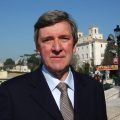
Archbishop Wenski urged community members to come together “to support one another in this time of grief.”
“With God’s help, we can remain strong and resolute to resist evil in all its manifestations,” the archbishop said in a statement. “May God heal the brokenhearted and comfort the sorrowing as we once again face as a nation another act of senseless violence and horrifying evil.”
Cardinal Daniel N. DiNardo of Galveston-Houston, president of the U.S. Conference of Catholic Bishops, called for prayer and healing. He urged all unite their “prayers and sacrifices for the healing and consolation” of those affected by the violence in South Florida and for a society “with fewer tragedies caused by senseless gun violence.”
Archbishop Wenski: “May God heal the brokenhearted and comfort the sorrowing as we once again face as a nation.”
Other Catholic leaders also weighed in Thursday, repeating similar refrains that have become common following mass shootings in the United States.
Cardinal Blase Cupich of Chicago prayed for “God’s blessing on the families of the victims, their classmates, teachers and community.” But he also took on the weapons that make these kind of crimes possible, saying, “Let us make it clear to our elected officials that the weapons and ammunition that facilitate this carnage have no place in our culture.”
“We owe it to our children to protect the cherished freedoms so many have fought and died for: to worship, learn and work in safety. That is true patriotism,” he continued. “Leaders in our country, who are in a position to make meaningful changes, need to hear the cries of the wounded and bereaved and open their hearts to the possibility of peace. Let us work and pray to that end.”
“Let us make it clear to our elected officials that the weapons and ammunition that facilitate this carnage have no place in our culture.”
Philadelphia’s Archbishop Charles J. Chaput recalled how he met with the family of victims of the Columbine High School shooting in 1999, when he was archbishop of Denver—and he lamented that the response to these kinds of shootings remain static.
“Nineteen years ago I sat with the parents of children murdered in the Columbine High School massacre, and buried some of their dead. Nothing seems to change, no matter how brutal the cost. Terrible things happen; pious statements are released, and the nation goes back to its self-absorbed distractions,” he said in a statement.
“We need to pray for the victims and their families because—as I witnessed firsthand at Columbine—their suffering is intense and long lasting,” he continued. “And we need to be angry: angry at our lawmakers for doing so little to prevent these catastrophes; angry at our news and entertainment media for simultaneously feeding off these tragedies and fueling them with a steady stream of sensationalism and moral incoherence; angry at ourselves for perversely tolerating these things, and then forgetting them until the next round of violence.”
“Nothing seems to change, no matter how brutal the cost.”
He said stricter gun control is “vital and urgent,” though he said that alone will not solve the problem of violence. “We’ve lost our respect for human life on a much broader scale, and this is the utterly predictable result,” he wrote.
Law enforcement officials identified the shooting suspect as 19-year-old Nikolas Cruz, who had been expelled for disciplinary reasons from the school where he opened fire. On the afternoon of Feb. 14, Cruz allegedly went on the shooting rampage shortly before school was to let out for the day. He was apprehended about an hour after shots were reported at the school.
The suspect carried an AR-15 rifle and had “countless magazines,” Broward County Sheriff Scott Israel said. He also told reporters that of the 17 fatalities, “12 people died in the school, two were killed outside the school, one died on the street and another two died at the hospital.” Several others were transported to the hospital. Details about the shooter’s motive were still being pieced together.
Broward County Superintendent Robert Runcie called it “a horrific situation. It is a horrible day for us.” Florida Gov. Rick Scott said, “This is just absolutely pure evil.”
Related Stories

“We are deeply saddened by the shootings in Broward County, Florida, and by the needless and tragic loss of life,” Cardinal DiNardo said in his statement. “May the mercy of God comfort the grieving families and sustain the wounded in their healing.”
“Catholics and many other Christians have begun the journey of Lent today,” he said. “I encourage us to unite our prayers and sacrifices for the healing and consolation of all those who have been affected by violence in these last weeks and for a conversion of heart, that our communities and nation will be marked by peace. I pray also for unity in seeking to build toward a society with fewer tragedies caused by senseless gun violence.”
Archbishop Wenski added in his statement: “This Ash Wednesday, we begin our Lenten Season that calls us to penance and conversion. With God’s help, we can remain strong and resolute to resist evil in all its manifestations.”
With reporting from Catholic News Service. This article has been updated with reporting from Michael J. O’Loughlin.

 Politics
 Faith
Faith Culture
 Vatican
 Scripture
 Podcasts