

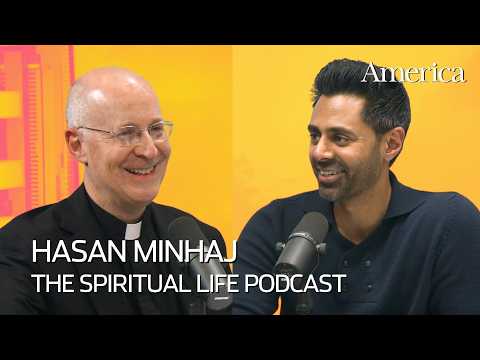
A few weeks ago, I was interviewed by Hasan Minhaj, who is best known as a comedian. But given his intense interest in different faith traditions, he could also be considered a student (or maybe even a teacher) of comparative religion. On the popular “Hasan Minhaj Doesn’t Know” podcast, he poses questions to experts in various fields for a lively conversation.
The topic of our conversation was, not surprisingly, Catholicism. And, as you might have seen, I had a delightful time fielding questions about Jesus, purgatory, the saints and pretty much everything a non-Catholic might be curious about.
My favorite part of our conversation, however, was when I turned the tables and asked Hasan about his own religion: Islam. I must admit that I am no expert in Islamic belief or practice. This is not false humility. Apart from a few books, a handful of articles, conversations with some Jesuit experts, some travel to countries where there are strong Muslim populations and osmosis from having a few Muslim friends in New York, I don’t know much about Islam.
So I was fascinated to hear Hasan’s organized, articulate and compelling answer to why he liked being Muslim. So did a lot of other people: That clip on Instagram really hit a chord.
As soon as he started explaining his religious beliefs, I knew that I wanted to have him on “The Spiritual Life” to present to us, in a little under an hour, his own understanding of Islam. And I found it, start to finish, fascinating.
I’ve never been threatened by other people’s religious beliefs (or lack thereof). That may be because I grew up in a multi-religious neighborhood outside of Philadelphia, which wore its tolerance lightly. If you know your American history and, more specifically, your Pennsylvania history, you’ll remember that William Penn, the founder of the Province of Pennsylvania, intended his colony to be a “Holy Experiment,” where people of all faiths (most especially those who had been persecuted) could settle.
When I learned more about that rich history in graduate theology studies, it finally dawned on me why, in our little neighborhood, there were not only Catholics, Jews, Methodists and Presbyterians but also Quakers and members of the Church of the Brethren. In fact, as a boy, I had far more Jewish classmates than Catholic ones, and went to about 20 bar and bat mitzvahs, compared to a total of zero first Holy Communion or confirmation parties. (I almost felt cheated for not having a bar mitzvah like my friends Gary and Arthur.)
Along the way, I went to Presbyterian youth group socials (lots of ice cream and roller skating), seders (of course) and even a nondenominational Bible camp at the home of a family down the street, where we made yellow-clay replicas of Jesus’s tomb. (If we behaved, we would be able to go down into their cool bomb shelter!) I learned a lot about different religions and different ways of speaking about, and speaking to, God.
So the next step for me is learning about Islam, and Hasan Minhaj is a wonderful guide. I hope you find our conversation as enjoyable as I did. Pay special attention to his answer about his own “image” of God. It will challenge you, I would suspect, as much as it did me.

 Politics
 Faith
Faith Culture
 Vatican
 Scripture
 Podcasts