


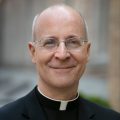
After I returned from the two sessions of the Synod of Bishops in October 2023 and 2024, many people asked me the same question: Which delegates impressed you the most? What people meant was not who was the most powerful, the most important or even the most well-dressed (though the cardinals’ and bishops’ robes were impressive). But rather, who did you look up to? And always on my list was my fellow Jesuit, Cardinal Stephen Chow, the bishop of Hong Kong.
There are not many Jesuit cardinals in the world, so other Jesuits tend to know them. So even before we met, I knew something about Stephen (as his brother Jesuits call him). Born in Hong Kong in 1959, he entered the Society of Jesus in 1984, studied psychology and then received his Ed.D. in education from Harvard University. Eventually, he became the provincial (or regional superior) of the Chinese Province of the Society of Jesus, was named bishop of Hong Kong and finally was created a cardinal by Pope Francis in 2023.
But what impressed me most was not his resume but his personality: He is calm, warm, wise, prayerful and often very funny. I found in him not only a Jesuit brother but a friend. That is one reason that I was delighted that Cardinal Chow agreed to join us for a deep conversation on “The Spiritual Life” podcast, where we discuss not only his upbringing, the interplay between psychology and spirituality and his experiences at the recent conclave that elected Pope Leo XIV (he does not, of course, break any confidences) but also his own spiritual life and practices.
Early on in our conversation, Cardinal Chow said something that I had never heard before, when I asked him about his vocation to the Jesuits. “Vocation is always relational,” he said. “It’s always relational. It’s a process of identification. I identify myself more and more with those people whom I admire, whom I respect, whom I want to be one of.”
I found that fascinating and upon a few seconds of reflection, true. It is not simply that we are attracted by a particular kind of life in the abstract (as a teacher, attorney, physician, priest, mother or father). Rather, we see individual people that we admire and say, in essence, “I think I could be like that person.” Or, “I want to lead my life like that person does, and I think that it’s possible.” “Vocation is always relational” is something that I’ll probably never forget. And the concept of vocation is intimately related to the concept of “discernment,” a favorite Jesuit word and one that Pope Francis used often.
But there is a problem: “Discernment” can be a slippery term. It is thrown around a good deal to describe almost any kind of decision-making. As Cardinal Chow says in our interview:
Do not trivialize discernment. Like, hmm, what lunch do I want to have?… Discernment is particularly good when there is tension…. That tension is a way that Ignatian spirituality really can contribute to our world. How do we hold tension?… How do we really learn from it and be creative from within the tension? And that creativity is really the work of the Holy Spirit when we listen. So, I keep on saying, do people really believe in the Holy Spirit? That’s my question.… Do we really let go and let the Holy Spirit guide us? That’s something we have to learn.
Good question. Do we really believe in the Holy Spirit? St. Ignatius Loyola felt that people had to in order to lead healthy and holy lives. And one of the great insights of St. Ignatius, particularly as outlined in the Spiritual Exercises, is not only that God wants us to make good decisions but that God will help us do that. Ignatius believed that by carefully considering the various impulses within us, some that draw us to God, some that draw us away (which he called the “good spirit” and the “evil spirit”), God would help us to make good and life-giving decisions.
Let’s take a simple example. For a person progressing along a good path (that is, trying to lead a good and moral life), the “good spirit” will always encourage a person, build them up and act “like a drop of water on a sponge,” that is, gently invite the person to move ahead. For a person going along a bad path, the “good spirit” will act “like a drop of water on a stone,” that is, noisily, waking the person up with a jolt, as we sometimes feel from our consciences. Writ large, discernment is what animated the conclave that Cardinal Chow participated in. As he saw it, the conclave was led by the Spirit.
“What is more important for me is how did we learn to listen to each other, to the Holy Spirit?” he told me. “If we all stuck with our own preferences without listening, let’s see who lasts longer, who will blink, then the conclave would’ve been much longer, right? Thank God that wasn’t the case. We were really searching, listening, looking and discerning.”
Discernment is important whether you’re a college student trying to decide on your major or a cardinal trying to choose the successor to St. Peter. I believe this conversation with Cardinal Chow, which also includes advice for finding a good spiritual director, will help you become a more discerning person.

 Politics
 Faith
Faith Culture
 Vatican
 Scripture
 Podcasts