


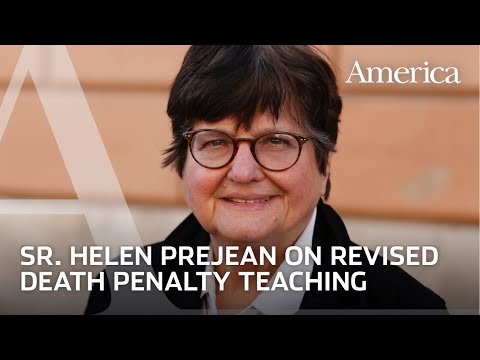
Sister Helen Prejean called it a “happy day,” 1,600 years in the making.
On Aug. 2 Pope Francis announced a revision to the Catechism of the Catholic Church that includes a complete rejection of the use of the death penalty and calls on all Catholics to work toward its global abolition. It had been a day Sister Prejean and other anti-death penalty advocates have worked for over the course of three papacies.
“No exceptions on the death penalty,” Sister Prejean said, marveling. “I’m a very happy person,” she told America in an interview live-streamed over Facebook.
“The huge thing,” she said, is the recognition by the church of “the inviolable dignity even of guilty people who have done terrible crimes.”
“The Catechism had often stated the dignity of innocent life, and people who are pro-life Catholics stand for the dignity of all life,” Sister Prejean said. “But where it pushed today, right into the heart of the Gospel, is [to say] even those who have done terrible crimes have an inviolable dignity,” she said. “And part of that dignity is not to be strapped down and rendered defenseless and killed by an intentional act. That’s what changed in this. No exceptions.”
“The huge thing,” she said, is the recognition by the church of “the inviolable dignity even of guilty people who have done terrible crimes.”
“Now all the loopholes are shut off; it’s the pure gospel of Jesus: ‘Thou shalt not kill.’ And you cannot put power in the hands of the state to decide that some of its citizens can be killed for their crimes.”
Previous rewrites of the Catechism inspired by Pope John Paul II’s encyclical “Joy of Life” had rejected the use of the death penalty as a form of punishment and described it as acceptable only out of absolute necessity in societies that were structurally unable to otherwise to defend themselves from violent actors. It was St. John Paul II’s belief, included in a revision of the Catechism promulgated in 1997, that such cases were “very rare, if not practically non-existent” (“Joy of Life,” No. 56) given the capacity of modern incarceration facilities.
Sister Prejean remembers describing the executions she has witnessed, with shackled men escorted to execution chambers where they were strapped down on gurneys, to Pope John Paul II before he began his own reworking of the catechism in the mid-1990s. “Where is the dignity in this death?” she had asked John Paul, adding, “Can you help the church solidify its opposition to the death penalty?”
But changes initiated under John Paul still left that tiny opening on “absolute necessity” that was hugely exploited by U.S. prosecutors, according to Sister Prejean. Now they will no longer be able to cite Catholic catechism as a justification for its use, she said.
The United States is the only nation in the West that still executes those sentenced under capital crimes, so the revised Catechism, which calls the death penalty “inadmissible because it is an attack on the inviolability and dignity of the person,” may have the greatest impact and generate the greatest controversy here. The death penalty may be imposed at the federal level and in 31 states; 19 states have abolished or overturned it. There are a little over 2,700 inmates on death row across the nation. This year 14 inmates have been executed and 14 more are scheduled to be executed.
As the Vatican made its announcement yesterday, New York’s Gov. Andrew Cuomo, a Democrat and Catholic who has been a prominent supporter of abortion rights, said that he would pursue the abolition of the death penalty in his state in solidarity with the pope and in honor of his late father, Mario Cuomo, a staunch death penalty opponent during three terms as New York governor from 1983 to 1994. Though the death penalty was reinstated in New York in 1995, the state has not executed a prisoner since 1963.
In Nebraska, Gov. Pete Ricketts, a Catholic, pro-life Republican, said the change in the catechism would have no impact on policy in his state. In the past, according to The New York Times, the governor has said that he viewed his position on the death penalty as compatible with church teaching.
Changes initiated under John Paul still left that tiny opening on “absolute necessity” that was hugely exploited by U.S. prosecutors.
He issued a statement in response to yesterday’s announcement. “While I respect the pope’s perspective, capital punishment remains the will of the people and the law of the state of Nebraska,” Mr. Ricketts said. “It is an important tool to protect our corrections officers and public safety.”
Carey Dean Moore, convicted of homicide, is scheduled for execution in Nebraska on Aug. 14, in what would be the state’s first execution in 21 years.
Despite the Nebraska governor’s undeterred enthusiasm for the death penalty in his state, Sister Prejean sees signs of a growing weariness with capital punishment across the nation. Public opinion polls in recent years suggest a marked turn against its use, and the number of inmates sentenced to death has plummeted. “The first signal you look to see when a country is abolishing the death penalty,” Sister Prejean said, “is what it does in practice. And now we see executions [are] way down.”
Discriminatory patterns in the application of the death penalty are becoming more obvious to courts and public alike, according to Sister Prejean. Most of the nation’s executions occur in southern states where slavery was once the law of the land, and just 2 percent of counties in the nation, she points out, are responsible for the majority of U.S. executions since the Supreme Court’s reinstatement of the death penalty in 1976.
“We’re beginning to see the shutting down of the death penalty,” she said.
How the catechism shift will affect the behavior and priorities of U.S. Catholic politicians—and even U.S. bishops—remains an open question, according to Sister Prejean, but the changes do pressure Catholics in the pews to consider how they can take part in the effort to abolish the death penalty. “When we say we’re part of the seamless garment and believe in the dignity of all life,” she said, “it means we believe that unborn children have a right to be born, of course…but [that] we also stand for the value of people who have committed murder but who are more than that.
“We stand for [life] across the board, not just for innocent life but also for guilty life,” Sister Prejean said.
The pope’s revision of the Catechism has provoked criticism from some Catholics who say that Francis is changing what should be inviolate church tradition by morally closing the door on capital punishment. Sister Prejean disagrees.


“When we made statements as a church against slavery, would the claim be that we were going against tradition?” she asked. “Because you could look back and you could see that definitely there was a time when the church upheld slavery and quoted St Paul’s words: ‘Slaves obey your masters.’
“And in the South where I grew up, in Louisiana, you could see the churches where the plantation owners would go and they would hear definitely that God supported slavery and they were O.K. morally as slave owners, and we changed that.
“So do we say then, ‘Hey, look we changed that tradition?’”
No, Sister Prejean said, “we grow as human beings, so there is always going to be development.”
Sister Prejean points out that when St. Thomas Aquinas offered his approval of the death penalty as a means of dealing with violent people “there were no prisons.”
“The bent of the Gospel is always going to be toward life,” Sister Prejean said. “Now we have a way to keep society safe without imitating the violence in killing people, so is that going against tradition or is that growing in the spirit of Jesus and his Gospel?”
This article appears in August 20 2018.

 Politics
 Faith
Faith Culture
 Vatican
 Scripture
 Podcasts