


This weekend, 40,000 people from around the world will gather at the Anaheim Convention Center for the Archdiocese of Los Angeles’ annual Religious Education Congress. There will be more than 300 workshops led by some of the Catholic Church’s most prominent figures, but the signature experience of the R.E.C. has long been its liturgies. Fourteen different services will be offered over four days, in styles ranging from small and contemplative to amphitheater-size celebrations of the Eucharist, staffed by hundreds of volunteers.
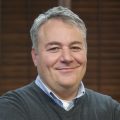
For decades the still point at the center of this whirlwind has been soft-spoken liturgist and composer John Flaherty. He recalls his first year working at the Congress in 1987: “We had one conga player, one piano player—I played synth—and a choir of about 10 people.”
“We had one conga player, one piano player—I played synth—and a choir of about 10 people.”
Leadership came quickly and without warning: A month before the 1991 Congress, the director of music took ill and Mr. Flaherty was asked to take over. “I have this vivid memory of Marty Haugen playing the piano,” he recalls. “David Haas, Chris Walker and all of these other artists were up there. They were giants to me, and they were all looking to me for direction, and I had no idea.
“I thought ‘Lord, just get me through this.’”
The Lord has seen to more than that. Under Mr. Flaherty’s leadership the R.E.C.’s liturgy committee has been a font of renewal and experimentation, exploring everything from the position of the altar to the place of silence in ritual.
“Sometimes musicians think they have to fill a moment, like when Father’s walking,” Mr. Flaherty explains. “Father doesn’t need that. That’s just muzak.
“When ritual is not filled up with noise, we experience it differently.”
The liturgy team’s most significant work, though, has been in the area of culture. When he began with the R.E.C., “There wasn’t much inculturation of the liturgy,” says Mr. Flaherty. “It wasn’t happening anywhere, really.”
But Los Angeles is one of the most culturally diverse communities in the United States. “The Eucharist is celebrated in over 50 languages every Sunday in this diocese,” Mr. Flaherty points out. “Fifty-seven of the world’s 195 countries have their greatest concentration of first- and second-generation immigrants in metropolitan Los Angeles.”
Respectful inclusivity is not enough. An inculturated liturgy must still be an invitation into a shared experience.
Mr. Flaherty believes the Congress should reflect that diversity in its liturgies. But how?
One possibility is a sort of liturgical “multiculturalism”: “The Vietnamese choir does a song in Vietnamese, the African-American gospel choir do their song, the English-speaking choir…”
But he found that this approach lends itself more to watching one another than to communal worship. “We’re all in the same room and we think we’re celebrating together, but really we’re not because we’re not doing anything together.”
And therein lies his key insight: To function as ritual, respectful inclusivity is not enough. An inculturated liturgy must still be an invitation into a shared experience.


With this lesson, participation and unity became the liturgy team’s guiding principles: “Who is the assembly,” Mr. Flaherty asks, “and what can we do to unify us?” So if the Congress offers a Vietnamese cultural liturgy, they might have the psalm verses sung in Vietnamese, he says, “but we will always answer in whatever language is most common among us.”
The resulting Mass looks different than it would in Little Saigon, but Mr. Flaherty discovered that this is an asset. “It becomes something new because we’re all doing it together.”
For Mr. Flaherty, the question of finding communion among various cultures is deeply personal. His mother grew up about 50 miles outside Nagasaki, and as a child she was repeatedly strafed by American fighter planes; her older brother was killed fighting for Japan at Iwo Jima. “Every time I see that famous picture of a Japanese soldier’s skull still wearing his helmet in the burned-out tank on Iwo Jima, I think of him,” Flaherty says.
“The war, and in particular the dropping of the atomic bombs, have had a profound impact on our family.”
Those in attendance at the R.E.C. this weekend will find in the liturgies a powerful expression of the worldwide Body of Christ.
Mr. Flaherty hopes there are moments for mystagogy and imagination, as well.
“That’s the beauty of art,” he says. “You’re constantly thinking and learning and growing.
“I look to moments that model the possibilities.”

 Politics
 Faith
Faith Culture
 Vatican
 Scripture
 Podcasts