


Editor’s note: This essay is adapted from a plenary address given at a conference on “Law, Conscience, and Migration Today” at Boston College on Feb. 19, 2026. It has been edited for length and style.
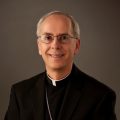
Since 2013, I have been the Bishop of the Diocese of El Paso, one of the “border dioceses” on the U.S.-Mexico border that has been for many years the focus of rhetorical and sometimes physical conflict over the issue of migration. As such, I am often asked to offer my view of the current situation at the border. In addressing that important issue, I try to take inspiration from the pontificate of Leo XIV and gesture a bit beyond the current news cycle to bring light on some deeper issues that I believe are at stake in the contemporary debate on immigration in our country and are urgent for our consideration. Finally, I also try to offer some reasons for which I think we can have hope, even in these challenging times.
Let me start with the reality at the border. For 396 days—that is, since Day One of the current presidential administration—our nation’s very carefully crafted system of protection at the border for receiving those fleeing threats to life and liberty, a system crafted in the aftermath of the horrors of the Second World War, has been effectively dismantled. This tracks, too, with the gutting of our nation’s obligations to international refugees. This is not to ignore the many challenges posed by migration at the border in recent years, or the outmoded nature and inflexibility of our asylum system, but the persistent rhetoric once emanating from the fringes of the political right—which demonized those arriving to the border and characterized them as existential threats to the homeland—has now migrated to the political center and had its intended effect. Asylum and international protection are over.
But the logic and mechanisms of patrol that have long been a reality of life at the southern border have now been extended to the entire nation. Let me offer an example.
Only several months ago, the Trump administration opened a very large detention center in El Paso called Camp East Montana. This immigrant detention center, now the largest in the country with a daily population well over 3,000, is located on an installation of the U.S. Army, Fort Bliss, one of the largest military installations in the world. As a historical point of curiosity, refugees fleeing the Mexican Revolution in the 1910s were also interned at Fort Bliss.
On most Sunday afternoons, I celebrate Mass at the camp. My office regularly receives phone calls from detainees at the camp asking me for help and to intervene for them. I won’t speak to my personal observations of the conditions there, but suffice it to say that in just the past couple of months, three people have died there, an extraordinary number. One of those deaths, that of Geraldo Lunas Campos, a 55-year-old Cuban gentleman, was ruled a homicide by officials of the El Paso coroner’s office. It appears he was asphyxiated in an altercation with guards. The most recent to die, Victor Manuel Diaz, a 36-year-old gentleman from Nicaragua, was determined by the facility to have died of suicide. The problem, however, is that following the determination of homicide in the case of Geraldo Lunas Campos by the El Paso coroner, the detention center moved to have the body of Victor Manuel Diaz autopsied by the U.S. Army, rather than the coroner, and the U.S. Army will not release a public report.
In recent months, many of those detained at Fort Bliss have come from Minnesota. Our diocese and our partners regularly receive urgent pleas from relatives in Minnesota: In one case, a detainee needed lifesaving medication and could not access it. Other people are receiving substandard medical care, or looking for their relatives (but the government won’t publicize their locations), or seeking pastoral care but can’t access it. Some are in need of attorneys or have already signed their voluntary deportation orders but for some unknown reason are languishing in detention, unsure when they will ever get out.
This is all happening on a military base, at a distance from the community. I am convinced we built the border wall and have sequestered these places of mental and physical torture on military bases or in faraway rural counties not so that immigrants stay away, but so that we don’t have to see them. Our tax dollars subsidize this luxury of sequestering human pain, clinically cordoning it off, just like the biblical scapegoats in Leviticus who were sent off into the barren wilderness, where some were even pushed off the cliffs to their deaths. Now, in El Paso, there are plans to open an additional detention facility, this time with capacity for 8,000 persons.
But you see the connection: The gross enforcement actions which all of us witnessed in Minnesota are linked to the migration of human pain from the Twin Cities to places like Camp East Montana in El Paso.
The border is everywhere now
There are more connections. You may have noticed in the Twin Cities—and not only there but in Chicago, in Los Angeles, in North Carolina and other places—the presence not just of ICE agents executing the administration’s mass deportation agenda, but also uniformed Border Patrol agents. Border enforcement agents are helping to carry out the country’s immigrant removal agenda.
Now, in my time at the border, I have met many honorable Border Patrol agents and personnel. (As a matter of fact, I recently ordained one as a permanent deacon.) There are many good ones. Yet there are some pertinent facts to lay on the table. Without even getting into the historically racialized dynamics of border enforcement (and these are important), the Border Patrol is an agency that has struggled significantly with corruption, the violation of civil liberties, a lack of accountability and issues surrounding the use of force.
I think the following is instructive. In the decade following Sept. 11, the Border Patrol doubled in size as a result of efforts to strengthen homeland security, from about 10,000 to about 20,000 agents. Budgets and infrastructure grew. This high growth of expansion led to a frightening reduction in hiring standards and the cutting of corners in training. Many of those who were recruited came from theaters of war in the Middle East and returned with a mentality that they were protecting the country from existential threats. This attitude collided with the need to process an increasing number of asylum seekers; what was needed was care, compassion and respect for constitutional law and international asylum law, for which the average agent was poorly equipped.
One can understand why, in the heat of this collision, there were so many frustrations on the part of agents, abuses, questionable deadly weapons discharges and a troubling pattern of skirting the rule of law.
Now consider what has been happening in Minneapolis and across the country. Following historic increases in funding for immigration enforcement with the “Big Beautiful Bill” last year, and a consequent hiring surge, we are seeing the same post-9/11 dynamics that we witnessed at the border play out nationwide. The administration has sidelined many of those in ICE leadership because they were not executing the deportation agenda quickly enough, complementing and supplanting ICE with Border Patrol personnel who have demonstrated a willingness to play fast and loose with the rule of law and with due process.
Many of those now being recruited into ICE are being recruited with the dangerous mentality that by detaining and deporting brown people, they are protecting America from existential threats. Sanctioned at the highest levels, abuse now risks going mainstream. When someone is an existential threat, anything is licit.
In this sense, the border now really is everywhere. And this should wake us all up.
Pope Leo XIV
Now let me turn to Pope Leo, with a slight detour via Pope Francis. I was blessed to have many occasions during his papacy to be with Pope Francis, who was a giant on the world stage and who I think was uniquely suited to our times. He offered the world joy, simplicity, credibility and an incisive call to moral coherence. He offered the world the Gospel and Jesus Christ.
For Francis, the moral challenge of our time was expanding the circle of people who count. He called us to build a wider we, un nosotros cada vez más grande. Who counts? Do the unborn count? Does the sick person or the poor person count? Does the foreigner count? Because at the end of the day, everybody counts or nobody counts. The mission territory of our time for Francis was the building up of human fraternity according to the mind and heart of God.
It is already clear that Pope Leo assumed his predecessor’s call as his own.
In October of last year, I brought Pope Leo a box of letters from immigrants across the country, many terrified of ICE, terrified for their families, terrified for their lives. He took it from me and he told me the church in the United States had to act, to speak up. Those are the marching orders he gave me. I brought that message back to the bishops, and they responded with a national message in November, condemning mass deportations.
That is a message I think needs to be read from every pulpit across the country. It should be printed in every parish bulletin in the country. If you haven’t heard it from your pastor, let him know.
I think Pope Leo sees his task as implementing his predecessor’s social vision, a Gospel-inspired claim to human fraternity in a world increasingly unmoored from political, social, economic and moral stability. That’s a challenging task.
Today, we can no longer count on truth-telling. Although we are drowning in information, we are in the midst of a famine of knowledge and wisdom. Our institutions are collapsing and we are riven by insecurity. Politically, the ascendant ideology is one of “might makes right.” Socially we are divided, even in the midst of instant communication, and when we are together, we are at each other’s throats. A new generation of robber barons, buttressed by the power of artificial intelligence, is now at the gates, threatening to overtake our entire political economy, not to mention our natural resources and common home, subordinating it to the interests of the elite.
All of this taken together represents a formidable challenge to the common good, and perhaps an unprecedented moral challenge as well.
This is precisely why the pope took the name Leo. Taking the name Leo was an important step, because all of these elements are the contemporary challenges which we must face and face down with the inspiration of the Gospel today, just as Pope Leo XIII did when the world faced the brutal realities of industrialization and the concentration of capital in the hands of a few in the 19th century and wrote his famous encyclical, “Rerum Novarum.”
This is why the new pope needs our prayers and our support. He is addressing the Gospel to these new realities and trying to do so, as Francis did, with joy, simplicity, credibility and an incisive call to moral coherence. He is pleading with us to rebuild on surer foundations of human dignity, justice and mercy.
The migrant victims of instability
In our world today, these sources of instability produce forced migration. It is immoral to make the victims of forced migration pay the price of our political, social, economic and moral crisis. Mass deportation is a campaign of scapegoating. It is a gross distraction. And taking place as it does against the ideological bunting of “might makes right,” I’m sorry to say that it is also violent.
How can we not recoil before the violence that is at the heart of this campaign? It is not accidental but structural. When enforcement agents patrol our streets and neighborhoods decked out with more military kit and equipment than our soldiers who patrolled the streets of Fallujah and Kabul, when women are ripped from their cars, when tear canisters are fired into automobiles with infants, when playgrounds become battlegrounds, when people are slammed into walls with concussive force, when people are gunned down on our streets, when detainees are choked to death—at what point do we say enough is enough? At what point do we recognize that this is not just a bug, but a feature? Are we so incapable of moral discernment? Have we lost our spiritual equilibrium?
Pope Leo, of course, is an Augustinian. At the heart of St. Augustine’s social theory was not violence, but an original peace: the idea that we and the world were created for peace. That peace is ultimately more fundamental, more credible, more generative of the common good and a just order than violence. To the notion that “might makes right,” St. Augustine famously opposes the tranquillitas ordinis. That is, every law and policy must be in the service of peace and human dignity. As the Second Vatican Council taught, the order of things must be subservient to the order of persons, not the other way around. The Sabbath was made for man, not man for the Sabbath. St. Augustine and Pope Leo propose a different vision of the human person and society.
And for this reason, Leo has insisted that “every migrant is a person and, as such, has inalienable rights that must be respected in every situation.”
Reasons for hope
In the Letter to the Romans, Paul calls God “the God of hope.” In 1 Peter, we read that we should always be ready to offer an account regarding our hope. That’s the task of our Christian community today and at all times.
Hope can be found even in situations and circumstances that seem hopeless. One example is part of the story of Alex Pretti, who was shot and killed by Border Patrol agents on Jan. 26.
It is hard to know the totality of the circumstances that led to Mr. Pretti’s death, so I am hesitant to make a judgment or assume anything. What I will say is this.
Following Alex Pretti’s death, a Mass was celebrated by a priest chaplain who worked with Alex for 10 years in the hospital and said that he was “known for his kindness and gentleness to patients.” In the video of his shooting, you see him instinctively reacting to a woman being shoved to the ground; nurses, of course, are trained to put the safety of others in front of their own. That’s what it means to be a caregiver.
In light of what I wrote above about St. Augustine and Pope Leo, it is worth noting that following Alex Pretti’s killing, Archbishop Bernard A. Hebda of Saint Paul and Minneapolis said his death “should prompt all of us to ask what we can do to restore the Lord’s peace.”
What happened in Los Angeles, in Chicago and in the Twin Cities ICE surge was hard to stomach. It was brutal and it was violent. People died. Kids were traumatized. Women and elderly persons, those to whom we owe care and gentleness, were brutalized. And it’s still happening. We’re not solving anything. We’re not fixing our immigration laws. We’re not making our streets safer. We’re not shoring up the rule of law. We’re not solving poverty or hunger or meeting human need.
But there are people like Alex Pretti who decided to put their bodies, their lives, on the line. There are priests and sisters and pastors and rabbis and imams who are saying enough is enough. It’s time for a change. There are ordinary people across this country who are watching what is happening with moral revulsion, who care about the Constitution, who care about the moral fabric of the country, who care about their immigrant neighbor, who care about our common future.
In Minneapolis, neighbors showed up for neighbors. Priests organized their parishes to support those who were missing from the pews, and they ensured access to the sacraments was made available to all. Truthful information was shared. People showed up to witness and document what was happening in order to protect the vulnerable.
These moral acts need to be multiplied. In Massachusetts, in Texas, in every state in the country.
And so there are seeds of hope.
An invitation
On Feb. 12, White House Border Czar Tom Homan announced the drawdown of ICE in Minneapolis. Now I like to believe it was at least partly because he is a Catholic, but it was also because of the clear rejection of mass deportation that we saw in the many acts of courage, solidarity and moral clarity in the aftermath of the deployment of ICE there.
On the Memorial of St. Oscar Romero this year, March 24, I’m going to call our El Paso Catholic community to march together, to take to the streets in an act of moral courage, as a seed of hope. Bishop Evelio Menjivar, who himself was called illegal and undocumented, and who is himself from St. Romero’s country of El Salvador, will join us.
The march has two purposes: one, to stand united against mass deportation, and two, in the face of so much death, to stand together for human life. Anyone who wishes is welcome to join us. At the border, we need your support. And those who cannot march, because they are afraid, also need your support.
Thank you for your kind consideration of my invitation. And I thank you for your support.

 Politics
 Faith
Faith Culture
 Vatican
 Scripture
 Podcasts