

 The USCCB’s Committee on Doctrine has just issued a critique of a recent book by Elizabeth Johnson, CSJ, Distinguished Professor of Theology at Fordham University and an award-winning Catholic author and educator, which is entitled Quest for the Living God: Mapping the Frontiers in the Theology of God. The Committee said in a news release published yesterday that it finds that many of the book’s conclusions “incompatible with Catholic teaching.”
“Against the contamination of Christian theology after the Enlightenment by modern theism, Sr. Johnson claims to be retrieving fundamental insights from patristic and medieval theology. As we have seen, however, this is misleading, since under the guise of criticizing modern theism she criticizes crucial aspects of patristic and medieval theology, aspects that have become central elements of the Catholic theological tradition confirmed by magisterial teaching,” the statement said. The committee’s complete analysis of the book is much more detailed.
“The Bishops’ Committee on Doctrine is first and foremost concerned about the spiritual welfare of those students using this book who may be led to assume that its content is authentic Catholic teaching,” wrote Archbishop Donald Wuerl, chairman of the committee, in a letter addressed to U.S. bishops, and suggested it would have been “helpful” if Sister Elizabeth “had taken advantage” of the opportunity to seek an imprimatur, the church’s official approval of a book, granted by a bishop after a lengthy process of review by theologians. The archbishop added, “The Bishops’ Committee on Doctrine is always open to dialogue with theologians and would welcome an opportunity to discuss Sister Elizabeth’s writings with her.”
For her part, Sister Elizabeth, in a statement said that the bishops’ committee “radically misinterprets” what she thinks in several instances “The book itself endeavors to present new insights about God arising from people living out their Catholic faith in different cultures around the world. My hope is that any conversation that may be triggered by this statement will enrich that faith,” she said. Sister Johnson noted that the committee had not invited her to discuss the book before the appearance of their statement. “I would have been glad to enter into conversation to clarify critical points, but was never invited to do so. This book was discussed and finally assessed by the Committee before I knew any discussion had taken place.”
Quest was reviewed in America in 2008 by John Thiel, professor of religious studies at Fairfield University, who concluded his review by saying, “It is rare that one finds a book that will appeal to all sorts of audiences, but Quest for the Living God is one. Professional theologians, undergraduate students and literate people of faith will enjoy all that this engaging work has to offer.” Elizabeth Johnson is also well known to America readers, having been selected by the editors to contribute to our 2009 Centennial Issue, for which she wrote, “An Earthy Christology.”
I haven’t read Quest, so I can’t comment on the notification at all.
But I have read almost all of Elizabeth Johnson’s other books, and have found them to be of great use to me as a Christian, a Catholic, a Jesuit and a priest. She is one of my favorite theologians. During my graduate theology studies, I was introduced to her scholarship in She Who Is, a remarkable and remarkably readable work on the often overlooked feminine imagery of God in the Bible (and elsewhere in our tradition), which opened my mind to new ways of thinking about God. (The sections on Sophia are especially good.) Her equally inviting Friends of God and Prophets, on the theology of the communion of saints, was a major influence in the way I look at the saints and helped me to understand more deeply their dual traditional roles as patrons and companions. Truly Our Sister is certainly the best book I’ve ever read on the theology of Mary (Mariology), and its companion book, Dangerous Memories, a shorter book drawn from Truly Our Sister, looks specifically at New Testament texts in which Mary appears. It’s the first book I recommend to people on that topic. My favorite of all of Sister Johnson’s books, though, is the wonderful Consider Jesus, which I’ve read many times, a user-friendly introduction to contemporary Christology. (Her meditations on Jesus’s growing self-consciousness of his mission and identity is particularly astute and provocative, and has helped me to understand more fully the concept of growing in an embrace of one’s vocation over time.) I’ve recommended that book to dozens of friends, parishioners and spiritual directees and, a few years ago, used it profitably (along with Dangerous Memories) in a book club that I ran at a local Jesuit parish. One evening Elizabeth Johnson herself came on a rainy night to speak to the book club and to the larger parish community, and she turned out to be a warm, welcoming and pastoral presence, always treating every question (no matter how barbed, ill-informed or weighted with sarcasm) with dignity and consideration and charity. She is a terrific teacher.
I hope that this recent notification does not deter anyone from reading the books I’ve mentioned above, which have been of inestimable help to me in my own quest to seek the Living God.
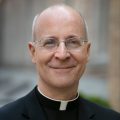
James Martin, SJ

 Politics
 Faith
Faith Culture
 Vatican
 Scripture
 Podcasts