


Can the truth set you free? That’s a complicated question in a “post-truth” era, where people will cling to beliefs that support their worldview, even in the face of hard evidence to the contrary. But this didn’t start with climate change denial or vaccine conspiracy theories: Humanity has always had a talent for ignoring or dismissing the truth when it’s personally inconvenient. That’s the story of the Gospels. Jesus preaches the truth about God and salvation, but it’s a truth that makes many people uncomfortable. In response they reject him, beginning with the scribes who try to poke holes in his theology and culminating in Pontius Pilate’s dismissive “What is truth?” (Jn 18:38).
The truth makes demands of us. It may call us to sacrifice our comfort, security or social standing as we pursue it. For some people, that discomfort is enough of a reason to turn a blind eye. But for others, once they know the truth, they must serve it at all costs.
When Robert Bilott (Mark Ruffalo), the protagonist of Todd Haynes’s “Dark Waters” (2019), investigates a case of illegal chemical dumping in Parkersburg, W.Va., he’s not on a quest for the truth. A successful corporate lawyer in Cincinnati, he’s really only doing it to humor a family friend: gruff farmer Wilbur Tennant (Bill Camp).
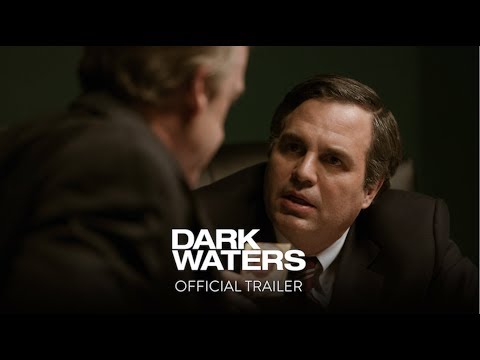
Wilbur is convinced that something is poisoning his land. Recently his cows have died by the dozens, their teeth rotted and black, monstrous tumors sprouting from their skin. He shows Rob rocks in a nearby stream that have turned an unearthly white, bleached by chemicals in the water. At first Rob dismisses Wilbur as paranoid, but as he investigates, a horrific picture emerges. Residents have developed deadly cancers, babies have been born with deformities. And the most dreadful revelation of all: DuPont, the chemical giant that is Parkersburg’s largest employer, dumped chemicals that they knew were harmful and covered it up. For decades they knowingly poisoned their employees, neighbors and consumers, and said nothing to protect their profits.
Wilbur is sure that things will change if they can expose the truth. But even Rob, who is well-acquainted with how the chemical companies work, is unprepared for how far DuPont will go to deny the truth. As the lawsuit drags on for years, Rob’s career, health and marriage to former-lawyer-turned-housewife Sarah (Anne Hathaway) begin to deteriorate. Plaintiffs die from their diseases with the fight unfinished. Others become frustrated with the lack of progress, accusing Rob of not fighting hard enough. The film never doubts that Bilott is doing the right thing, but it also offers no illusions that doing the right thing is easy.
Our heroes even face rejection from the people they are trying to help. The ordinary working folks of Parkersburg resent that the lawsuit is targeting their town’s biggest employer, afraid of the economic impact if DuPont decided to pull up stakes. We see Wilbur and his family receive a particularly chilly reception at their local church: In a company town, the company reigns above all other gods.
Still, Rob and Wilbur have the satisfaction (such as it is) that they are serving the truth and not a false idol. Where others turn away or back off because of the personal costs, they persevere. “You saw a man hurting and you did the Christian thing,” Sarah tells Rob (she is a devout Catholic, although Rob’s own piety is left ambiguous). “You helped him.” In one powerful scene, Bilott confronts DuPont’s C.E.O. with the photo of a former employee’s baby, born with a facial deformity—just one of many babies poisoned in the womb by DuPont’s chemicals. The C.E.O. is clearly uncomfortable, and maybe even feels the sting of conscience. But even after that meeting, the company continues to avoid any responsibility for years. He sees the photo—literally stares the truth in the face—and chooses denial because it’s more comfortable.
Although Rob is eventually victorious (the film is based on a true story, so I don’t think that counts as a spoiler), Haynes isn’t interested in a triumphalist David and Goliath story. Much of the film is filled with a queasy sense of dread, with cinematographer Edward Lachman’s desaturated color palette suggesting a world slowly being leeched of life. Yet at heart “Dark Waters” isn’t a cynical film, either. The truth can set us free, and things can change for the better. But “Dark Waters” tells us that if we want to serve the truth, we should be ready for an uphill battle.
“Dark Waters” is available to rent and buy on Amazon Prime and AppleTV+.

 Politics
 Faith
Faith Culture
 Vatican
 Scripture
 Podcasts