


The pope calls for international institutions to serve the most vulnerable.
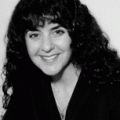
Maryann Cusimano Love
Dr. Maryann Cusimano Love is an Associate Professor of International Relations in the Politics Department of The Catholic University of America in Washington, DC. She is also a Fellow at the Commission on International Religious Freedom. She teaches graduate and undergraduate International Relations courses at Catholic University and the Pentagon, such as Security, Just Peace, Terrorism, Globalization, and The Problem of Sovereignty. Her recent books include Beyond Sovereignty: Issues for a Global Agenda (4th Edition, 2010), Morality Matters: Ethics and the War on Terrorism (forthcoming at Cornell University Press), and "What Kind of Peace Do We Seek?" a chapter on peacebuilding to appear in Notre Dame University's volume on The Ethics and Theology of Peacebuilding. She serves on the U.S. Catholic Bishops' International Justice and Peace Committee, the Advisory Board of the Catholic Peacebuilding Network, and the board of Jesuit Refugee Services.
Dr. Love lives on the Chesapeake Bay outside of Washington, DC, with her husband Richard and three young children, Maria, Ricky and Ava, who inspired her New York Times best-selling children's books, You Are My I Love You, You Are My Miracle, You Are My Wish, and Sleep, Baby, Sleep.

Posted inFrom Our Archives
A Call for Truth and Trust: The moral and economic vision of ‘Caritas in Veritate’
Daily I receive emails, often from Nigeria, offering financial partnerships and lots of easy money. You likely receive them too. The themes vary, from estates left unclaimed to widows needing assistance from corrupt government bureaucrats, but usually they boil down to a pledge that huge sums will be deposited in my bank account if I merely divulge my account numbers. Why do we delete these emails? Because we don’t believe the information is true and we don’t trust the “business partners.”
What do we do when the entire economy becomes a Nigerian email scam? This is essentially what has happened to us in the global economic crisis. People, investors, and banks have lost trust because they don’t believe economic players are telling the truth, and so they are unwilling to do business with them. Banks stopped lending, individuals stopped buying investments, due to a loss of trust and truth across the global market.
For most of us, our eyes glaze over at talk of the causes of the current economic crisis. Complex derivatives, subprime mortgages, overleveraging of corporations, inflated rating systems, dark markets—the terms and practices are convoluted and opaque. Pope Benedict XVI’s summary of the problem is not. The pope’s recent encyclical, “Caritas in Veritate,” offers ethical standards for the global economy. Economies need truth and trust to work. Absent those they do not work. We have to put people before profits. When we don’t the whole enterprise comes tumbling down. As the pope notes, “Without truth, without trust and love for what is true, there is no social conscience and responsibility, and social action ends up serving private interests and the logic of power, resulting in social fragmentation, especially in a globalized society at difficult times like the present…I would like to remind everyone, especially governments engaged in boosting the world’s economic and social assets, that the primary capital to be safeguarded and valued is man, the human person in his or her integrity.”
We cannot blame only Bernie Madoff, Nigerian scam artists or a few unscrupulous individuals for the recession. The lying, lack of full transparency and insufficient attention to love of neighbor, the common good and justice was widespread. Individuals, banks, investment companies, insurance companies and major corporations lied (even to themselves) or were not fully transparent or were misled about how much income and debt they had, what their assets and liabilities were worth, how much risk they were exposed to and were exposing others to, and how much risk and debt they could afford. When the deceptions (and lack of full transparency) became apparent, trust disappeared and so did the market. Credit froze and people pulled their money out of banks and investments because they didn’t know who was telling the truth and who to trust anymore; good businesses and business people suffered along with the unscrupulous ones. When the markets died so did people; the poor and most vulnerable around the world suffer the most as they lose jobs, food, homes and health. One hundred million more people now go hungry than when this crisis began. Charities lost their investments and donations dried up precisely when more people need their services.
Beyond Profits

Posted inFrom Our Archives
The Pope’s Call for Charity: An examination of Benedict XVI’s encyclical on the economy

Two contributors consider Benedict XVI’s encyclical on the economy

Posted inColumns
Accounting for Torture: ‘What are our moral obligations as disciples of a tortured God?’
‘What are our moral obligations as disciples of a tortured God?’

Posted inColumns
The Common Ground: ‘Perhaps the visions of Benedict and Obama can coincide.’
‘Perhaps the visions of Benedict and Obama can coincide.’

Posted inColumns
Peaceful Change: ‘Peaceful political transfer is under tremendous threat.’
‘Peaceful political transfer is under tremendous threat.’

Posted inColumns
Woman and Child: ‘Often the simplest interventions can work miracles.’
‘Often the simplest interventions can work miracles.’

Posted inFrom Our Archives
An End to Torture: Can the United States recommit itself to legal interrogation techniques?
Can the United States recommit itself to legal interrogation techniques?
