

 According to The Washington Post and The New York Times the Iraq War has ended—again. But we still have not come to terms with what it has really meant.
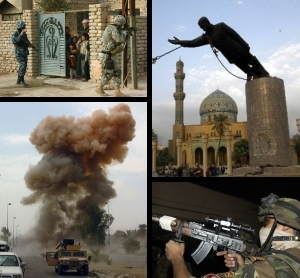
Those with long memories remember that the first George Bush Gulf War ended as we slaughtered the helpless remnants of the Iraqi army fleeing from Kuwait, bombing their defenseless convoy. The Bush Junior phase of the war ended symbolically when American troops staged the yanking down of Saddam’s statue in a Baghdad square, and again when Bush landed on an aircraft carrier to declare victory, and again when Saddam was hanged. Today it is over again because all the American troops are coming home—except for those who are remaining and those who will be sent back when the terms have been negotiated.
The Washington Post’s front page featured a photo of a wailing Iraqi widow at the discovery of a mass grave of Saddam’s victims. According to the caption, “Over the years thousands of people had disappeared into the dictator’s security apparatus.” The picture’s message seems to be that the American troops have liberated Iraq from a dictator who was killing his own people, and that therefore the war was justified. Not counting those who died in wars and rebellions, Saddam’s regime, during his 30-plus years rule, killed an estimated 300-500,000 citizens.
The Post’s story by Scott Wilson recognizes the war’s ambiguity, considering the effect on the national debt from its trillion dollar cost, the 4,400 dead American troops and probably twice as many amputees, and the fragility of the war-torn country left behind. Wilson records but does not question what was perhaps the main reason for the war, the neoconservative theory that by removing Saddam we could establish a friendly democracy in the Middle East and make Israel safer.
Both papers carry standard stories of President Obama welcoming home and thanking the troops. On page one the Times takes a different approach. It breaks the story of its reporter discovering in a junkyard outside Baghdad 400 pages of secret documents, meant to be destroyed, the interrogations from the investigation of the Haditha war crime, where Marines, enraged at the death of one of their buddies from a road bombs, killed 24 Iraqi civilians, including a 76-year-old man in a wheelchair, women, and children, some of whom just toddlers. No one has been punished.
According to the documents, Marines had come to consider 20 dead civilians, “not remarkable,” but as routine. Maj. General Steve Johnson, commander of the forces in Anbar, described it as “the cost of doing business.” He adds, “It happens all the time.”
Oh?
Nothing in the papers, no editorials, about the real human and moral costs of the war. The most conservative estimate of civilian deaths caused by the U.S. (Iraq Body Count, which considers only those reported by two media), is 113,125. Wikileaks adds another 15,000. And according to Joy Gordon’s Invisible War, on the sanctions between the two Gulf Wars, sanctions killed another 500,000 children. Questioned, Madeline Albright said it was “worth it.”
Today President Bush, Donald Rumsfeld, Dick Cheney and Condolessa Rice publish memoirs and have no regrets. The U.N. inspectors had told us there were no “weapons of mass destruction.” That the war was fought under false pretenses does not bother them. All those dead are not people, they’re just numbers. They’re the cost of the way America does business.
Raymond A. Schroth, S.J.

 Politics
 Faith
Faith Culture
 Vatican
 Scripture
 Podcasts