


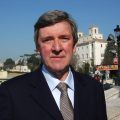
Cardinal Ángel Sixto Rossi, S.J., 66, one of the four Argentine cardinals who voted in the election of the first American pope, will welcome Pope Leo XIV to Córdoba on Nov. 10, where he is archbishop. He will accompany the pope during his one-day visit to the second-most populous city in Argentina with a long tradition in university education, culture and the Christian faith.
In this interview, conducted by email in Spanish with America’s senior Vatican correspondent on the eve of Leo’s visit, Cardinal Rossi speaks about the significance of the visit for Argentina and for the church in this country. He highlights the priority Pope Leo gives to “vulnerability” in society and firmly asserts that “on the essential issues,” the first pope from the United States “is keeping step” with his Argentine predecessor, whom the cardinal knew well.
Born in Córdoba in 1958, Cardinal Rossi entered the novitiate of the Argentine province of the Society of Jesus in 1976, when Jorge Mario Bergoglio (the future Pope Francis) was provincial. After studying philosophy and theology in Argentina and Ecuador, he was ordained a priest in December 1986. He then studied at the Pontifical Gregorian University in Rome, where he obtained a degree in spiritual theology, with a thesis on spiritual discernment in the writings of St. Ignatius Loyola.

Ángel Rossi and the future Pope Francis lived under the same roof for eight years, first at the Colegio Máximo de San José in San Miguel, Argentina, and later in the Iglesia del Salvador in Buenos Aires (1990-92). Cardinal Rossi is deeply committed to the poor and opened the Hogar San José for the homeless in Buenos Aires. In 1992, he created Manos Abiertas (Open Hands), a foundation that provides aid to the poorest and most vulnerable in social assistance centers spanning 10 cities throughout Argentina.
He served as master of novices for the Argentine province from 1992 to 1995 and as superior of the Jesuit community in Córdoba from 2013 to 2019. Pope Francis appointed him archbishop of Córdoba in November 2021, and created him cardinal in September 2023.
The following interview was conducted in Spanish and has been edited for length and clarity.
Gerard O’Connell: Pope Leo will visit Argentina from Nov. 8 to 11. What kind of country will he find from a socioeconomic and political perspective?
Cardinal Rossi: He will find an Argentina that is, let’s say, socially and economically depressed, wounded. And although you always sense a kind of hope in people, which honestly surprises you, I think a kind of disenchantment is also setting in little by little. It would be good if it didn’t do us too much harm because I have the sense that there are too many broken promises or a triumphalist language or message that, when it doesn’t match reality, inevitably leaves people feeling disappointed.
What kind of Argentina will Pope Leo find from a religious and cultural perspective?
Perhaps he will find an Argentina that, religiously, still has strong embers of faith. I believe his visit will surely brush the ash off a certain weariness, a certain slackness in faith. I think we have to approach this with hope. There is a reserve of faith that, even if at times it seems to be dimming a little, I believe is still in the heart of the people, and it’s on occasions like this that it comes to light.
How would you describe the Catholic Church in Argentina today? What role does it play? What place does it hold?
It is a respected church. To some extent, it seems to me a church that is still a little drowsy, a little anesthetized. I think all of us lack a greater apostolic aggressiveness.
Not the bad kind of aggressiveness but the apostolic kind: a proclamation that is clearer, closer to people, more forceful.
You know Pope Leo. How would you describe him?
I would describe him as a meek man. Meekness doesn’t mean uselessness.
It is an active meekness. He is quiet, reflective. Being quiet doesn’t mean being mute.
He is a quiet, reflective man who takes his time to mull over issues before he speaks. And when he speaks, he can certainly be more concise than Francis but no less forceful.
How do people in Argentina see Pope Leo? How do you sense people perceive the pope?
They see him as a gentle shepherd, as someone who, with his words and everything [he does], I would almost say even with his bearing, his demeanor, is a man who inspires peace. And in fact, I think that’s what he is.
Which moments in the schedule do you consider key to his visit to Argentina?
There are very powerful moments on a broad, popular level, such as in Buenos Aires at the Monument of the Spaniards and the Mass in Córdoba [on Nov. 11].
There are also some gestures or events that carry great symbolic force. That the Cottolengo Don Orione, dedicated to people who are ill and living with disabilities, should be his first visit is a message in itself. The visit to the prison is also a message. In other words, it’s as if he is saying: What we offer is for everyone, but priority goes to this world of vulnerability, which right now, globally and here, too, unfortunately, is an area where I don’t know if [vulnerability] is scorned, but it’s certainly undervalued. And at times I would almost say scorned.
Pope Leo, like Francis, is firmly committed to the church’s social doctrine. How is this reflected in the program prepared for him?
Well, these very visits to places of vulnerability show what is proper to social justice: putting the person at the center and above all, the fragile person.
In the Argentine case, social justice has been described as almost a crime; it was called aberrant.
Pope Leo will visit the Cottolengo but not the “villas,” the informal settlements. Is there a connection? How is that viewed from Argentina?
No. I don’t think it’s a choice in the sense of wanting to exclude them.
He has possibly focused more on people with disabilities and on people deprived of their liberty. I don’t think it’s a choice in the sense of not wanting to be with the people in the villas. Besides, many people from the villas will be present at the large ceremonies.
It’s not as if the doors are closed to them. It could also have been a gesture, but in such a short time you have to choose, and sometimes in choosing, other things fall by the wayside. That is without failing to recognize, of course, that it would be a very fitting place, but everything has its limits.
President Javier Milei branded social doctrine as “theft” in an interview with Tucker Carlson before he was elected president. He said: “Social justice is stealing the fruit of someone’s work and giving it to someone else. Supporting social justice is supporting theft, which goes against the Ten Commandments.” How does that sound to you?
I would almost say I wouldn’t even dare to comment on it because responding would make it seem important. Honestly, it’s sad to hear this, isn’t it? I’d leave it there. It doesn’t reach the point of anger, but it does cause me deep sadness to have to hear this from someone who ought to be leading the way on social justice.
Pope Leo will visit Córdoba. Why? What is the significance of his coming to Córdoba?
Córdoba is perhaps no better than other provinces, is it? It does have its roots, its tradition, its history, its religious history. It’s a place where much of priestly and religious life is concentrated; it has its tradition. So, I think that carried weight. It also has its world of education, of the first university; the university here was the first in Latin America, wasn’t it? So those are aspects that I think influenced the decision.
There will be a tribute to Pope Francis in the Cathedral of Buenos Aires, but in an earlier interview you said the whole of Pope Leo’s visit will be a tribute to him. Why, in such a short visit, take on so great a project as a tribute to Francis?
I believe his visit honors Pope Francis. It is not, as some would like or would claim, a rematch or the anti-visit of Francis; quite the opposite. It’s as if he has had the sensitivity to take into his heart and onto his shoulders what Pope Francis was unable to accomplish.
And I think it honors him because his choices, which will surely be expressed in his messages, where he frequently mentions Pope Francis, show that on the essential issues he is keeping step with him: the issue of peace, the issue of migrants, the issue of ecology. In short, these are major issues. Clearly there is the issue of synodality, which many wished to bury in the tomb along with Francis. Thank God, Pope Leo clearly signals that the option still stands and that he is leading it, in the desire that it take root (in fact, it has taken root) and not be lost along the church’s way.

 Politics
 Faith
 Culture
 Vatican
 Scripture
 Podcasts