


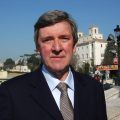
Juan Raúl Ferreira Sienra, Uruguay’s ambassador to the Holy See since 2025, says Pope Leo XIV’s visit Nov. 6-8 “has raised expectations no one anticipated, a climate never seen before.”
Uruguay, a country with just under 3.5 million people, is one of the most secular nations in Latin America, with a strict separation of church and state. But the ambassador explained that “secularism, properly understood, does not mean it’s hostile to religion”; rather, “it means the state does not take sides with any one religion.”
The ambassador, who is married and has two children, is the son of Wilson Ferreira Aldunate (1919-88), a towering figure in Uruguayan politics. The family went into exile in the United States after a civic-military dictatorship took power in June 1973 with the assistance of Jorge Bergoglio, the then-Jesuit provincial in Argentina and future pope. The military remained in power until March 1985, during which time the young Ferreira gained a bachelor’s degree and a master’s degree from George Washington University in Washington, D.C., and worked at the Washington Office on Latin America. He also got to know Archbishop Óscar Romero; the two remained friends until his assassination on March 24, 1980, and he witnessed Romero’s canonization by Pope Francis in St. Peter’s Square on Oct. 14, 2018.
Following the end of military rule, he served in Uruguay’s bicameral parliament, first as a senator (1985-90) and then as a member of the chamber of deputies (1990-95). He was appointed ambassador to Argentina (1995-99) under President Julio María Sanguinetti, despite their belonging to rival parties, and while there, he again met Archbishop Bergoglio. He is also a journalist, a leading human rights advocate and the author of several books.
In an interview with America at Uruguay’s embassy to the Holy See on Oct. 30, he revealed that he planned to return to Montevideo ahead of Pope Leo’s visit, for which “there is tremendous anticipation.”
Mr. Ferreira first met Leo XIV on Dec. 29, 2025, when he presented his diplomatic credentials and said he was “deeply impressed” by him during their conversation. “I worked hard for the pope’s visit,” he added, “and even asked that it begin in Uruguay, partly because in Argentina and in Peru, his second homeland, the turnout will be much larger than in Uruguay.”
“I assumed it wouldn’t have such a strong impact here, because Uruguay is not a very religious country; it is sparsely populated and deeply secular. But when the pope fell ill, I was struck by how the world came to a standstill, and Uruguay stopped with it, in shock,” he said.
He attributed this global reaction to the fact that over the past year Pope Leo “has shown a capacity to reach people, to win a place in their hearts with tremendous closeness. He has earned international recognition with a style all his own, very personal and very humble.”

“All of this has raised expectations no one had anticipated, a climate never seen before,” he said.
Mr. Ferreira reported that “tickets sold out right away for the prayer vigil at the Centenario Stadium on Nov. 7, the place where Uruguay made history by becoming the first world champion at the 1930 FIFA World Cup,” defeating Argentina 4-2. A couple of years ago, he said, “no one could have predicted that the pope would need a stadium in Uruguay. That tickets would be sold out a month in advance was unthinkable. “
The ambassador observed that “the same is happening in the city of Florida, home to the National Shrine [of Our Lady of the Thirty Three], and something similar in the north of the country, in Paysandú.” Paysandú is in the west of the country, on the Uruguay River, which forms the border with Argentina, and he thinks Argentinians might travel there for a Mass at the city’s vast public park. “The mobilization has been remarkable, and the news revolves almost entirely around the pope’s visit,” he said.
For Mr. Ferreira, the explanation lies in the fact that “secularism, properly understood, does not mean hostility to religion.” He recalled that former President Sanguinetti, “a committed agnostic and a theorist of secularism,” supported keeping the enormous cross at the site where Pope John Paul II celebrated his first open-air mass in Montevideo, on April 1, 1987, attended by a vast crowd. “Later on, another agnostic [president] from a different party, Tabaré Vázquez of the Frente Amplio, the Uruguayan left, added a monument to John Paul II at the foot of the cross,” he said. “In other words, both reminders of papal visits to Uruguay were championed by agnostic and staunchly secular presidents.”
Pope Leo XIV will not visit any of the informal settlements or shantytowns known as villas during the Argentine leg of his trip. But in Uruguay, he will go to Casavalle, one of the poorest and most violent neighborhoods in Montevideo, and meet with the social community at the parish of Our Lady of Guadalupe.
“Poverty has come down a little [in Uruguay],” Mr. Ferreira noted, citing the latest official figures, which showed that slightly less than 15 percent of the population live below the poverty line, compared with about 18 percent in the first half of 2025.
Nevertheless, he said, “there is tremendous social marginalization in Uruguay,” and “Casavalle is one of the most economically deprived neighborhoods and a clear example of the isolation in which its residents, especially young people, live. It shows the new forms extreme poverty is taking in Latin America, and in Uruguay as well.”
Unlike Argentina, a polarized country that the pope will visit from Nov. 8 to 11, Uruguay is a model of political coexistence, the ambassador said, and there is “great anticipation” for what Leo XIV will say.
“I think the arrival of a man committed to peace, tolerance and dialogue will do Uruguay a great deal of good because we are slowly losing those things there, too. Uruguay is still different from the rest of the region, compared with what is happening in Brazil or even in Argentina. Uruguay is still held up as an example, but things are happening that had never happened before,” he remarked.
“I think what all Uruguayans, not only the government, want is for the pope’s visit to help Uruguay once again take pride in its tradition of tolerance and respect. It is something we must protect because Uruguay could lose the true meaning of a democratic state,” he said.
He recalled that, growing up in Uruguay, where his father was a legislator for many years, he was proud of its tolerance and democracy. He said his father once clashed bitterly with a young deputy in parliament, Dr. Julio María Sanguinetti, who later served two terms as president: “I was in the gallery watching the debate when Dr. Sanguinetti came in behind where my father was sitting, right after a fierce exchange. I got scared and thought, he’s going to hit him. He didn’t. Instead, he said, ‘It’s no good attacking each other in public and apologizing in private,’ and the two of them embraced.”
“That mattered a great deal to Uruguay,” the ambassador said. “It defined us by our values; it defined us as a nation, [but now] we are losing it badly.” He expressed his conviction that the pope’s visit “will help in that direction, though I don’t know how much, and I think everyone is waiting for it.”

 Politics
 Faith
 Culture
 Vatican
 Scripture
 Podcasts