


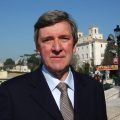
During Pope Leo XIV’s visit to Angola, a majority-Christian country where Catholics make up more than 18 million of a population of 40 million, I spoke with Michel N’Tangu Kinsau, S.J., the superior of the Jesuit mission in Angola.
Although Angola was first evangelized by the Jesuits when they arrived with the Portuguese in the 16th century, today the Jesuit community in this country is small (around 10 members), and the Angolan Jesuits form the province of Central Africa together with the Jesuits in the Democratic Republic of the Congo. Father N’Tangu Kinsau was born in the Democratic Republic of the Congo and served as assistant to the general treasurer of the Society of Jesus at the Jesuit Curia in Rome from 2015 to 2023. Subsequently, Arturo Sosa, S.J., the superior general of the Jesuits, appointed him as superior of the community in Angola.
We met in Luanda, the capital of Angola, on the evening of April 20, as the pope’s visit was drawing to a close. The interview, however, was conducted by email. The text has been edited for length and clarity.
Angola has come through a long and bloody civil war. Pope Leo referred to it several times, speaking about divisions and wounds that need healing. How do you read the situation in Angola today from social and political perspectives?
We acknowledge the deep wounds of Angola’s civil war and its enduring impact on many communities. A former Portuguese colony since 1575, Angola gained independence amid confusion on Nov. 11, 1975. Then came 27 years of civil war that left the country bled dry, deeply destroyed and divided, with a human toll of more than one and a half million deaths. The consequences of this murderous madness are still visible: destroyed schools, unemployment and poverty for the population, wounded memories and traumas, rural exodus and overpopulation of large urban centers, thousands of amputees who were victims of anti-personnel mines, countless widows and orphans, as well as a cohort of street children.
Pope Leo has referred to it several times because this war has profoundly affected the Angolan population through the inversion of values, leaving the door open to social division and the violation of fundamental human rights. In addition, there is a fragile economic situation which aggravated the country’s development by destroying infrastructure. It is imperative not only to rebuild social structures and infrastructure (roads, bridges, railways, education and health systems, public administration, rule of law, etc.) but also to rehabilitate Angolan men and women. The church accompanies the reconciliation process, healing initiatives and moral leadership in pursuit of lasting peace. Pope Leo’s references underscore the urgency to address human suffering, to promote justice, and safeguard the dignity of every Angolan, especially the most vulnerable and excluded.
Angola is a country with immense natural resources—oil, diamonds, gold, etc.—but it also has great inequalities. How would you describe the present economic situation?
Angola is a country with huge and incommensurable natural resources but with an astonishing paradox: Immense natural wealth contrasts with glaring inequality and poverty. It is one of Africa’s richest countries in terms of mineral resources, yet it has a very low human development index. More than 52 percent of Angolans live below the poverty line.
Why these great inequalities? We can attribute this situation to the fact that the wealth of the country is not fairly distributed among the people. Angola’s wealth has not always translated into broad-based development due to its historical governance challenges, unequal access to opportunities and governance gaps. The church advocates for inclusive growth: transparently managed revenues, social investments in health, education and housing, and mechanisms to reduce poverty and regional disparities.
Pope Leo has called on the authorities to put the common good above partisan interests. Could you unpack this statement?
The pope’s appeal is above all a warning to Angolan leaders to refrain from the temptation of governing for partisan and personal interests. Angola needs decisions grounded in constitutional commitments and the rule of law, not political expediency. Establishing independent institutions like anti-corruption bodies and auditing agencies with real autonomy and resources will serve to promote shared national projects, like infrastructure for health and education, that require cross-party collaboration and long-term planning. The government and the church should encourage dialogue with civil society, labor and business leaders to align on social priorities.
In his talk to the state authorities, Pope Leo denounced the “powerful interests” from outside that lay their hands on the country’s rich resources and cause suffering, death and environmental damage with their “extractive logic.” Who is he referring to?
The phrasing reflects the concern of his predecessor, Pope Francis. He referred to the material wealth of Angola, in which the arrogant and powerful interest groups lay their hands on that wealth and, through their extractive logic, cause suffering and death for the people and social and environmental catastrophes. This denunciation is not only for Western countries and the United States of America, nor exclusively for China, but for every global dynamic that bypasses the legitimate needs of African people and tends to see Africa as only a huge reservoir of raw materials.
Africa is a continent with good people and local communities, living according to their own traditions and cultural richness. Millions of men and women of goodwill constitute the main wealth of this country. Angola is a beautiful country with a very colorful mosaic of people, together with the multiformity of its wealth. The pope said that people of Angola “possess treasures that cannot be sold or stolen.” He called for a responsible and just approach [by foreign interests] that respects the national sovereignty of African countries, as well as the local dignity of people and the environmental integrity of the continent. The pope’s critique targets interests that prioritize profit over people. The aim is to build a good partnership based on solidarity, fair trade, debt relief where appropriate and policies that serve the common good, especially of the poorer countries.
Is there much corruption in the country?
Like many countries, Angola faces corruption challenges at various levels. The church advocates zero tolerance, stronger accountability and robust anticorruption measures, so that the country’s wealth serves the common good and the Angolan population. The pope invited Angolans to heal themselves from the curse of corruption that plagues the country and undermines its development and to build a new culture of justice and peace.
How would you describe the Catholic Church in Angola today? What are its strengths and weaknesses?
The Catholic Church remains prophetic when it speaks the truth of the Gospel to defend human dignity and advocate for the marginalized while strengthening pastoral accompaniment and advocacy. The pope wishes that “the Catholic Church be leaven in the dough and promote the growth of a just model of coexistence to free [the people] from the slavery imposed by elites with a lot of money and false joys.” The church of Angola must work unceasingly for peace and reconciliation.
How would you describe the church’s relationship to the Angolan state?
The Catholic Church seeks a cooperative, respectful relationship with the state, grounded in the common good and the freedom of religion. Relations between the Catholic Church and the Angolan government are currently at a positive turning point because in September 2019, the Angolan government and the Holy See signed a framework agreement establishing areas of cooperation, such as in education, health and social issues. The church collaborates on social projects, human development and peacebuilding, while maintaining independence in matters of conscience and moral witness.
How is Pope Leo seen by people in this country?
First of all, the pope is seen as the successor of St. Peter, the spiritual leader of the Roman Catholic Church and a global advocate for dignity, mercy and reconciliation. His trip emphasizes solidarity with those who suffer and a commitment to dialogue across cultures and religions and to the young generations in search of a better future. In Africa, wherever he has been, whether in Algeria, Cameroon, Angola or Equatorial Guinea, his visit is perceived as an invitation to renew faith, to build unity and a peaceful coexistence between people, with justice, love and true joy as the fruit of the Spirit.
How do you evaluate the pope’s visit?
As the successor of St. Peter, his role is to strengthen the faith and give hope for reconciliation where the church is growing in Africa. His first trip to the African continent testifies to the importance of the continent in world Catholicism. For Angola, the pope’s visit reinforces missionary zeal combined with social responsibility, and the church’s commitment to accompany the poor while promoting peace, reconciliation and development. He also invited the government of Angola and those in positions of responsibility to “not suppress the visions of the young or the dreams of the elderly.” I think his message resonated deeply with young Angolans.

 Politics
 Faith
Faith Culture
 Vatican
 Scripture
 Podcasts