


On a cold Tuesday night in December, in the early days of the Advent season, at the Church of St. John in Westminster, Md., an experiment is underway. It is shortly after 5 p.m. and the pews in the large, modern church are starting to fill with families. The priests and pastoral staff are on the altar preparing for the liturgy. In the nave, Bishop Adam Parker, fully vested and leaning on his crozier, greets visitors as they enter the church.
So far, so normal: just another confirmation ceremony, one of dozens that take place in the Archdiocese of Baltimore every year.
But there is something different about this class of confirmandi. It is a large group, over 100 people, from two parishes. There are teenagers and preteens, as you might expect, but also a group of young children, just 9 years old, who can be easily spotted when they stand before Bishop Parker and prepare to receive the sacrament. For that is when the bishop must, as he recites the sacred words, reach down to anoint their foreheads.
In 2025 the Archdiocese of Baltimore decided to change the confirmation age from between 14 and 16 to the age of 9. It will take a few years for all the parishes in the archdiocese to make the shift, but St. John’s is one of the first. The decision has provoked some anxiety. Are 9-year-olds ready? Will they take part in Catholic life once they have received the sacraments? But Archbishop William E. Lori, after consulting the signs of the times and speaking with diocesan leaders, decided it was time for a change.
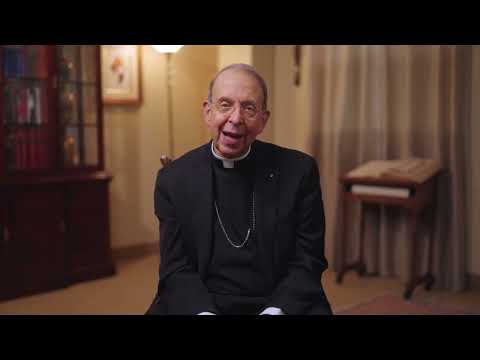
“In reaching this pastoral decision, I asked the question, “When is the most fruitful moment in the life of a young person to receive the fullness of the Holy Spirit in confirmation?” Archbishop Lori explained in a video announcing the decision. “And how can this grace of the Spirit help us reverse the troubling trend of young people disaffiliating from the church at earlier and earlier ages?”

Indeed, if there is one piece of data driving this decision, it is the fact that many young people begin the process of leaving the church at roughly the same age at which they receive confirmation: 13. Bishop Parker spoke about the move to lower the age on the America podcast “Preach.”
“We felt that if the age of disaffiliation is more in the middle school years, then let’s do a couple of things by lowering the age of confirmation to age 9,” he said. “Let’s get the family more involved. Let’s get the parents more involved in that preparation. And let’s get the grace of the sacrament to these young folks at an even earlier age, and that allows that grace to build within them.”
For the last seven years I have taught confirmation preparation in my home parish in Westchester County, in New York. In the Archdiocese of New York, as in many dioceses, the age of confirmation roughly coincides with middle school years: We begin in fall of seventh grade and the students are confirmed in the middle of eighth grade. I traveled to Maryland to see how another diocese is approaching the sacrament. What I discovered on my visit and in subsequent conversations with theologians and pastoral leaders was a lively debate touching on many of the most critical issues facing the church today.
The Archdiocese of Baltimore, the oldest diocese in the country, does not claim to have found a silver-bullet solution to the problem of keeping young people engaged in the faith. But they are following the data and trying something different. In a church that moves slowly and tends to do things the way they have always been done, that is a reason enough for a closer look.
Not a Graduation
If you want to start an argument with a sacramental theologian, describe confirmation as a “graduation sacrament.” It is, they will strenuously insist, not that: It is a sacrament of initiation, just like baptism and the Eucharist. That is why new Catholics normally receive all three sacraments together during the Easter Vigil liturgy.
In the early church, confirmation was part of the baptismal rite, but it was pushed later as the church grew so that bishops might connect with new Christians. Over time, the age for first Communion was also moved later, to what was described as the “age of discretion.” The exact age varied but often drifted to as late as 14, while confirmation was celebrated around 12. Then, in 1910, Pope Pius X moved the age for Holy Communion to 7, leaving confirmation on its own.
The next century saw a variety of approaches to the sacrament. And as Timothy Gabrielli writes in his 2013 book, Confirmation: How a Sacrament of God’s Grace Became All About Us, the arguments around confirmation often reflected the tenor of the times. “Confirmation, unlike any other sacrament, has served as a cipher for Catholics’ place in the wider American context and as a location for working out that identity,” he writes.
The key moment, in retrospect, came in the 1970s, when pastoral leaders looked to theology and the sciences to help determine the best age for confirmation. They landed on adolescence as a critical moment in a young person’s development and thus an appropriate moment for the graces of the sacrament. In his book Confirmation: The Baby in Solomon’s Court, Father Paul Turner describes these developments:
Teens who reflected on their personal experience deepened their personal involvement with faith. This they ritualized in a sacrament. Many theologians believe this put more teeth into the sacramental experience, removing its magical tendencies for those who celebrated the sacraments without much interior renewal. And educators reflecting on their experience with teens discerned that this was a new Spirit-filled occasion in the church.
But in the long history of the church, confirming teens—an experience most of us who have grown up in the last 50 years share—is actually an anomaly.
“In the end, the Catholic Church has never taught that it is a sacrament for a teenage commitment,” Father Turner tells me in a conversation from his home base in Kansas City, Mo. “And in fact, any time the Vatican has been pressed…you get the impression they’d like it younger than older.”
Timothy Gabrielli points to another factor at play: the influence of Protestant culture, in which individuals make a public commitment to the faith through adult baptism.
“There’s this consistent anxiety, among Catholics, particularly in the U.S., about infant baptism,” Professor Gabrielli tells me. “So…we’re surrounded by evangelical populations who don’t buy that—infant baptism—and [there is] this kind of sense that we got to have something that is a replacement for believers’ baptism. And so maybe confirmation is that thing.”
But there were risks to this approach, which became evident as the decades passed. If confirmation is presented as a moment of commitment, and most of religious education builds to that moment, then what happens next?
“[It] had this totally unintended effect,” Professor Gabrielli says. The hope was that “if we get them committed, then they’ll be in. Instead, it was, ‘No, I’ve made my choice. I’ve got my sacraments. I’m done.’”
Confirmation became graduation.
The Gifts of the Spirit
Kenn deMoll is the director of “formation and innovation” at St. John’s Church and an enthusiastic booster for lowering the age of confirmation. When Archbishop Lori began considering the move a few years ago, Mr. deMoll sent him a 30-page letter making his case for the move. For a year he worked in a diocese in Montana where the confirmation age was also lower.
In a country as large as the United States, there has been room for different approaches to confirmation, often depending on the personal preferences of the local bishop. (Efforts to get the U.S. Conference of Catholic Bishops to agree on a national practice, going back to the introduction of the adult catechumenate in the 1980s, have failed.) That is why the age can range widely, from 7 to 16. Some dioceses have opted for what is known as the “restored order” approach—meaning that confirmation is given before first Communion, in keeping with ancient church tradition and with the goal of restoring the Eucharist to its pride of place.
It is still early, but Mr. deMoll is encouraged by the rollout of the new program. He is particularly excited about the involvement of families. One major reason for the move was to shift away from a “drop off” approach to religious education, where parents had little involvement with sacramental preparation, to one built on family faith formation.
Working closely with families has helped him to see the challenges they face. “I don’t think anybody starts out being like, ‘I’m just not going to be all that into my faith,’ right?” he tells me. He says many people feel: “We live very busy lives. We’re very stretched. We’re pulled in 1,000 different directions.”
“And so I think a lot of times, parents operate from the sense of, OK, ‘I’ve got all these fires. How do I control it? How do I manage things?’”
To address these challenges, St. John’s has tried to reduce the number of requirements for confirmation. The idea is to make sacramental preparation a positive experience, one that brings a sense of peace and connection, rather than another item on a long to-do list. If the experience is a positive one, perhaps families will be more likely to stay involved after they have received the sacraments.
This represents a shift from traditional confirmation preparation programs. When I was confirmed, I was required to complete a certain number of service hours and to write a report on the saint I chose for my confirmation name. But these requirements were not a church-wide mandate. The guidelines issued by the U.S.C.C.B. for sacramental catechesis are more elementary. A candidate, among other requirements, must be able to recognize the role of the bishop and identify the signs and symbols of the sacrament.
In Mr. deMoll’s view, 9-year-olds can “100 percent” meet the standards set by the U.S. bishops. But he is aware that some parents and religious educators are skeptical. Introducing them to a new approach will take time.
One consequence of moving confirmation to teenage years is that it is sometimes seen as a sacrament of maturity. But Mr. deMoll warns against that.
“I think it robs and takes away the spiritual experiences kids can and do have,” he says. “I think there’s a reason Jesus said, ‘Let the little children come unto me.’… As we get older, our hearts tend to solidify. I think we kind of get a bit narrower in our thinking.”
“I think the best time to give them those gifts of the Spirit is when they’re younger,” he adds, “so they can take full effect in people’s lives.”
Toward a Deeper Communion
Larry Fraher has been involved in youth ministry in the Diocese of Phoenix for decades. He was there 20 years ago, when Bishop Thomas Olmsted made the move to confirm young people in third grade rather than at age 16, in keeping with the “restored order” approach to the sacraments of initiation. It was a big jump, but Mr. Fraher confirms Mr. deMoll’s instincts: 8- or 9-year-olds can comprehend the basic facts about confirmation.
“It depends on how we teach,” he tells me. “How do we portray this idea that the spirit is coming to animate you, animate your baptism, bring you into a deeper communion with the church?”
But Mr. Fraher also has more sobering observations to share. “The problem that I’m finding—and I’m just gonna go ahead and say it—is that the parents don’t understand that this isn’t graduation,” he says. “This is the big fight I have on a regular basis.”
“How do we reintegrate a Catholic worldview in the family as opposed to just a supply-demand mentality about the sacraments?” he wonders. How do you fight the sentiment that “I go, I get my sacrament, I’m good until I get married”?
Here is where confirmation preparation runs against a hard reality of the need for evangelization. Religious practice has plummeted in recent decades. And it seems that these trends are affecting even those parents who are sending their children for the sacraments. They may be willing to make certain commitments to their children’s faith, but for other reasons—which can vary from the demands of youth sports to their own questions about the integrity of religious institutions—they are choosing not to go beyond “what’s required.”

Another wrinkle: Many parents feel insecure talking about faith themselves. So even if their child has a strong experience in religious education—perhaps on a retreat or on a service trip—that experience may not develop roots at home.
“Mom and Dad may not have had a very solid experience of retreat, or maybe they haven’t had a really solid experience of Jesus,” says Mr. deMoll. The goal then becomes finding models of ministry that allows families to find a shared spiritual framework.
Understanding that there may be no single solution to these challenges, the Archdiocese of Baltimore is allowing pastoral leaders to experiment with different programs. At St. Elizabeth Ann Seton parish in Crofton, Md., confirmation preparation happens mostly in the home, with two in-person sessions with pastoral staff as well as a half-day retreat. This helps young people and their parents learn to talk about their faith together, with guidance from the parish.
But confirmation preparation is just one part of youth ministry at St. Elizabeth’s—and perhaps not the most important. Middle school ministry is particularly critical.
“This formation is what is going to give them the groundwork for high school and college when there’s so many other things that are…pulling at them,” says Sarah Jarzembowski, the director for marriage and family life at St. Elizabeth’s.
The idea is to give young people a solid foundation in their faith so they are less likely to drift away from the church when they hit their teenage years. This is the trend Archbishop Lori is trying to reverse, and this is what Ms. Jarzembowski and her team are squarely focused on. Their website lists several opportunities for middle school students, from bowling nights to faith sharing and service projects.
“Great things are happening, I’m loving it,” says Ms. Jarzembowski. “We just need to get this middle school piece…. Because if that piece does not become solid, then we’re just moving the exodus level [the age when young people start to drift away from the church], and that defeats what the archbishop is looking for.”
Follow the Data
The data tells us a lot about when young people leave the church. It doesn’t say as much about whether moving the confirmation age to a younger age can help reverse this trend. But one study from 2012 contains some interesting findings. In an article in the journal Catechumenate, Angela Darrow Flynn looks at dioceses where the “restored order” approach has been implemented and compares them with neighboring dioceses where the confirmation age is later.
In most of the dioceses, before restoring the order of the sacraments, “the number of confirmandi was fewer, sometimes dramatically so, than the number of children receiving first Eucharist.” This makes intuitive sense. In my experience, some families, while excited to have their children receive their first Communion, do not continue through the five additional years to confirmation. By restoring the order of the sacraments—in most cases, by administering the sacraments in the same grade—it is to be expected more children will be confirmed.
But another finding is also clear from Ms. Flynn’s study: “When the sacraments of initiation have been restored to their ancient order in the United States, overall participation in faith formation has usually decreased.” This confirms the fears of some youth ministers: Namely, that without the “carrot” of confirmation, many young people will simply choose not to take part in faith formation programs.
Yet that is not the end of the story. Ms. Flynn found a few dioceses where the rates of participation stayed the same even after the confirmation age was lowered. In one, the Diocese of Spokane, the number of young people participating in faith programs increased. No further research into this was done, but the results suggested that these dioceses were doing something right.
In the Archdiocese of Baltimore, spreadsheets and other technology are being used to track students and gauge their rates of participation. Meanwhile, each parish is looking for creative ways to keep young people involved. On the night I attended confirmation at St. John’s, the printed program for the event encouraged young people to stay committed—“Confirmation is just the beginning of your journey as a disciple”—and listed several ways to nurture their faith, including special days of retreat and a free, one-year subscription to Hallow, a prayer app. There were also three age levels of youth ministry advertised, with weekly formation and special events.

Thomas and Felicity Serio were both confirmed at St. John’s Church in Westminster, Thomas in 2024 and Felicity in 2025. Both were 9 at the time. Thomas was surprised when he learned that the parish would start confirming students at a younger age. “I didn’t even really know much about confirmation to that point, but that’s when I started learning a lot about it,” he told me in a Zoom conversation that included his mother, Elizabeth Serio, and his sister.
Thomas, an altar server at St. John’s, chose Benedict as his confirmation name. Felicity, who sings in the children’s choir, chose Therese, after St. Therese of Lisieux. About her confirmation day, she recalls: “I was really excited that my cousins and my aunt were there, and I was also a little nervous about everything. But I was mostly excited and happy and joyful.”
Elizabeth Serio, like many of her generation, was confirmed as a teenager. But she welcomed the experience of accompanying her children at a younger age. “It was just a joy…to walk through this process with my kids when they were younger,” she tells me. “I find at this age, there’s such a thirst for knowledge, and they’re like sponges, absorbing all of the information around them.”
Reviewing my conversation with Thomas and Felicity, I was reminded of something I read from Father Jay Peterson of the Diocese of Great Falls-Billings, Mont., where children are confirmed at a younger age. We all come to a better understanding of the sacraments over time, he said. His advice on confirmation day has stayed with me as a parent, as a religious educator and as a baptized Catholic:
“I point to the sponsors and the rest of the assembly, and say that we all have a responsibility to help these children grow into the meaning of the sacrament of confirmation.”
Reporting for this story was supported by a grant from Lilly Endowment Inc.
This article appears in April 2026.


 Politics
 Faith
Faith Culture
 Vatican
 Scripture
 Podcasts