


Leaving Castel Gandolfo this evening, Nov. 4, Pope Leo XIV told reporters that he “would certainly invite the authorities to allow pastoral workers to attend to the needs” of detained migrants. On Saturday, Nov. 1, U.S. Immigration and Customs Enforcement barred a delegation of Catholic clergy, religious sisters, lay people and an auxiliary bishop of Chicago from bringing Communion to migrants detained in the Broadview Processing Center, just outside the pope’s hometown, for the second time in three weeks.
Leo told reporters, “In the first place, the role of the church is to preach the Gospel.” Citing Matthew 25, he said, “Jesus says very clearly at the end of the world, we’re going to be asked, ‘How did you receive the foreigner? Did you receive him and welcome him or not?’ And I think that there’s a deep reflection that needs to be made in terms of what’s happening.”
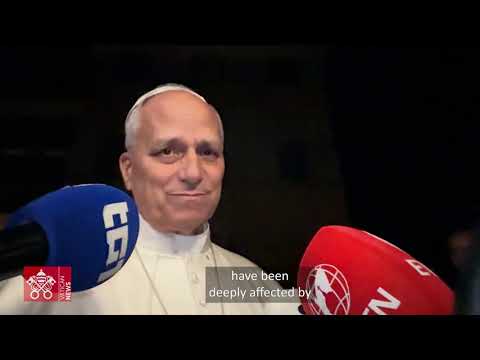
“Many people who’ve lived for years and years and years, never causing problems, have been deeply affected by what’s going on right now,” the pope said. “The spiritual rights of people who have been detained should also be considered, and I would certainly invite the authorities to allow pastoral workers to attend to the needs of those people.”
The number of people in ICE detention has been at a record high for much of 2025 following a series of Trump-signed executive orders suspending entries to the U.S. across its southern border and disallowing asylum requests that would allow asylum-seekers to remain present in the U.S. while their requests are processed. Another executive order deputized state and local police to “perform the functions of immigration officers in relation to the investigation, apprehension, or detention of aliens in the United States” and removed federal funding from so-called “sanctuary” cities or jurisdictions that did not cooperate with immigration enforcement. The latter has led to raids, including in Chicago, that have detained thousands of people, including U.S. citizens, packed detention centers that have been the subjects of human rights complaints and met fierce resistance from local communities.
Speaking about those detained, the pope said, “Many times they’ve been separated from their families for a good amount of time. No one knows what’s happening, but their own spiritual needs should be attended to.”
The pope’s comments came a day after a U.S. bishop said Trump administration officials have “assured” him the matter of detained migrants’ access to sacraments is “under careful review.”
Bishop Robert E. Barron of Winona-Rochester, Minnesota, who was appointed by President Donald Trump to the Department of Justice’s Religious Liberty Commission, said in a Nov. 3 social media post that he and Father Alexei Woltornist, a Melkite Catholic priest and a member of the Department of Homeland Security’s Homeland Security Advisory Council, “have been in touch with senior officials in both the State Department and the Department of Homeland Security and have brought forward the concerns of the Church regarding detainees’ access to Sacraments.”
According to Vatican Media, Pope Leo also responded to questions from reporters tonight about escalating tension between the U.S. and Venezuela, what he called the “fragile” ceasefire in the Middle East and the case of disgraced Jesuit Marko Rupnik.
Regarding Venezuela, in September and October, the U.S. authorized at least 10 lethal strikes on Venezuelan civilian watercraft that the administration alleged, without presenting proof, were engaged in drug trafficking and has deployed 10,000 troops to the region. Speaking to reporters tonight, the pope said he had read reports of warships moving closer to Venezuela’s coast and commented, “I believe violence never brings victory.”
“The key is to seek dialogue, to find fair ways to resolve the problems that may exist within countries,” the pope said.
Asked about the ceasefire between Israel and Hamas that has grown increasingly fragile following new Israeli strikes and settler violence in the West Bank, the pope said, “At least the first phase of the peace agreement is still holding,” referring to the parties’ Oct. 10 agreement.
At the same time, he said, it is necessary to advance to the “second phase, addressing governance and ensuring the rights of all peoples.”
Vatican Media reported that Leo said the matter of Israeli settlements in the West Bank is “truly complex” and that “Israel said one thing, but sometimes it does another,” though it was unclear exactly what the pope was referring to.
Finally, responding to a question about the former Jesuit, the Rev. Marko Rupnik, who is accused of sexually, psychologically and spiritually abusing more than two dozen women, the pope confirmed that a Vatican trial against the priest “has recently begun.”
“Judges have been appointed, and judicial processes take time,” Leo said. “I know it is very hard for victims to be asked for patience, but the church must respect the rights of all individuals. The presumption of innocence until proven guilty applies in the church as well. We hope this process will bring clarity and justice for everyone involved.”
The pope also commented on the debate over removing Rupnik’s artwork from churches around the world, saying that many had already covered up the artwork. He added that “artwork has been removed from websites. That issue is certainly something that we’re aware of.” In June, after repeated requests from survivors and from Cardinal Sean O’Malley, the Vatican began removing Rupnik’s artwork from its websites. A Vatican spokesman had previously defended the use of the artwork.
Material from OSV News was used in this report.


 Politics
 Faith
Faith Culture
 Vatican
 Scripture
 Podcasts