


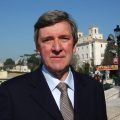
A Vatican tribunal has condemned Msgr. Carlo Alberto Capella, a former diplomat for the Holy See, to five years in prison and a fine of 5,000 euro for the possession, sharing and transmission of child pornography in a large quantity while serving at the Holy See’s nunciature in Washington, D.C.
The tribunal issued its verdict on June 23. The Vatican prosecutor had asked for a sentence of five years and nine months in prison and a fine of 10,000 euro.
It is the first time that a Vatican official has been condemned for such a crime, and the penalty reflects the seriousness with which the Vatican considers this offense under the “zero-tolerance” policy of Pope Francis. “It sends a clear signal”,a senior Vatican official told America
Msgr. Capella admitted his guilt during the first day of the trial in the Vatican on June 22, in the presence of the Vatican City State’s judges—Giuseppe Della Torre, Venerando Marano and Carlo Bonzano—and the prosecutor, Roberto Zannotti.
It is the first time that a Vatican official has been condemned for such a crime.
The Italian monsignor has been in prison in the Vatican since April 7, after the prosecutor concluded an investigation, which began in September 2017 following a notification from the U.S. State Department the previous month of a “possible violation of laws relating to child pornography images” by Msgr. Capella.
Then, in September, Canada issued a nationwide arrest warrant for him after police in Ontario discovered that he had accessed, possessed and distributed child pornography during his 2016 Christmas in Windsor. During his investigation, the Vatican prosecutor gained international cooperation to obtain evidence relevant to the case.
After he concluded the investigation, in conjunction with the judicial authorities, he ordered the arrest of the monsignor based on a section of the Vatican City State penal code that deals specifically with the possession and distribution of child pornographic material and envisages both prison sentences and financial penalties for the same. Msgr. Capella was indicted on June 9.
At the sentencing trial, which opened on June 21, the 51-year-old monsignor was present together with a psychologist, Tommaso Parisi, who has been helping him since his arrest.
Capella revealed that he did not enjoy his work in D.C. and experienced a “personal crisis.”
Msgr. Capella, in his deposition, recalled how he had been a priest of the Milan archdiocese until, at Cardinal Carlo Maria Martini’s request, he joined the Holy See’s diplomatic service in 2003. A year later, he was assigned to work in the Holy See’s missions, first in India and three years later at its “study mission” in Hong Kong.
In 2011, he said he was recalled to work in the Vatican’s Secretariat of State and was happy there, but—much to his dislike—he was sent to work in the nunciature in Washington, D.C., in 2016. He revealed that he did not enjoy his work in D.C. and experienced a “personal crisis”; he had “little work, few friends and felt useless.” All this led him to go online looking for amusing memes and pictures of animals to relieve his personal desolation and boredom.
Asked by the prosecutor how all this led to his use of child pornography, Msgr. Capella revealed that before his crisis “this kind of morbidness” had never been part of his “priestly life,” but in his “internal conflict,” which he said he had “underestimated,” he began to use the social media site Tumblr on July 23, 2016, to find these humorous images, and this led to his slide into pornographic images and eventually child pornography. He said he began using Tumblr’s chat function to exchange images and engage in “vulgar” conversations with other persons. All of which, he said he now considers “repugnant.”
Dr. Parisi said Msgr. Capella is “aware of his role” in the crimes and admits his errors.
The prosecutor called two witnesses to give testimony at the trial: a psychologist who had helped him since last October and a computer engineer who works with the Vatican Gendarme and examined Msgr. Capella’s electronic devices.
His psychologist, Dr. Parisi told the tribunal that he first met Msgr. Capella in October 2017, after he asked for assistance. He revealed that Msgr. Capella had trouble sleeping then, and so he prescribed medication. Since then, they met twice weekly. Dr. Parisi said Msgr. Capella is “aware of his role” in the crimes and admits his errors.
Related Stories

The Italian computer engineer, Gianluca Gauzzi, told the court that during the investigation he examined three cell phones, two USB drives and several hard drives. He said that he found some 40 to 55 videos and photos in his investigation in the United States, which were held on a cloud storage space that had been deleted from other devices. He said he divided the images into two primary categories: one for images from Japanese comics and the other for images of children aged 14 to 17 engaged in sexual acts with adults. He revealed that at least one video showed a child depicted in an explicit sex act with an adult. He confirmed that monsignor had asked for images of children between the ages of 14 and 16. He said the images were exchanged by the monsignor in chats with other persons.
The monsignor’s lawyer, Roberto Borgogno, told the press that his client “has admitted certain things” but seeks “to diminish” what has been reported about him outside the court.
A Vatican source told America that as a cleric the priest could also be subject to a judicial process conducted by the Congregation for the Doctrine of the Faith relating to “the most serious delicts,” which Benedict XVI promulgated on May 21, 2010, that revised and updating the earlier norms of the Motu Proprio issued by St. John Paul II in 2001, known as “Sacramentorum Sanctitatis Tutela.” Article 6 introduced the norms that deal specifically with pornography.

 Politics
 Faith
Faith Culture
 Vatican
 Scripture
 Podcasts