
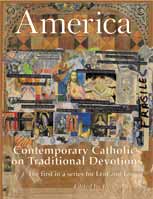
During the weeks of Lent, America has offered a series of articles by Catholic writers on traditional devotions. This week we conclude our eight-part series with a look at devotion to St. Joseph and to the Immaculate Heart of Mary. As some of our essayists have noted, the theological question of the role of devotions is a complex one. For while devotions have historically played an important role in Catholic spirituality, they need always be seen as flowing from (and leading back to) the liturgythe central form of worship in the church. The Second Vatican Council wrote that while devotions should be warmly commended and possess a special dignity, they remain subordinate to the Mass, which by its very nature far surpasses any of them (Constitution on the Sacred Liturgy, No. 13). Theologians and liturgical scholars have therefore rightly cautioned against devotions usurping the place of liturgy in the life of the faithful.
Indeed, in the past, excesses in popular piety may have led some Catholics to focus their spiritual lives on a particular devotion, rather than participating in the Eucharistfor example, if the celebration of the Mass at their local parish was not to their liking. (Why should I go to Mass? I have my Rosary.)
Today, however, the tendency may be the opposite: a reflexive dismissal of the devotional life, as if it had no meaning or relevance whatsoever.
Both reactions go against the grain of our Catholic heritage. A comprehensive guide published by the Congregation for Divine Worship in 2001 noted that the liturgy and popular piety are two forms of worship which are in a mutual and fruitful relationship with one another (Directory on Popular Piety and the Liturgy, No. 58). In other words, there is no conflict between loving the Mass and having a devotion, say, to the Sacred Heart. The Introduction to the document expressed the hope that other forms of piety among the Christian people are not overlooked, nor their useful contribution to living in unity with Christ, in the church, be forgotten (No. 1).
The riches of the devotional life speak to millions of Catholics whose faith was nurtured in a world where devotions played an important role in their religious education. Today these same devotions speak in a particular way to many younger Catholics eager to rediscover their Catholic heritage, to explore new ways of prayer and to regain a sense of mystery in their lives. As our writers have shown over the past weeks, the devotional life can move us to prayer and contemplation, can comfort us in times of suffering or confusion, can encourage us to care for others, can spur us on to appreciate Scripture more fully, can provide us with models of Christian discipleship, can prompt us to meditate on the love of God and, overall, can draw us closer to the one who lies at the center of any expression of our faith: Jesus Christ.